
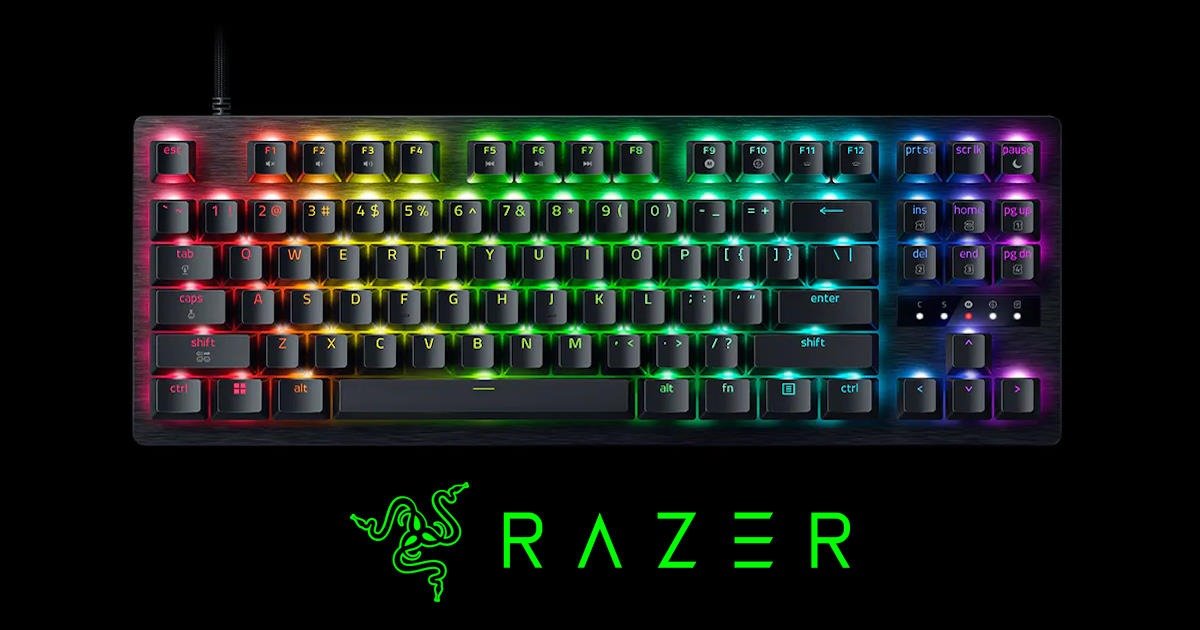
My old gamer tag was Huntsman. Not for any clever reason, a coworker once said I had a habit of appearing and disappearing like a Huntsman spider, and the name stuck. I didn’t overthink it. It was just a nickname that followed me through a few games, a few questionable phases, and more than one “this is definitely my final username” moment.
Then Razer started releasing Huntsman keyboards, and suddenly the name meant something. Or at least, it felt like it did. Every time one showed up in a review, a desk setup, or some aggressively clean YouTube thumbnail, a tiny, irrational part of me whispered, That’s the one I should have. Not because it was the best option. Not because I’d researched it. Just because it shared the name.
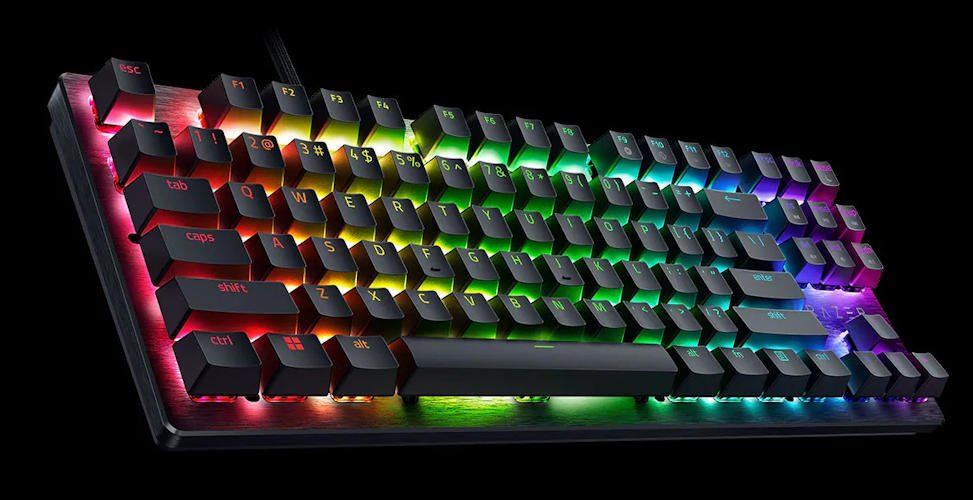
So when the Razer Huntsman V3 Tenkeyless 8KHz Optical Analog Gaming Keyboard finally landed on my desk, it wasn’t just another review unit. It arrived with this strange, self‑inflicted pressure attached, not from Razer, but from years of quietly assigning meaning to a product line that had no idea I existed.
And maybe that’s why I noticed everything.
I caught myself paying attention in a way I don’t normally do on the first unboxing. The feel of the keys. The sound. The way it sat on the desk. I think I was trying to decide, almost immediately, whether it deserved the mental space it had been renting for years. Whether it lived up to the version of it I’d built in my head long before I ever touched it.
First impressions — stripped back, but in a good way
The Razer Huntsman V3 Tenkeyless doesn’t try to dazzle you out of the box. There’s no dramatic unboxing moment, no “look at me” accessory tucked underneath the cardboard. You lift the keyboard out and… that’s it. Just the board, a detachable USB‑C cable, and a quiet confidence that feels almost out of place in the gaming world.
The aluminium top plate has that reassuring, slightly cold touch that makes you think, okay, this is built properly. The PBT keycaps feel solid without being heavy. The detachable USB‑C cable is a nice touch, too, and yes, this is a wired‑only keyboard. No wireless mode, no Bluetooth, no multi‑device switching. It’s very clear about what it wants to be: fast, consistent, and absolutely uninterested in anything that might introduce even a hint of latency.
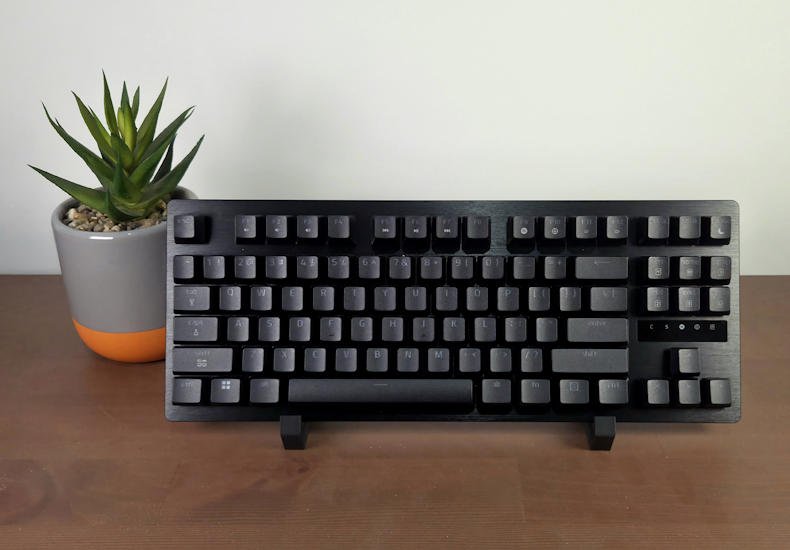
My first thought was, honestly, Oh. Is that all? Not in a disappointed way, more in a “did I miss something?” way. It felt almost too clean, too minimal, as if it were hiding something.
But the longer it sat on the desk, the more that simplicity started to feel intentional. The whole board has this compact, purposeful presence that doesn’t scream for attention but still manages to look good in that understated, quietly confident way.
The tenkeyless layout does a lot of the heavy lifting here. Suddenly, there’s more room for your mouse. Your shoulders relax a bit. Your desk feels less cramped. It’s one of those changes you don’t fully appreciate until you go back to a full‑size board and immediately feel like someone pushed the walls in.
It’s funny, I’ve used full‑size keyboards for years without ever thinking about it. But after a few days with the Razer Huntsman V3 Tenkeyless, switching back felt wrong. Not dramatically wrong, just… slightly irritating, like wearing a shirt that technically fits but doesn’t sit right anymore.
8KHz Polling — Impressive, Subtle, and Occasionally a Mind Game
Alright, the big headline feature: 8,000 Hz polling. Eight. Thousand. Hertz. It’s the kind of number that makes you squint at the spec sheet and wonder whether you’ve accidentally wandered into marketing fiction. The Razer Huntsman V3 Tenkeyless promises a theoretical latency of around 0.58 ms, which sounds like something only esports pros or lab equipment should care about.
But here’s the thing: sometimes you do feel it.
Not in a dramatic, “my life has changed forever” way, more like a quiet tightening of the screws. In fast shooters, quick taps land exactly when you expect them to. Strafing feels a little snappier. There’s this subtle sense that your inputs are happening with you instead of trailing half a heartbeat behind. It’s not loud or showy; it’s more like the keyboard is politely stepping out of your way.
And then there are the other moments.
Typing. Browsing. Playing something slow and cozy. And suddenly you’re sitting there thinking, Is this actually different, or am I just convincing myself it is? Because sometimes it just feels like… a really good keyboard. No fireworks. No “aha” moment. Just clean, consistent input.
Which makes the whole 8KHz thing a bit of a psychological puzzle.
You know the performance is there. You know the numbers are real. But the benefit depends entirely on what you’re doing, and maybe how sensitive you are to tiny differences. Some days, I swear I can feel it in every movement. Other days, I wonder if my old fingers are simply not the target demographic anymore.
But here’s the funny part: once you’ve used it for a while, going back to a standard polling rate feels slightly off. Not broken, not sluggish, just… softer. Like someone put a thin layer of bubble wrap between you and the game.
It’s not a feature that screams at you, until it’s gone. It’s a feature that quietly spoils you.
The Switches — Where Things Get Properly Interesting (and Slightly Dangerous)
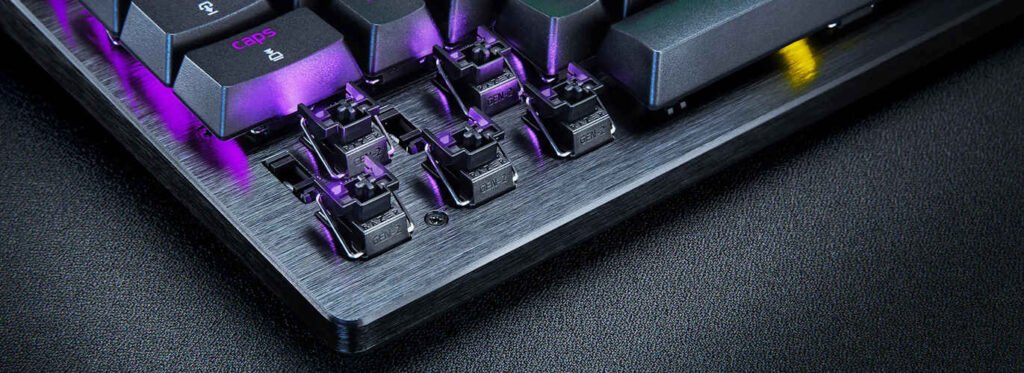
If the 8KHz polling is the flashy headline, the Gen‑2 Analog Optical Switches are the part of the Razer Huntsman V3 Tenkeyless that actually change how you interact with the keyboard. This is where the board stops being “just a keyboard” and starts becoming something you can accidentally ruin your own life with if you’re not careful.
On paper, adjustable actuation from 0.1 mm to 4.0 mm sounds simple enough. You pick a depth you like, set it, and move on with your day. That’s what a normal person would do.
But then you realise you can adjust it per key.
Per. Key.
And that’s when things get a bit… unhinged.
I went through a full arc with this feature, the kind of arc that should probably be studied by behavioural scientists. At first, I told myself I’d just tweak WASD a little. Just a tiny bit lighter. Nothing dramatic. Then I thought, well, maybe spacebar could be a touch heavier. And maybe my ability keys could be somewhere in between. And maybe I should try a different setup entirely because what if there’s a better combination I haven’t found yet?
Before I knew it, I had created a keyboard so sensitive that simply resting my fingers on the keys was enough to trigger inputs. Not pressing. Not hovering. Just existing in the same postcode as the switches was enough to send my character sprinting off a cliff.
It was funny for about thirty seconds. Then it was very not funny.
So I dialled it back. Then adjusted it again. Then adjusted it again because the second adjustment made the first adjustment feel wrong. It’s the kind of feature that pulls you in, not because you need it, but because it whispers, you could make this even better.
And the thing is… when you finally land on a setup that matches how you play, it feels incredible. There’s this weirdly personal connection that forms, like the Razer Huntsman V3 Tenkeyless is responding with you, not after you. It becomes less of a tool and more of an extension of your hands, which sounds dramatic, but that’s genuinely how it feels when everything lines up.
Going back to a standard mechanical switch after that? It felt dull. Not bad, just like someone had turned the saturation down on my inputs.
I didn’t expect to care that much. Turns out… I kind of do.
Rapid Trigger & Snap Tap — Smaller Features That Hit Way Harder Than Expected
I’ll be honest: when I first read about the Razer Huntsman V3 Tenkeyless Rapid Trigger and Snap Tap, I mentally filed them under “nice extras I’ll probably forget exist.” They sounded like the kind of features companies add to justify a spec sheet; technically impressive, practically ignorable.
Yeah… no. I was very wrong about that.
Rapid Trigger removes the traditional reset point, meaning keys can re‑activate almost instantly as you lift off. Snap Tap prioritises your most recent input when you press conflicting keys. On paper, both sound a bit abstract, like they should matter, but only if you’re the kind of person who can feel the difference between 1 ms and 0.8 ms.
But in actual gameplay? They’re shockingly noticeable.
The first time I jumped into Farlight 84 with Rapid Trigger enabled, I felt like someone had quietly upgraded my movement without telling me. Strafing felt cleaner. Direction changes felt sharper. There was no hesitation, no mushy in‑between moment where the keyboard seemed to be deciding what I meant. Inputs just… landed. Immediately. Consistently. Almost suspiciously so.
It wasn’t dramatic. I didn’t suddenly transform into a cracked esports prodigy, but everything felt more deliberate. More controlled. More mine. And the weirdest part? I didn’t fully appreciate it until I went back to a keyboard without it.
Suddenly, everything felt slower. Not broken, just slightly dulled, like someone had wrapped my movement in a thin layer of cotton wool. I found myself overshooting corners, mistiming peeks, and generally moving like someone who had forgotten how legs work.
Snap Tap was the same story. I didn’t think I’d notice it. Then I realised I was winning more movement trades simply because the Razer Huntsman V3 Tenkeyless wasn’t getting confused when I mashed opposing keys in panic, which, let’s be honest, is 90% of my movement in shooters.
It’s not a feature that makes you better overnight. It’s a feature that quietly removes the friction you didn’t realise was there. Yet, due to the Razer Huntsman V3 Tenkeyless, I can no longer blame my equipment.
And once you get used to that feeling, that sense that the Razer Huntsman V3 Tenkeyless is keeping up with you instead of lagging half a thought behind, it’s incredibly hard to go back, which is annoying, as I have 2 more keyboards to review before I go back to this keyboard. You start to expect that level of responsiveness everywhere, and when it’s not there, you feel it immediately.
It’s the gaming equivalent of switching to a car with launch control. You don’t notice how good it is until you drive something else and think, Why does this feel like it’s running on wet cardboard?
Typing & Everyday Use — Surprisingly Comfortable, Occasionally Unhinged
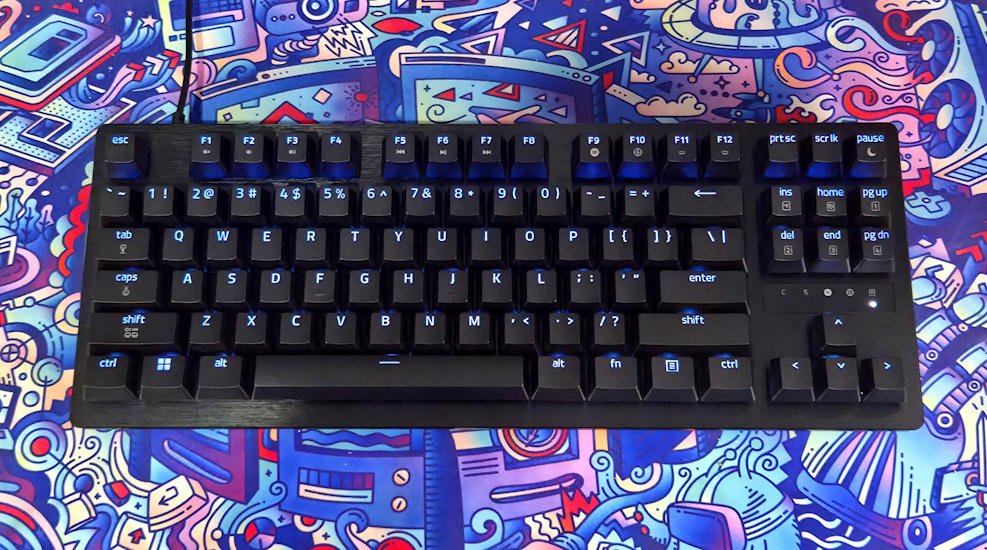
For a keyboard that’s so unapologetically built for gaming, the Razer Huntsman V3 Tenkeyless is surprisingly lovely to type on. I went in expecting it to feel a bit harsh, something I’d plug in for a gaming session and then swap out the moment I needed to write anything longer than a sentence. But it didn’t play out like that.
The PBT keycaps have this solid, confident feel under your fingers, and the internal dampening foam takes the edge off the sound without muting it into oblivion. It’s still clearly a performance board, but it doesn’t punish you for using it outside of games. There’s a nice balance between crisp and cushioned, like it’s trying to remind you it’s fast without being obnoxious about it.
But here’s where things get interesting, and by interesting, I mean mildly chaotic.
If you’ve been experimenting with actuation settings (and let’s be honest, you absolutely will), typing on the Razer Huntsman V3 Tenkeyless can become a bit of an adventure. Set things too sensitive, and suddenly every tiny movement becomes a keypress. Not even a press, really, more like your fingers thinking about pressing. I had a moment where I was trying to write a simple sentence and ended up with something that looked like my keyboard had been possessed:
“wwwwwwritinggggg a ssssentenceeeee.”
It wasn’t unusable, just… unpredictable in a way that makes you question your own coordination. You start wondering if you’ve forgotten how to type, or if the Razer Huntsman V3 Tenkeyless is quietly judging your life choices.
But once you dial things back, or simply remember what you changed at 1 a.m. the night before, everything settles into something genuinely nice. Fast, clean, responsive, and surprisingly easy to live with for long stretches of work. I spend around twelve hours a day typing, and I never hit that “I need to switch keyboards before I lose my mind” moment.
It’s almost funny how quickly it goes from “this might be too much for daily use” to “actually, this is kind of perfect.”
Just… maybe check your actuation settings before you start writing anything important on the Razer Huntsman V3 Tenkeyless. Or at least before you send an email that could end your career.
So…Who It’s For
The Razer Huntsman V3 Tenkeyless is a performance keyboard. Full stop. It doesn’t pretend otherwise, and honestly, I respect that about it.
Everything about the Razer Huntsman V3 Tenkeyless 8KHz, the analog switches, the Rapid Trigger, the 8K polling, and the per‑key tuning is built for people who care about the tiny details. The ones who tweak sensitivity settings for fun. The ones who can feel a 1% difference in input delay and will absolutely tell you about it. The ones who, if we’re being brutally honest, might be just a little bit obsessive.
If that’s you? This keyboard is going to feel like home.
It lines up with you quickly. You start adjusting things, experimenting, dialling in your perfect setup, and before you know it, you’ve spent an hour fine‑tuning actuation depths like you’re calibrating a piece of lab equipment instead of a keyboard. And the wild part is… You enjoy it. Because it rewards that kind of attention.
But if you’re not that person, if you just want a keyboard that works and don’t care about shaving off fractions of milliseconds, this might feel like overkill, but might still be for you. Not bad, not overwhelming, just more than you’ll ever realistically use. It’s like buying a high‑end espresso machine when you mostly drink instant coffee. You can do it, and you will definitely enjoy it, but you’re not the target audience.
That said, it’s not exclusive to competitive gamers. I’ve had friends who don’t game at all use the older Huntsman models and absolutely love them. There’s something about the feel of optical switches that just clicks for some people, even if they never touch an FPS in their life.
But the Razer Huntsman V3 Tenkeyless always feels like it’s capable of more than you’re asking of it. Even when you’re typing an email or writing a document, there’s this underlying sense of restrained power, like driving a Lamborghini in a school zone. You’re technically using it correctly, but you’re also very aware that it was built for something a bit more intense.
So who is this for?
- Competitive players
- People who obsess over responsiveness
- Anyone who loves tweaking settings
- Gamers who want their keyboard to feel like an extension of their hands
- And, honestly, people who just enjoy owning something that feels fast
If you’re the kind of person who notices the difference between “good” and “this feels weirdly sharp and satisfying,” the Razer Huntsman V3 Tenkeyless 8KHz is going to make you very happy.
If you’re not… you’ll still enjoy it. You just might not unlock its full gremlin potential.
Final Thoughts — A Bit Sentimental, A Bit Ridiculous, and Honestly Kind of Wonderful
I didn’t expect to feel this way about a keyboard. That sounds dramatic, and it is, but the Huntsman name has been sitting in the back of my mind for years, quietly building up this weird emotional significance it never asked for. So when the Razer Huntsman V3 Tenkeyless 8KHz finally arrived, it wasn’t just a piece of hardware showing up on my doorstep. It felt like the end of a long, oddly personal running joke with myself.
And the wild part? It actually lived up to it.
Not in a fireworks‑and‑confetti way. Not in a “my life is changed forever” way. But in a quieter, more grounded way, the way something earns your respect by simply doing its job exceptionally well.
It’s not perfect. It’s probably overkill for a lot of people. And there are definitely moments where you wonder whether you’re enjoying the performance or the idea of the performance. The 8K polling, the analog switches, the Rapid Trigger; they’re all real, they all work, but they also play mind games with you if you let them.
But then you get into a game. Or you hit that perfect actuation sweet spot. Or you switch back to a normal keyboard and immediately feel like someone has put a layer of molasses between you and your inputs.
And suddenly it all makes sense.
The Razer Huntsman V3 Tenkeyless 8KHz doesn’t try to be everything. It doesn’t try to win over the masses. It leans unapologetically into speed, precision, and control, and if you click with that, it pulls you in deeper than you expect. It’s fast, sharp, and a little bit obsessive. It rewards people who like to tinker. It forgives people who don’t. And it somehow manages to feel both restrained and wildly capable at the same time.
For me, it ended up being exactly what I hoped it would be, not because it matched the fantasy I’d built around the Huntsman name, but because it earned its place on my desk in its own right. It’s the kind of keyboard you grow into, the kind you keep tweaking, the kind you notice when it’s gone.
A little sentimental? Absolutely. A little ridiculous? Without question. But also… genuinely amazing. And honestly, that’s enough.


2 Comments
[…] make that trade-off. The Razer Reclusa X Mini 65% certainly made it easy to; it might even push my Razer Huntsman V3 Tenkeyless 8KHz off the desk for a little longer after the review is […]
[…] announced the Razer Huntsman V3 Pro Mini 8KHz, the latest addition to the Huntsman V3 Pro lineup, and Razer’s most advanced analog optical keyboard in a 60% form […]
Comments are closed.