
Some tabletop games arrive in a flash of inspiration. A clever idea takes hold, a prototype comes together, and before long it’s finding its way onto tables. Others take the scenic route.
Primordials, the upcoming fast-paced set-collection card game from Masterforge Games, has quietly evolved behind the scenes for nearly a decade. What began as a handful of promising mechanics slowly grew through years of playtesting, refinement, artistic collaboration, and more than a few unexpected hurdles along the way. The result is a game that’s had far longer to mature than most, with every card, mechanic, and design choice shaped by years of iteration.
Now, almost ten years after its original conception, co-designers Thomas Sullivan-Mayberry, better known as Sully, and R.B. Commins (Ryan) are finally bringing their long-running passion project to Gamefound. It’s been a journey that’s survived changing trends, cancelled events, global disruptions, and enough playtesting sessions to fill several lifetimes of friendly arguments over game balance.
Fresh from the bustling floor of PAX Australia, where Primordials was attracting curious players eager to see what nearly a decade of development looks like in card-game form, Sully sat down with us to talk about the game’s lengthy path to publication, the mechanics-first philosophy that shaped its design, and what backers can expect from the campaign that’s finally turning years of work into a reality.
Because sometimes great games are built in a weekend. Sometimes they take ten years, a mountain of patience, and the stubborn refusal to let a good idea stay unfinished.
A Nine-Year Evolution
The story of Primordials began roughly nine years ago when Sully approached Ryan with a handful of mechanical ideas he wanted to flesh out.
“We created the bare bones of the game and we were like, ‘Oh, this is really fun. Let’s flush this out,'” Sully shared during the interview. “So yes, it’s a game of mechanics first, theme later.”
Once the framework was locked in, the duo sought out visionary art to match. They partnered with Riky, a phenomenal artist from the Czech Republic, who hand-crafted the game’s striking visuals long before AI art tools ever entered the mainstream. By 2020, Primordials was polished, fully illustrated, and essentially ready to print—right in time for an intended appearance at PAX Australia 2020. As many in the tabletop industry experienced firsthand, global disruptions put those plans on hold, quietly sidelining the release.
Seven years after those early prototypes hit tables, the game is finally seeing its rightful day in the sun.
Mechanics Meets Art: The World of Primordials
Designed for 2 to 6 players with snappy 20-minute play sessions, Primordials is built as an accessible “palate cleanser” between heavier, time-consuming hobby board games.
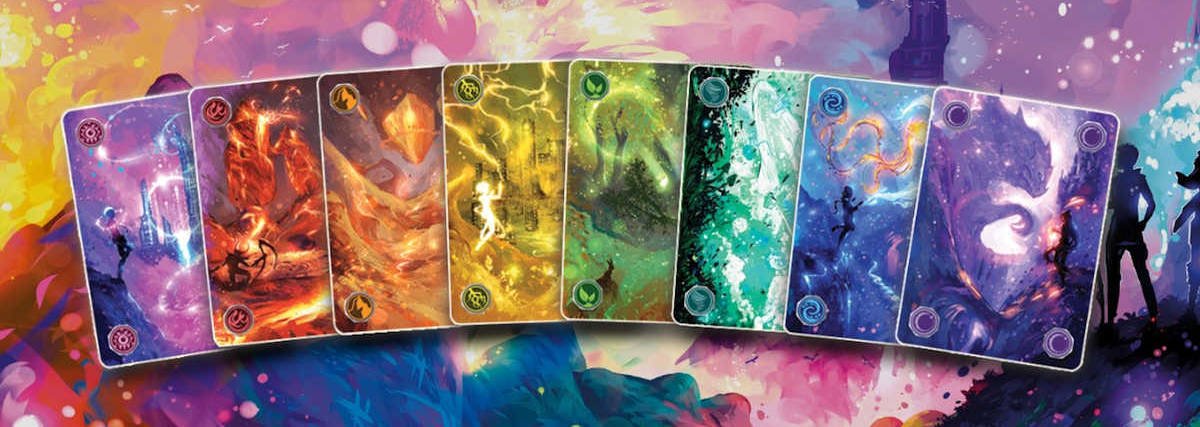
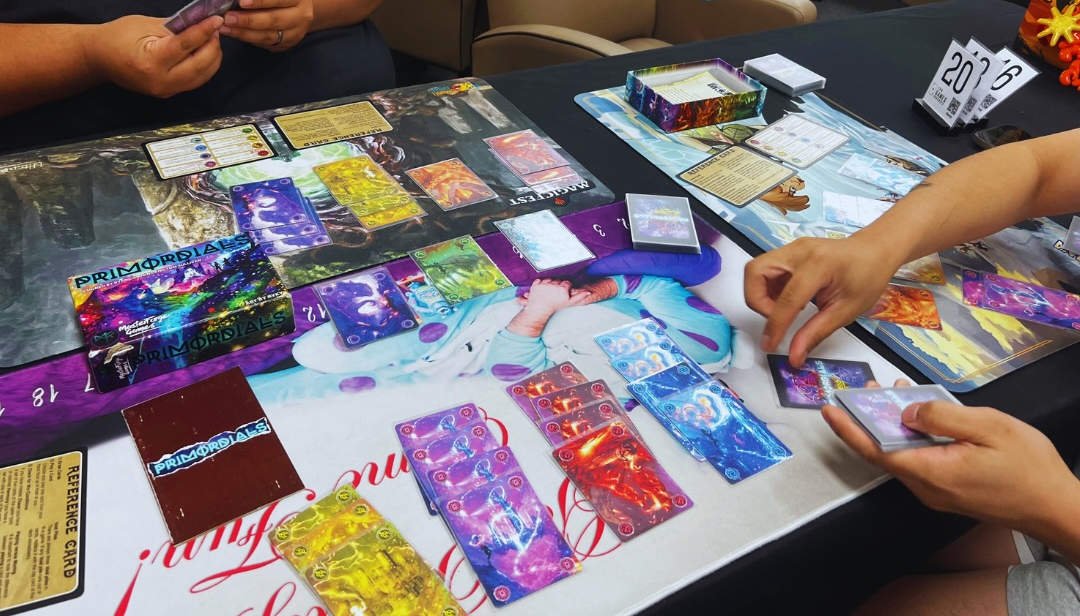
The gameplay loop is deceptively simple: players draw a card, play it into their personal area, and trigger its effect. There are eight distinct card effects in total, offering a blend of self-help mechanics and lighthearted, table-talking backstabbing. Depth emerges as players manage card counts: hitting three of the same card triggers a powerful “surge effect,” while collecting five of a single type yields an instant win known as “chaos”. Alternatively, players can pursue “harmony”, collecting one of each card type to unify the universe’s elements and claim victory.
Adding to the immersion is Riky’s breathtaking artwork, which goes beyond standard card design. Rather than standalone illustrations, the artwork across the deck lines up to form a continuous 360-degree spherical panorama, allowing players to start at any card and rotate seamlessly through the landscape. To preserve this visual integrity, the cards feature zero text, keeping the aesthetic clean while ensuring the game remains entirely bilingual and universal.
The Gamefound Campaign and What’s Next
Following a successful launch that crushed its initial $10,000 funding goal in under eight days, Primordials is live on Gamefound through the end of October.
Masterforge Games has structured the campaign to prioritise community building over profit. According to Sully, crowdfunding funds are being poured directly back into manufacturing minimums and stretch goals rather than paying back the creators. Should the campaign hit its stretch milestones—such as a 200% funding goal—backers will unlock exclusive rainbow-foil edging on the standard cards. Meanwhile, the premium “shiny” tier features a refined silver foil finish that enhances the game’s graphics without washing out its vibrant colour palette. Further funding milestones aim to secure professional French translations to take the indie title global.
Packed into a pocket-sized box featuring tight manufacturer tolerances and a clever notch design for easy access, Primordials proves that good things come to those who wait—even if that wait spans nearly ten years.
You can check out the Primordials campaign on Gamefound before it closes at the end of October.
We spent some time with Thomas learning more about the game and how it came about.
Ben: I’m here with Thomas Sullivan-Mayberry, or Sully, as most people know you. So tell me about Primordials. This has been a long time coming. You reminded me that I played this game back in 2019. That’s seven years ago, you know that?
Tom Sullivan: Yeah, seven years ago.
We’ve been working on this game for almost ten years now. About nine years ago, the idea came to me and I sent Ryan a message saying, “Hey, I’ve got some ideas for some mechanics that I’d like to flesh out.”
When I got back from Canberra, because I was away there at the time, we started developing it. We created the bare bones of the game and thought, “Oh, this is really fun. Let’s keep fleshing this out.”
So yes, it’s a game of mechanics first, theme later.
From there we did a lot of research and looked at a range of artists. The artist we ended up working with is Riky from the Czech Republic. He’s a phenomenal artist.
Ben: Oh, wow.
Tom Sullivan: Yeah, he’s absolutely amazing. He created all of this artwork well before AI art was even a thing.
Seven years ago, the art was already completed. The game was pretty much ready to print in 2020.
Life happened.
Ben: Yes. What happened in 2020?
Tom Sullivan: Yeah, we don’t know. I remember having a booth booked for PAX Australia 2020, but I vaguely remember it being a really quiet year. You would’ve been with TGDA back then as well.
Ben: Yes, definitely.
Tom Sullivan: The game itself is super simple. We wanted to create a game where essentially… (Cheering in the background.) Did someone just win the game?
Ben: We have a winner!
Tom Sullivan: We have a winner! Sorry about that, chat.
One thing you’ll notice is that our artist really went above and beyond with the brief. We wanted each piece of art to line up and create a panorama. Not just a single panorama where you have to start at one point, but one that actually rotates through.
You can start at any card and continue around, creating what’s essentially a 360-degree panorama. Maybe less spherical because you don’t need the full 180-degree effect, but you get the idea.
Now, the depth of the game comes from the card effects. When you play a card, you trigger its Prime Effect, which is its standard ability. When you play a card and you have exactly three of that card in your play area, you trigger what’s called a Surge Effect. It’s a more powerful version of the Prime Effect. You then play a fourth card and trigger the Prime Effect again. When you play the fifth card, you simply win. You win because you’ve collected five of that card type.
You can see a couple of players here already have three of a kind in front of them, so they’ve surged a few times. Others are collecting four or five different colours.
A lot of people initially think, “Alright, if I’m going for Chaos,” which is our victory condition for collecting five of one type, “that sounds easier because I only need five cards.”
The fun part is that you immediately become a threat.
Everyone can see you’re getting close to winning, so suddenly you’re a target. That’s where the little bit of game politics comes in. People start blocking you, stealing cards, and generally engaging in some light-hearted backstabbing.
The other way to win is Harmony, where you collect one of each card type and bring all the Primordials together, uniting all the elements.
And that’s the game.
Ben: Awesome. These cards look shiny. Are these foil cards?
Tom Sullivan: What you’re looking at right now is the standard version.
Ben: They definitely look shiny.
Tom Sullivan: Yeah. When we hit 200%, we’ve got a stretch goal planned. We haven’t made it public yet, but I’ve been telling people at PAX.
This is the standard version. Are you ready for this?
Ben: Yes.
Tom Sullivan: So what we’re looking at is rainbow foil edging on the sides of the cards. Did we need to do it? No. Did we want to be a little bit extra? Absolutely.
Everyone who backs through Gamefound will get that if we hit 200%. It probably won’t be available at retail, so at this stage it’ll likely remain a Gamefound exclusive. Unless everyone decides it’s amazing and demands we keep it.Then we’ll listen.
And then we have what we call our Shiny Version.
Ben: Oh yes.
Tom Sullivan: The sample I’m showing you is very rainbow-heavy. We found it ended up being a little too shiny in places, and it could make some colours harder to distinguish.
So instead of rainbow foil for the final version, we’re moving to a silver foil treatment.
Ben: Which keeps the natural colour but still enhances it.
Tom Sullivan: Exactly. It adds that foil effect and shine without changing the colours or introducing extra tones. That’s the version people are currently backing.
Ben: That’s good. And people can back it now on Gamefound?
Tom Sullivan: Yep. It’s live on Gamefound until the end of October. Every follower helps us promote the game, and every backer helps us get more copies into people’s hands.
The crowdfunding isn’t about paying ourselves back. We’re literally asking, “How much do we need to hit minimum print quantities?” Everything beyond that helps us continue building the brand.
If we reach 200%, we’ll add a French translation. Ryan has been working with someone in France who can handle that for us, but all those additions cost money. That’s what the stretch goals help fund.
One thing you’ll notice is that there are no words on the cards.
We didn’t want to take away from the artwork, but we also wanted the game to be as universal as possible. If the rules are translated, the cards themselves work in any language.
Ben: Cards are universal.
Tom Sullivan: Love it. What we’ve also discovered is that the more people play, the less they need the reference cards. Eventually players look at a card and immediately know what it does.
We really wanted a small, pocket-sized game you can throw in a bag and travel with.
Ben: I like the box size. Is that the final production box?
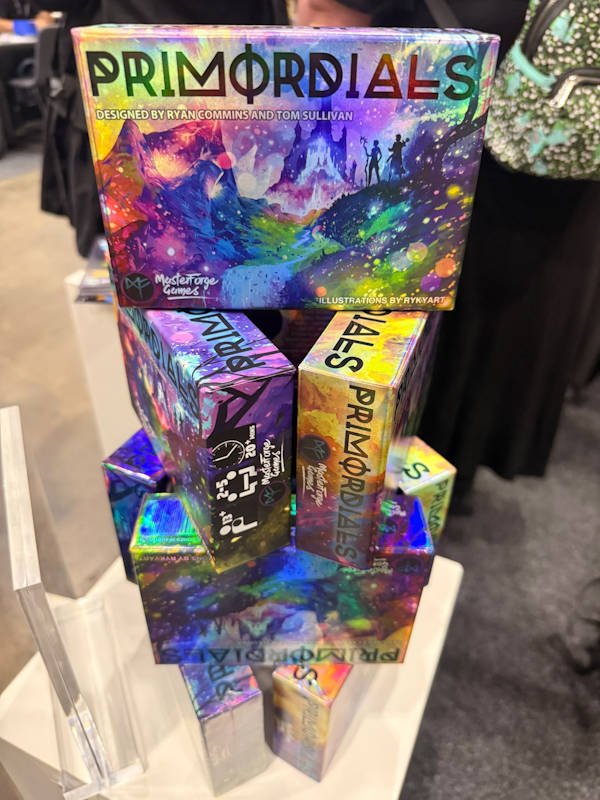
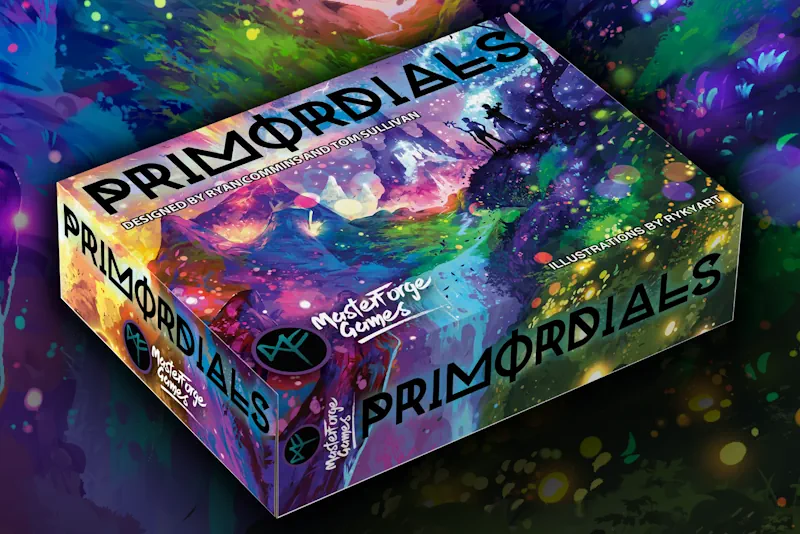
Tom Sullivan: It is. That’s the final box size. The only tweak I’ll make, based on feedback from this weekend, is adding a small notch on the side.
Ben: To make it easier to open?
Tom Sullivan: Exactly. Right now the manufacturing tolerances are very tight, and because of the glossy finish it becomes a little sticky to open. I love that because I know it’s not going to pop open in my bag, but it could be easier to access. We’ve also made sure it accommodates sleeved cards.
Ben: And you’ve even hidden the barcode.
Tom Sullivan: I did! Where is it?
Ben: Not on the back.
Tom Sullivan: Ah, there it is. It’s on the bottom.
Brilliant. You don’t need the barcode front and centre because the box is pretty. You can still see the player count, age recommendation, and play time regardless of how it’s displayed on a shelf.
I love it. It’s an awesome box.
Ben: Well done.
Tom Sullivan: Thank you so much. Nine years in the making, and we’re finally here. It’s so close.
Ben: End of this month?
Tom Sullivan: End of this month. We’ll hit our goal. I’m just curious how high we’ll go.
Ben: Four hundred percent.
Tom Sullivan: Four hundred percent? I love that. I’ve had people say 750%, which would be incredible. I’d be absolutely wrapped if we could reach 300%, because then I can start adding more language translations and really work towards making the game global. That’s the goal.
Ben: Awesome.
Tom Sullivan: Thanks again, Ben. Absolute pleasure.
Ben: Thank you. It’s always good seeing you. We only seem to catch up once a year, but it’s always a pleasure. That’s PAX for you.




Recent Comments