
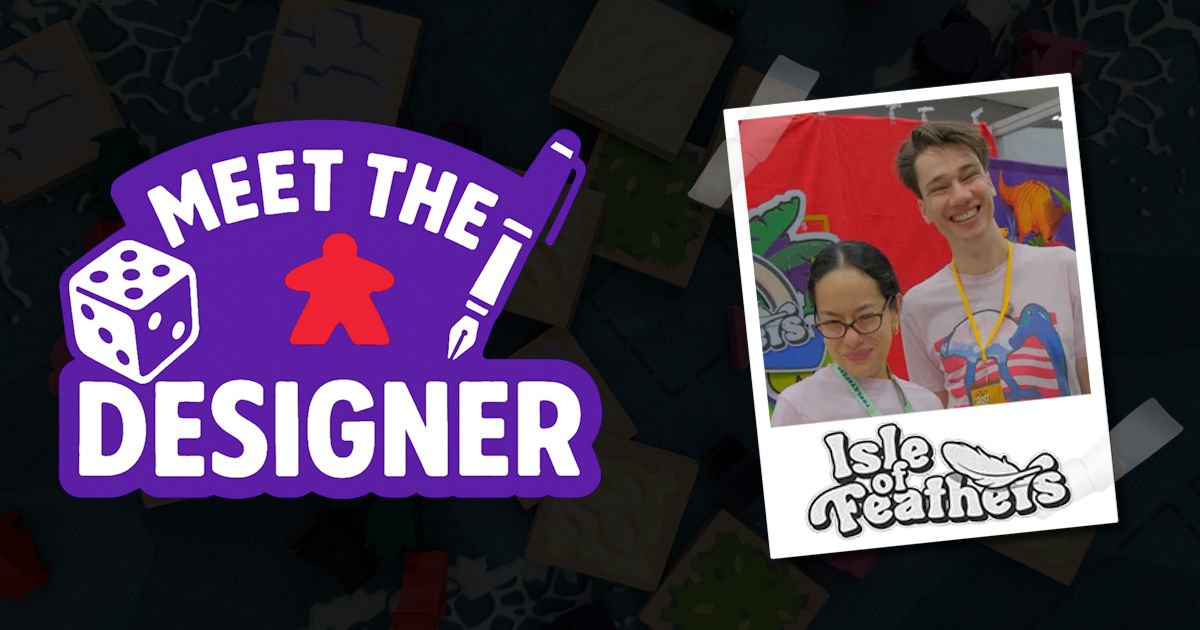
What do you get when you cross a global lockdown, a profound love of bizarre wildlife, and a shared obsession with tabletop gaming? If you’re Brisbane-based designers Daniel Galbraith and Juno Schaaffhausen Te’o, the answer is Isle of Feathers. This fast-paced vertical tile-placement game challenges 1 to 4 players to build the ultimate micro-habitat for some of nature’s most wonderfully strange birds.
Born during the long stretches of pandemic lockdowns, what started as a creative side project gradually evolved into a fully-fledged tabletop experience. At its heart, Isle of Feathers is all about careful planning, clever spatial decisions, and figuring out how on earth you’re supposed to fit one more oddly shaped bird into an already crowded ecosystem. It’s the sort of puzzle that feels approachable at first, right up until someone places the exact tile you were hoping to use, and your entire habitat strategy begins quietly falling apart.
Then there’s the game’s most important rule. Or at least the funniest one.
Every time a player introduces a new bird to the island, they are morally, socially, and quite possibly legally obligated to share a completely unverified “Bird Fact” in their best David Attenborough-inspired documentary voice. The fact doesn’t have to be true. In many cases it probably shouldn’t be. What follows is usually a barrage of questionable wildlife trivia delivered with an uncomfortable level of confidence. Somehow, it works brilliantly.
The result is a game that sits in a delightfully unusual space. Part strategic tile-placement challenge, part improvised nature documentary, and part collective attempt to convince your friends that a puffin can communicate through advanced tax law. Whether that’s scientifically accurate remains hotly debated.
We sat down with Daniel, a video game industry technical artist and co-creator of Think of the Children, and Juno, an architecture graduate making her debut in tabletop game design, to talk about weird animals, vertical habitats, pandemic creativity, and the surprisingly complicated process of turning a joke about birds into a real game people can put on their shelves. Sometimes the best ideas arrive after years of careful planning. Sometimes they arrive because somebody really, really likes odd-looking birds.
Ben: I’m here with Daniel and Juno from Isle of Feathers. Tell me a bit about the game. What is it about and how does it play?
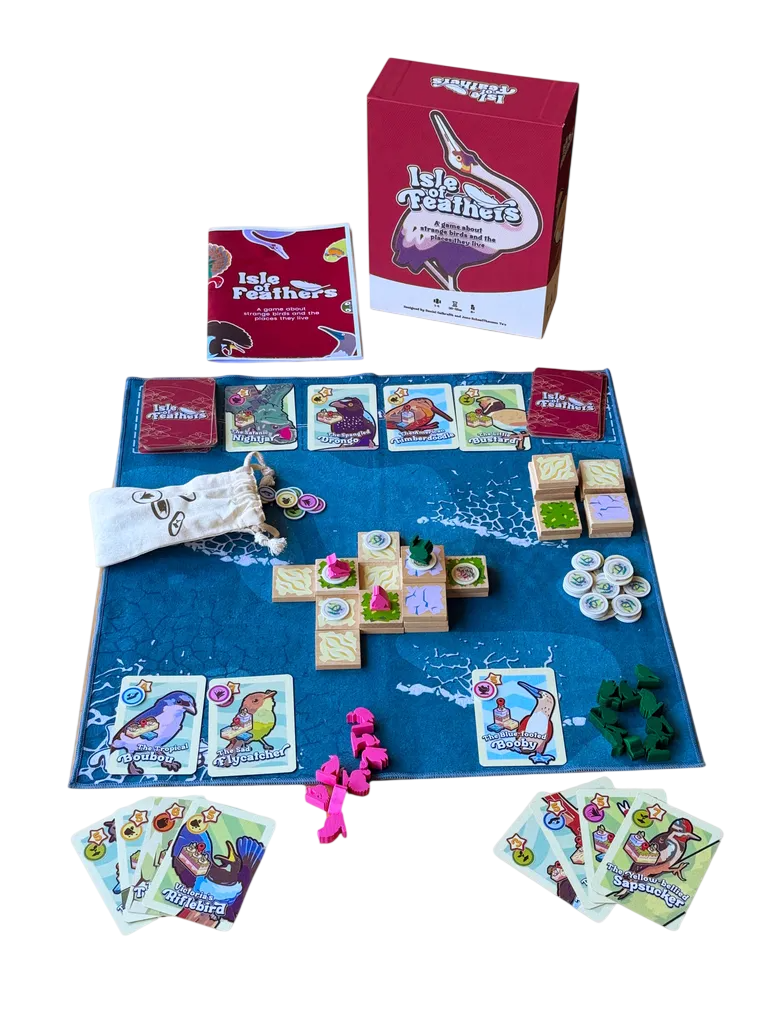
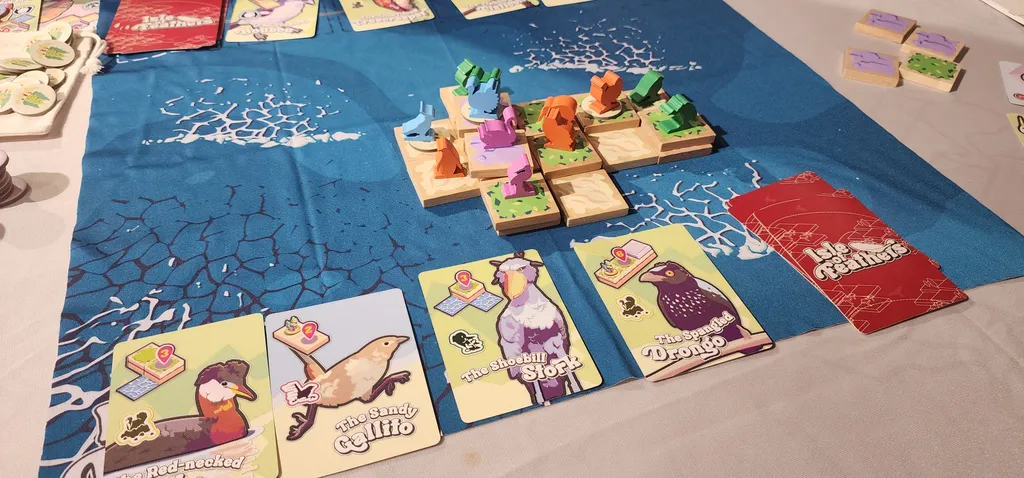
Daniel (Isle of Feathers): Isle of Feathers is a competitive tile-laying game where you build a little island out of wooden tiles and then fill it with different species of colourful birds. Every bird in the game is unique, and you’re all building in the same space, so you’re jostling for position and adapting to the changing islands to get your birds on the table before the tiles run out. And every time you add a bird to the island, you make up a fun fact about the species and deliver it to the table like David Attenborough. So it’s got a bit of an icebreaker element, too.
Ben: There’s a little bit of world-building as part of the gameplay?
Juno (Isle of Feathers): Absolutely. Every bird in the game is real, and you’ve got these wonderful opportunities to make up outrageous things about them.
Ben: Awesome. How did you come up with the idea? Where did that come from?
Juno (Isle of Feathers): Well, we’ve always been really big fans of birds, especially Daniel, who grew up around a lot of different kinds of animals. During COVID, we wanted to make a board game together. Daniel’s from the video games world, and we always had this idea of making some sort of tile game. Then it just felt natural to put birds with that one as well. It also helped that we went on a trip to Bundaberg to visit friends, and we played Tetris and Wingspan in the same 24 hours. That really helped solidify it for us—we thought, what if we built Wingspan with Tetris?
Daniel (Isle of Feathers): My friend is a zoologist who we went to visit, and it’s like the elements coalesced together. It was like, “Oh, there’s something here. How can we pull this together?”
Ben: I love how it’s a mixture of tile placement, then world-building as part of laying the birds down.
Juno (Isle of Feathers): Very much so.
 Ben: How have you found designing the game? Because you’ve got two elements there with the wooden parts and the cards. Often it’s easy just to get cards manufactured. How did you find that whole process of making the game with these different elements?
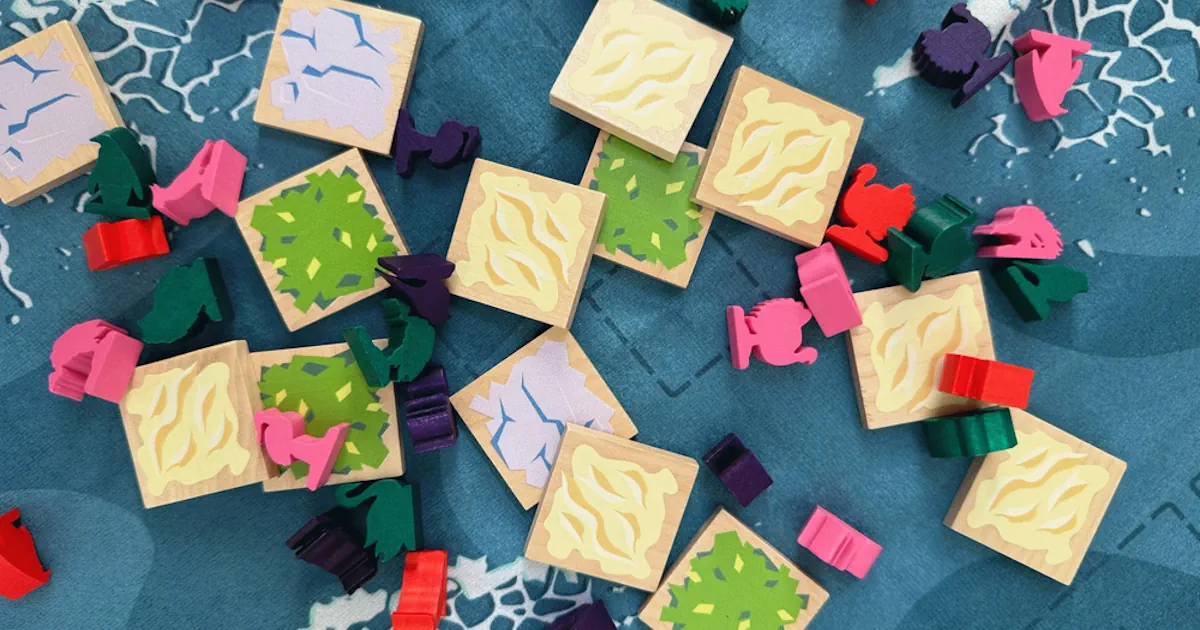
Juno (Isle of Feathers): Honestly, we really enjoyed it, and something we thought was really important from the start was making a game that was tactile. We wanted things to feel and sound really good. I studied architecture, so having a design focus was something I was used to. We work together well and really enjoy it, so that came naturally. But something that was really integral for us is that we made our first prototypes literally out of sticky notes and cardboard, as most game designers do. Then we went to a board game barbecue event.
Daniel (Isle of Feathers): Which has just been wonderful.
Juno (Isle of Feathers): Yeah, that was really integral and lovely. Having accessible events for people to take games in whatever stage they’re in—whether finished or just bits of cardboard and sticky notes—is really important to a scene like this. People continue to be so giving with their time and feedback. That aspect of the design process has been really rewarding and wonderful. It’s a really nice community here in Australia and up in Brisbane, where we’re from.
Daniel (Isle of Feathers): The board game scene’s been so supportive there.
Juno (Isle of Feathers): That’s been really important to us: making use of a wonderful network of people, including our family and friends who were like, “Alright, this looks cool, what’s this? Can I eat the bird?”
Daniel (Isle of Feathers): It’s been a five-year development process, living and breathing Isle of Feathers.
Juno (Isle of Feathers): Life happened, we got married halfway through that, and we had no money. Small things! Game design is fun, stressful, and expensive at times, but we’ve really loved it.
Daniel (Isle of Feathers): It’s the most rewarding thing we’ve ever done. Aside from getting married, that’s our second most rewarding.
Ben: I’ll come back to the development process, but I wanted to focus on that comradeship and the ability that tabletop has. Tabletop sums it up really well in how everyone works together. I know Eris, who’s co-hosting here with his game Sugarrr!, runs the game design event up in Brisbane. How does that world exist for you guys, and how does it help the whole industry grow?
Juno (Isle of Feathers): I think it’s the lynchpin of this industry, especially in Brisbane and the rest of Australia. It’s integral for getting your ideas out there, for feedback, and for development. I’ve never met a group of people who are more giving with their time and expertise. When we were doing our Kickstarter, Martin Wallace—who is responsible for Brass—was so lovely and gave us connections to help get fulfilment started in so many areas of the world. He just did that because he’s lovely. There are so many stories of people helping hook us up with others, and we do the same.
Daniel (Isle of Feathers): It’s a rising tide and all that. There are so many things you have to learn building a game, taking it from a scrappy prototype to a physical product and Kickstarter. We ended up building a global distribution network to get it to people. It’s wild. Everyone’s been so happy to chat, share, and ramble with anyone who will listen.
Juno (Isle of Feathers): Exactly. Unlike before, it is a business as well. Your stuff will only be as good as other people’s, too. It benefits everybody if you share your knowledge. That’s why it’s really important to have free or community spaces, and I very much hope they continue to exist.
Ben: Being in Australia, we’re at the tyranny of distance. You talked about distribution and trying to get it out there, often needing a warehouse in North America and Europe. How did you go about building your own distribution network?
Daniel (Isle of Feathers): It was quite a fun experience and fascinating. We learned so much on the go, like figuring out a shipping charter and owning a barcode. There’s so much to learn, lots of collaboration and talking with business owners, and everyone has been so welcoming.
Juno (Isle of Feathers): We did a lot of independent research. Our browser history for quite a long time was very much about shipping routes and packaging. AusPost loves us!
Daniel (Isle of Feathers): We also made it challenging for ourselves since this is our debut game and it’s full of wooden tiles, so it’s very heavy. Trying to get things shipped internationally over the past six to 12 months has been very interesting.
Juno (Isle of Feathers): We got very lucky sending things to America because our games were accepted on the exact day tariffs were declared unconstitutional, so instead of paying over 100%, we paid 10%.
Daniel (Isle of Feathers): We managed to thread that needle by pure fluke, so we were very fortunate. Getting overseas to America, the European Union, and Great Britain is quite an undertaking.
Juno (Isle of Feathers): Still tricky, but fairly doable.
Ben: Any barriers to selling to those other markets, like restrictions around child-friendly certification?
Juno (Isle of Feathers): That was interesting. We were lucky because a very kind man in the UK named John at Spiral Galaxy sat us down and gave us a guide on how to go about certification. It was a godsend and spelled out what we needed to do.
Daniel (Isle of Feathers): And John introduced us to Robert Pratt, who helped us set up postal logistics and register a company throughout the European Union. As a result, we’ve done the full battery of tests and can confirm there’s no asbestos in our board game!
Juno (Isle of Feathers): Just in case anyone was wondering!
Daniel (Isle of Feathers): A huge learning sprint, but it’s been really cool.
Juno (Isle of Feathers): The most challenging was the US and Canada due to distance and high tariffs. Being someone who enjoys games in the US must be difficult because everything is very expensive. We tried to keep our costs down as much as possible, but as first-time developers, it’s tricky. We want our game to be accessible to everybody, but avoiding massive costs for both players and ourselves is a challenge. We’ll see what we do for the next game.
Ben: That leads to the question: is there something in the pipeline? Is there an Isle of Feathers 2?
Daniel (Isle of Feathers): We’re definitely gearing up for a second, larger print run because the game is making its way into retail distribution now, which is very exciting. Beyond that, it’s not going to be our only game, that’s for sure. We’ve got things cooking away.
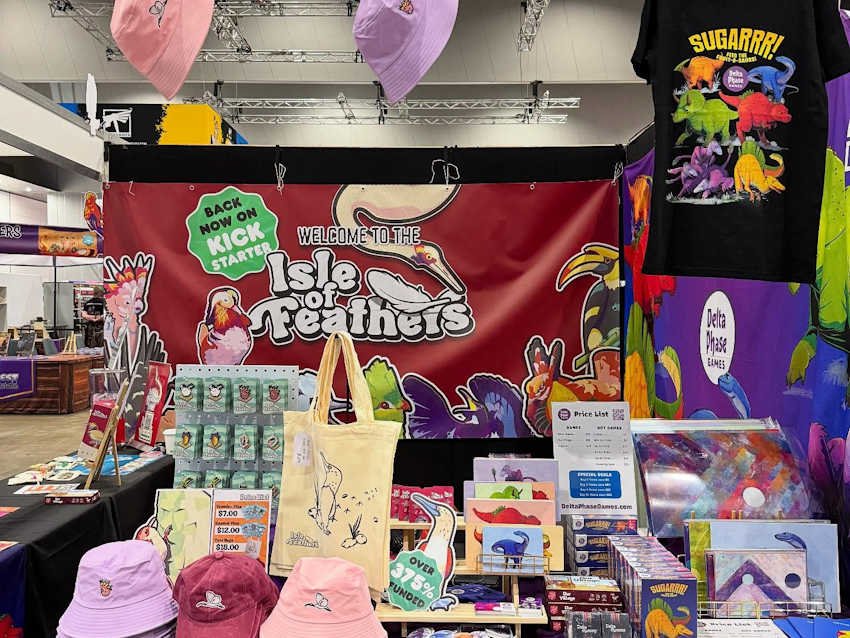
Ben: This is your second year with a booth at PAX, and it’s a larger booth this time?
Juno (Isle of Feathers): Yes, it’s a larger booth. Last year we shared with Eris from Delta Phase Games, who we love and is an excellent game designer. But this time we decided to do a double booth, and it’s lovely having ample room to play-test.
Daniel (Isle of Feathers): Two setups so you can have entire games running, plus a table that goes up to standing height.
Juno (Isle of Feathers): It’s the little things with us, isn’t it?
Ben: Thanks for your time, and good luck with the rest of PAX. It’s been a pleasure talking with you.




Recent Comments