
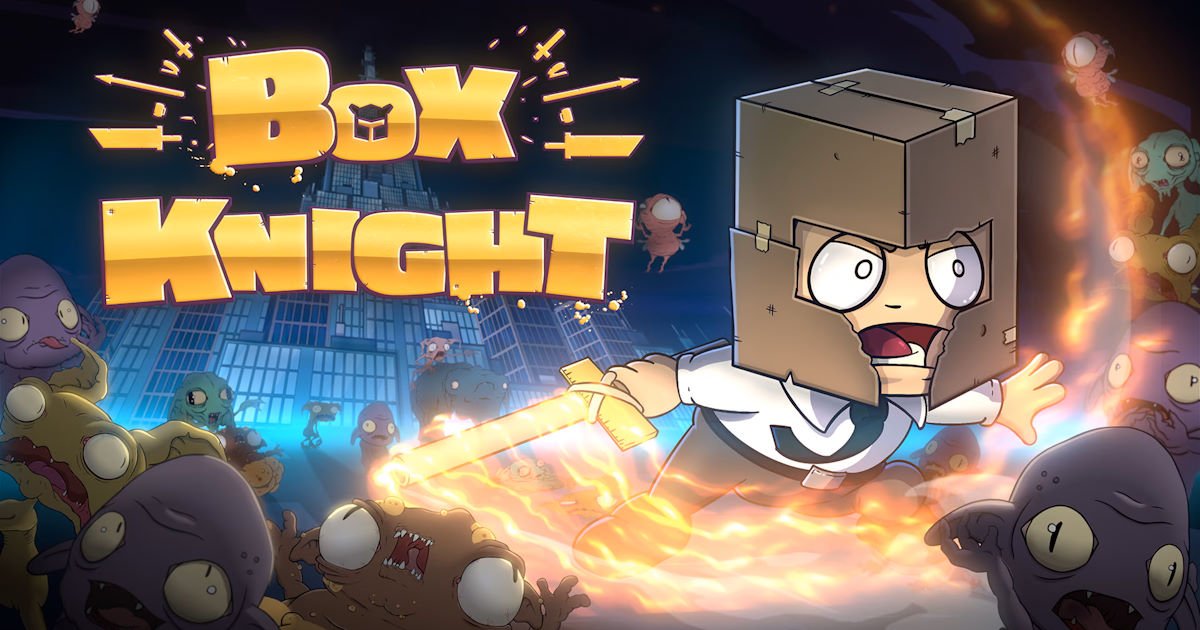
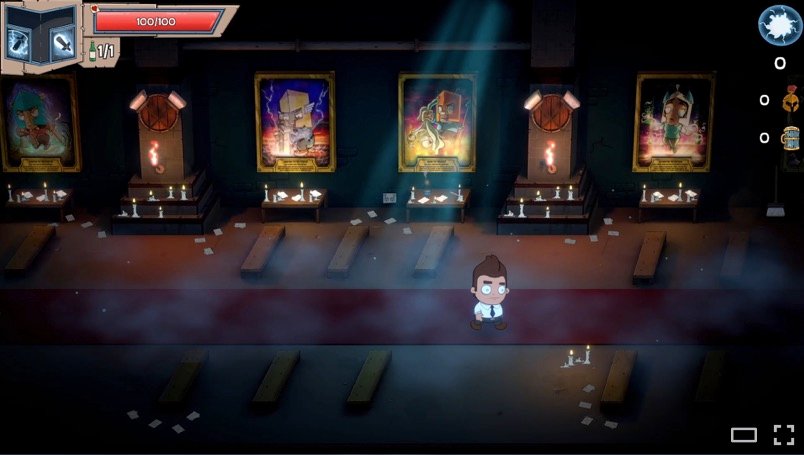
Box Knight is an indie roguelike action game developed by We Made A Thing Studios. Set in a corporate office tower where everyone’s collective misery has become so intense it’s literally turned into monsters, you play as the Box Knight and fight your way through an increasingly chaotic office.
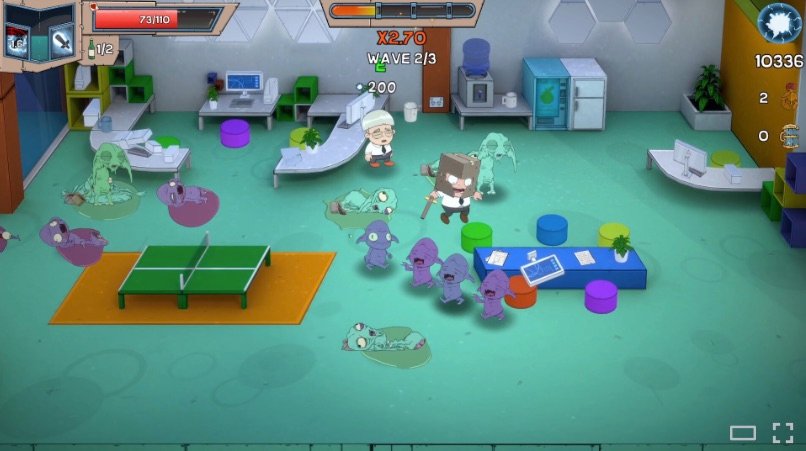
At first glance, the game has that familiar old-school side-scrolling brawler feel. You run in, start swinging and, if you’re anything like me, probably do a fair bit of button-mashing while you work out exactly what everything does. There’s a lot more going on once you settle into it, though. Different enemies have their own roles, attacks and behaviours, and things can become surprisingly hectic when several enemy types start appearing together.
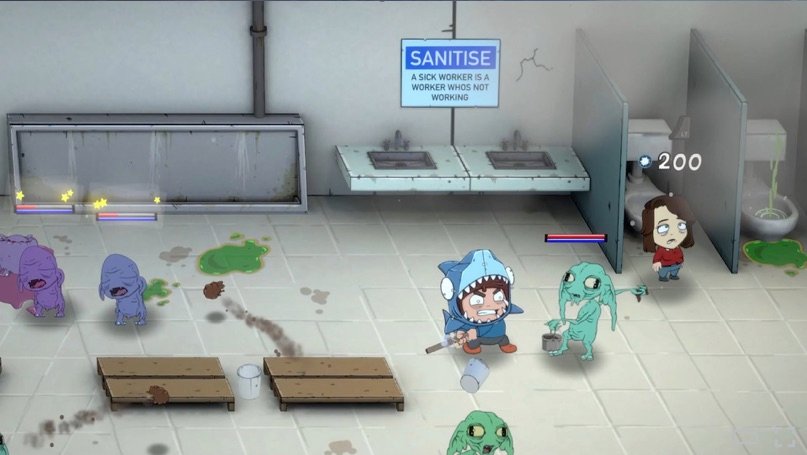
The whole thing is wrapped in this wonderfully handmade art style as well. The team created every pixel, with the creatures animated in Adobe Animate and textures and UI elements drawn by Jeremy on his increasingly tired iPad. There are slightly wonky buttons, hand-drawn elements and little imperfections throughout, and honestly, that suits Box Knight perfectly. It gives the game its own personality rather than making everything feel overly clean.
Jeremy also mentioned during our chat that some of the thinking behind the enemies was inspired by Halo. Not so much how they look, but how individual enemies have recognisable silhouettes and specific jobs within a fight. As different combinations begin appearing, you have to change how you approach them. That becomes particularly important later when enemies start working together and one neglected mob can suddenly become a much bigger problem.
Ben: G’day, Ben and Kelly from DezDoes.com.
Jeremy: I’m Jeremy Kelly-Bakker. I’m one of the devs on Box Knight from We Made A Thing Studios. Box Knight is an indie roguelike brawler set in a corporate office tower where everyone’s workplace misery has become so intense that it’s turned into monsters and completely overrun the office.
Ben: It sort of looks like a fun side-scroller. Reminds me a little of Street Fighter.
Jeremy: Yeah.
Ben: So you’re based here in Australia?
Jeremy: Yeah, we’re based in Adelaide, Australia. We love people knowing that.
It’s been a really interesting production because we pulled this together in our own time, between all of our other jobs and contracts. So it’s been incredibly disjointed. We’d be on for a month, then off for two weeks, back on for another two weeks, then off for six months, and then suddenly working on it for 18 months.
So when people ask how long it took to develop, I always have to say, “Well, do you mean calendar time or on-tools time?” Because they are wildly different things.
Ben: So you could say Box Knight started as a bit of a passion project outside of your normal world?
Jeremy: Yeah, yeah, it started out that way. But then I think my business partner, Tom, and I really fell in love with game development and game design. We originally came from film and TV, and we started to figure out that with a really small team in games, you can tell a much bigger story than you could in film, which requires so many more resources.
Just as a creative exercise, that became really, really appealing to us. We’re huge fans of fantasy and sci-fi, so being able to tell those kinds of stories without needing a massive team was really engaging.
Ben: I thought it was a crazy game. I started out just button-bashing, but once you start figuring it out and get your head around the controls, it becomes really intense. In a good way.
Jeremy: I appreciate that. I think one of the things that may have, you know, shot ourselves in the foot a little bit is that it looks like a really simple button-mashing brawler.
But it turns into much more of a strategy game as it goes on. As more and more enemy types start appearing, particularly later in the game, they begin synergising with each other. So if you leave one particular enemy type unattended, things can get out of control really quickly.
Kelly: Yeah. That’s what happened when I tried to revive you.
Jeremy: Yes, exactly!
It’s interesting because we’ve had a few reviews where people have said, “Oh, it’s actually a strategy game. You need to go in there and be very selective about who you’re taking down and how you’re fighting.” You need to be quite careful and cautious, rather than simply running in and hitting everything.
Ben: So it’s different to the old-style Gauntlet or a straight hack-and-slash.
Jeremy: Yeah. Because you’ve got different moves. It’s not simply one attack. You can jump and hit, you can move through enemies, and you’ve got different ways of approaching them.
I always get raised eyebrows when I use this as a reference, but I actually based Box Knight a lot of the creatures on Halo. Not aesthetically, necessarily, but in the idea that everything has a really unique silhouette and a very specific role.
Once you start changing the configurations of what’s appearing and how they’re appearing, you suddenly have to readapt your approach.
It becomes this little combat puzzle game.
Ben: That’s really cool. Taking inspiration from mechanics in other games works really well. What about the Box Knight artwork? Is that all something you’ve done in-house?
Jeremy: It is all us. Literally every pixel on the screen was drawn by me.
All of the creatures were animated in Adobe Animate because we love that old Flash-style animation. Every texture in the game was drawn on my very sad and tired old iPad.
The entire game is super, super hand-spun from the ground up. There’s very little in the way of asset packs. Every pixel has basically been built by us.
Which drove our dev nuts because all of the UI was also drawn on my iPad, and I’m not particularly good at drawing straight lines. So all of our buttons and menus are just a little bit wonky.
So it’s real.
Kelly: Oh, I love it. It’s awesome.
Ben: So how did you end up here on this stand with a café from Tokyo?
Jeremy: We partnered up with Yokuryu Studios. We actually met them in San Francisco after we were accepted into Day of the Devs, which is a really cool event.
While we were there, we made friends with the Yokuryu guys. They were taking their booths all around the world to places that we could never realistically get to ourselves.
We also needed localisation done, and they had localisation people, so they said, “Hey, if you want to jump in with us for localisation, we can take Box Knight around with us while we’re travelling and set up a computer here.”
Their involvement with Box Knight has just increased through release and in the lead-up to PAX. Eventually they were like, “Hey, did you want to take one of the big ones?”
So yeah, it’s just been extraordinary.
Ben: That’s awesome.
Jeremy: It’s also really nice to be back here because we first demoed the game about four years ago.
Back then, whenever people asked when it was going to be released, we were absolutely convinced it was “six months away”.
It kept being six months away for a really, really long time.
So it’s nice to finally be back where we first demoed it, now having actually launched the thing and being able to tell people, “We did it. We finally finished the damn thing.”
Ben: Awesome. And it’s available on Steam now?
Jeremy: It’s available on Steam. It’s currently 20% off, it works great on Steam Deck, and the couch co-op works really well through Steam Remote Play.
Only one person needs to own the game, so it’s been really, really great being able to play online while still getting that couch co-op experience.
Kelly: It’s more controller-based than keyboard and mouse, yeah?
Jeremy: Yeah, although keyboard and mouse plays really nicely as well. Our dev Rory much prefers keyboard and mouse, and that works for him.
I’m a controller guy.
We did build the game with consoles in mind, and hopefully, if Box Knight sells some more units, we can eventually start looking at ports for Xbox, PlayStation and Switch.
It turns out a console port costs about $30,000 US dollars. We do not have that.
Then you start multiplying that across different platforms and suddenly it becomes a lot of money.
So we’ll take a staggered approach. Hopefully people discover the game on Steam, and then eventually we can get it onto consoles as well.
Ben: Put it on Mac for me. That’d be nice.
Jeremy: We were actually looking at the wishlist breakdown in the lead-up to launch and talking about it like, “Oh, we should get a Mac version as well.”
Then we hit about 10,000 wishlists before launch, which was lovely.
And I think about 12 of those were specifically for Mac.
That was about the point where we were like, “Oh. We now need to cater to this audience.”
Kelly: Awesome. Well, thanks so much for coming by. Really appreciate it.
Jeremy: Thank you. We are deeply relieved to have launched it.
Ben: It’s awesome. We see a lot of games here where we first come across them during playtesting, and they might have a really rough demo or something. Then suddenly, years later, you see them again and they’re actually finished.
Jeremy: Yeah.
Ben: I was talking to Sully from Primordials yesterday, and he reminded me that I’d actually played the demo back in 2019. Now it’s finally ready to go!
Jeremy: It took us so much longer than we expected because we just kept adding to the whole thing as well. It got bigger and bigger and bigger.
Originally, it was supposed to be this retro-y game with a couple of floors, a couple of bosses, and a very linear structure. And then it just blew up.
Ben: So how long does it take to play through?
Jeremy: That’s a really good question.
I think part of it depends on skill and how far you want to level up your character. We’ve got people who’ve spent 40 to 60 hours in the game, which is insane.
If you really lock in, you could probably beat the main story in about three to four hours.
If you want to do the true version of the story, because there’s a boss ending and then there’s the real ending, you’re probably looking at around six to seven hours.
So I’d say somewhere around four to six hours overall, depending on your skill, how comfortable you are with it, and how much you want to muck about and unlock everything.
The replayability we’ve carved out has been awesome as well. There’s a whole set of challenges, including survival mode, where people will beat the main game, unlock everything and then start sinking their teeth into all the other stuff.
The couch co-op has been great too. It’s such a different way to play, and it gets pretty erratic.
I think that’s what you guys were playing. It gets so intense later in the levels as all the different enemies start synergising and compounding.
What you’re getting with the Xbox demo over there is really just the surface-level version of it.
Ben: Yeah, the co-op was great fun!
Jeremy: I’m glad you guys checked it out.
Ben and Kelly: Thank you so much, and all the best for the rest of PAX!



Recent Comments