
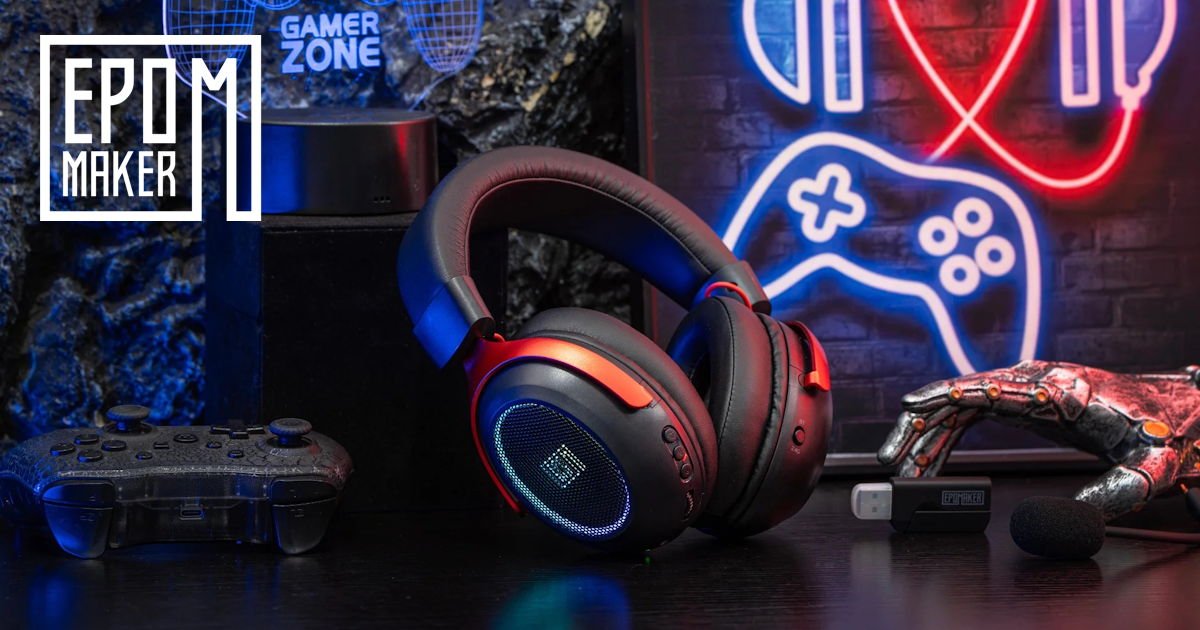
The gaming headset market is crowded. Really crowded. Which is probably what makes the Epomaker GX1 interesting in the first place.
Known largely for dominating the custom keycap and mechanical keyboard scene, Epomaker has spent years building a strong reputation among keyboard enthusiasts. Seeing the company turn its attention to gaming audio feels like a natural next step, even if a wireless gaming headset wasn’t necessarily the product I expected to see next. Then again, if you’ve already nailed the peripherals people spend all day touching, perhaps the thing they spend all day listening through was always going to be on the roadmap.
That brings us to the Epomaker GX1, the company’s first serious step into gaming audio. At first glance, launching a headset into an already overcrowded budget market feels like a bold move. Yet with a price tag hovering around the $40-$50 USD mark, the Epomaker GX1 arrives with a feature list that would have looked far more at home on a considerably more expensive headset only a few years ago.
What immediately caught my attention was how little feels missing. Budget headsets usually come with an invisible asterisk somewhere. Maybe the battery life is disappointing. Maybe the microphone makes you sound like you’re calling from the bottom of a well. Maybe compatibility involves a collection of adapters that somehow vanish the moment you need them. The Epomaker GX1 largely sidesteps those familiar budget compromises by offering tri-mode connectivity, 50mm drivers, dual microphones, RGB lighting, and a battery large enough that charging often feels like an afterthought.
More importantly, the Epomaker GX1 doesn’t feel like a keyboard company taking a random swing at gaming audio. It feels like a product designed by people who understand how modern headsets are actually used. One minute they’re handling a Microsoft Teams meeting, the next they’re sitting in a Discord call while someone passionately explains that the team’s defeat was definitely matchmaking’s fault and absolutely not because they rushed an entire squad by themselves.
After spending time with the Epomaker GX1 across daily work calls, Discord sessions, music listening, and plenty of gaming, here’s how Epomaker’s debut headset holds up.
What’s in the Box?
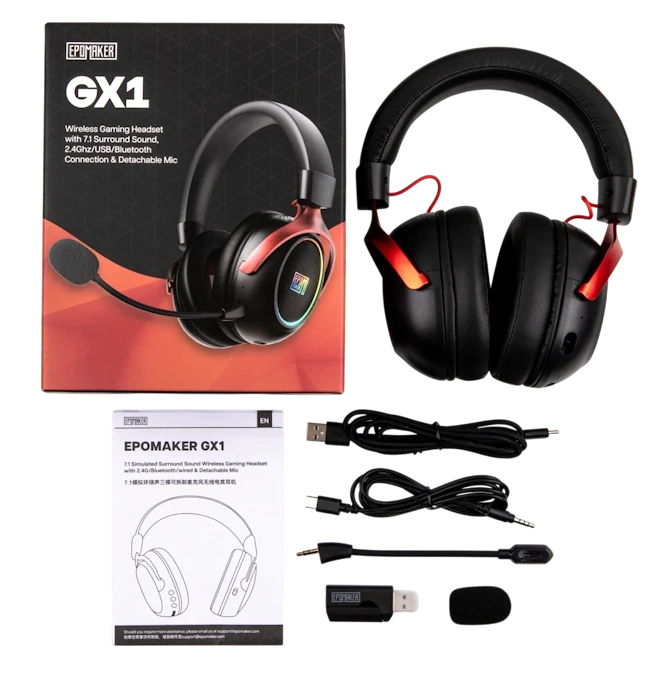
Epomaker doesn’t skimp on the essentials here. Unboxing the GX1 reveals a clean setup with everything you need to plug and play across virtually any platform:
- Epomaker GX1 Wireless Gaming Headset
- Detachable ENC Boom Microphone (complete with foam pop filter)
- 2.4GHz Wireless USB-C Dongle (with integrated USB-A adapter)
- USB-A to USB-C Charging Cable (braided)
- USB-C to 3.5mm Audio Cable (for wired fallback)
- Multilingual User Manual
Build Quality and Design
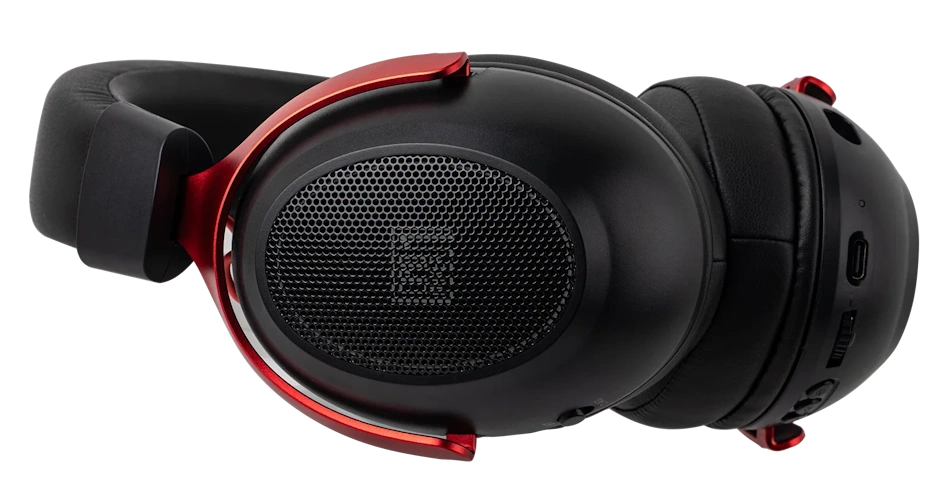
Out of the box, the Epomaker GX1 immediately makes a strong visual impression that punches well above its budget price tag. Featuring a metallic oil-sprayed and electroplated finish, the chassis avoids the cheap, hollow-plastic look that defines most entry-level headsets. Even better, the surface treatment holds up exceptionally well under daily handling, actively resisting fingerprints, smudges, and minor desk scuffs to stay looking clean over time.
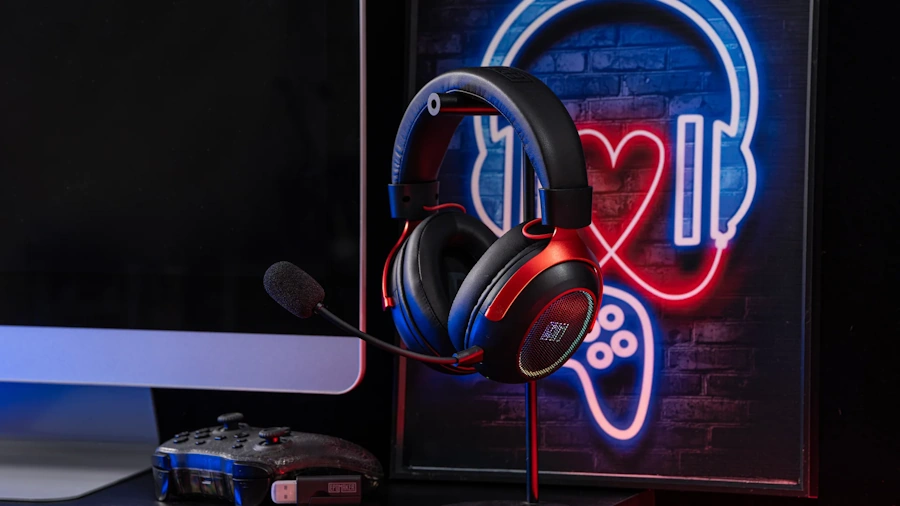
What surprised me most is that the Epomaker GX1 never really looks like a $75 (or $50 in freedom bucks) headset from a distance. Sitting on a desk beside considerably more expensive gaming gear, it doesn’t scream “budget” in the way many competitors do. There’s a density to the finish and a confidence to the overall design that gives it a more premium presence than the price tag suggests. I found myself reaching for it repeatedly, partly because it performed well, but also because it genuinely looks good sitting next to a keyboard and monitor setup.
Epomaker also offers a refreshing level of aesthetic variety by releasing the GX1 in three distinct colourways: Red, White, and Pink. The Red edition pairs bold metallic crimson accents with dark gunmetal hardware for an aggressive, classic gaming look, while the White variant offers a crisp, minimalist finish that blends seamlessly into clean, modern desk setups. For those building pastel or cosy-themed battle stations, the Pink colourway delivers a soft, vibrant aesthetic without sacrificing the premium metallic sheen found across the lineup.
Honestly, I appreciate seeing manufacturers offer something beyond the usual choice of black or slightly different black o. Not every desk setup looks the same anymore, and it’s nice that the Epomaker GX1 can either blend into a professional workspace or become part of a more colourful gaming setup without looking out of place.
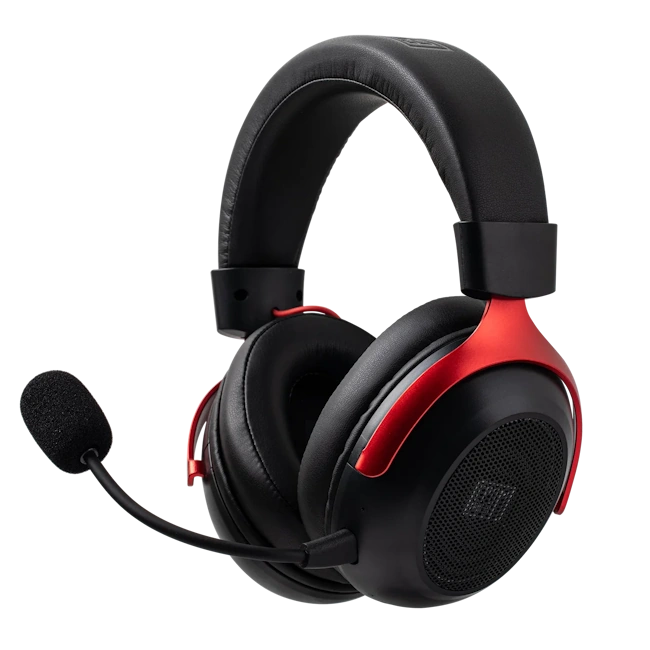
The outer earcups sport an open-mesh grille paired with a subtle RGB lighting halo that illuminates the central Epomaker logo, adding just enough visual flair without feeling overly loud or distracting. The lighting is restrained in a way that I actually prefer. Gaming peripherals occasionally seem determined to recreate a small nightclub on your desk. The GX1 keeps things far more tasteful, adding a little personality without drawing attention away from whatever you’re supposed to be focusing on.
Exposed braided cabling links the earcups to the adjustable headband, an industrial design touch reminiscent of classic HyperX models that reinforces its sturdy build. It also gives the headset a slightly more serious appearance, almost as though the design team wanted to remind you this is a piece of gaming hardware rather than another generic Bluetooth headset pulled from an online marketplace.
While the plush protein leather coating on the headband and earpads will naturally require standard care and occasional wiping down to prevent wear over the years, the underlying structural frame feels rigid, durable, and reassuringly well-constructed. Twisting the earcups and adjusting the headband never produced any alarming creaks or flex, which is usually one of the first things I check on a budget headset. You can often tell where corners have been cut within a few seconds of picking something up.
That never really happened with the Epomaker GX1. It feels solid in the hand, secure on the head, and durable enough to survive being tossed onto a desk after an especially frustrating multiplayer match. Not that I’d ever do that intentionally, of course. Probably.
Comfort & Ergonomics: Made for Marathon Sessions
Tipping the scales at roughly 320 grams, the Epomaker GX1 balances weight distribution masterfully, feeling noticeably lighter on the head than its spec sheet suggests. Combined with generous padding across the top band, the chassis spreads its mass evenly across the crown, preventing the painful downward pressure points that often cut multi-hour gaming or work sessions short.
Weight is one of those specifications that rarely tells the full story. I’ve worn lighter headsets that somehow felt heavier after an hour because all of that weight seemed determined to concentrate on a single spot at the top of my head. The Epomaker GX1 avoids that problem surprisingly well. During several long workdays that rolled directly into evening gaming sessions, I rarely found myself adjusting it or taking it off simply for relief. That’s usually a good sign because the most comfortable headset is often the one you stop thinking about entirely.
Straight out of the box, the clamping force lands right in the “Goldilocks zone.” Unlike many budget headsets that feel either uncomfortably tight until broken in or overly loose, the GX1 strikes an immediate equilibrium. It remains snug enough to stay securely anchored when you lean back or turn your head quickly, yet relaxed enough to avoid squeezing your jaw, cheeks, or temples during extended wear.
I think this is where some budget headsets get themselves into trouble. Manufacturers often seem terrified that a headset might slip off, so they compensate by making it clamp onto your skull like it’s trying to win a wrestling match. The Epomaker GX1 feels considerably more refined. Whether I was sitting upright at my desk, slouching on the couch, or performing that dramatic backward lean people do after losing three matches in a row, it stayed comfortably in place.
Dialling in that personalised fit is effortless thanks to the smooth 7-step ratchet adjustment mechanism built into the headband sliders. Each click locks firmly into place without slipping under tension, offering plenty of extension range to accommodate larger heads while keeping the earcups properly aligned with your ears.
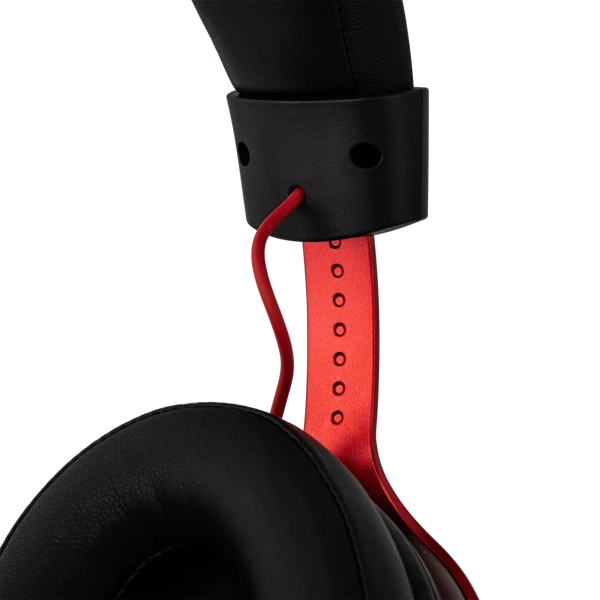
The adjustment mechanism also feels sturdier than many similarly priced competitors. There’s none of that vague, loose movement that leaves you wondering whether both sides are actually set to the same height. Every adjustment feels precise, with a reassuring click that suggests Epomaker paid attention to the small details. Those little things tend to matter more after months of use than they do on day one.
Completing the ergonomic package are the plush memory foam ear cushions, which contour gently around the ears for a comfortable, non-fatiguing seal. Better yet for glasses wearers, the foam offers just the right amount of softness and give to conform around frame arms without pressing them painfully into the side of your head, making all-day wear genuinely comfortable from start to finish.
As someone who spends a good portion of the day wearing either glasses, a headset, or sometimes both simultaneously, I appreciated this more than expected. It sounds like a minor thing until you’ve worn an uncomfortable headset for three hours and suddenly become very aware that your glasses are trying to merge with your skull. The Epomaker GX1 handles this remarkably well. The memory foam has enough density to create a secure seal for audio performance, but enough give that it doesn’t create hotspots around the ears.
The closed-back earcups also provide a decent level of passive noise isolation. No, it’s not active noise cancellation, and Epomaker doesn’t pretend otherwise, but it does a solid job of softening the hum of air conditioners, PC fans, and general household chaos. That’s particularly useful when you’re trying to focus on a meeting or hear a teammate’s callout over the sound of somebody aggressively clicking their mechanical keyboard.
Overall, comfort feels like one of the strongest parts of the Epomaker GX1 package. It’s the kind of headset that remains comfortable long after the novelty of unboxing it wears off, and honestly, that’s probably one of the biggest compliments you can give any gaming headset. After all, nobody enjoys being reminded they’re wearing one.
Connectivity: The Plug-and-Play USB Dongle Hero
The Epomaker GX1 does a lot of things well, but its connectivity might be the feature I ended up appreciating the most. Good wireless audio often goes unnoticed because it’s supposed to. You plug something in, it connects instantly, and then it quietly gets out of your way. The GX1 understands this better than many headsets costing considerably more.
At the heart of the experience is Epomaker’s clever 2.4GHz wireless dongle. Rather than including separate USB-C and USB-A receivers, the Epomaker GX1 uses a modular design that combines both into a single compact unit. The USB-C receiver nests neatly inside a USB-A adapter, making it easy to swap between modern laptops, desktop PCs, consoles, and handheld devices without digging through drawers for missing accessories.
It’s a small thing. But it’s one of those genuinely useful small things.
Throughout testing, I regularly bounced between a Windows desktop, a MacBook, and a handheld gaming device, and the GX1 handled the transitions without drama. Unplug the receiver from one device, plug it into another, wait a second or two, and you’re back in business. No drivers. No setup wizard. No mysterious pairing process that somehow works differently every single time.
The low-latency 2.4GHz connection is rated at around 25ms, and in real-world gaming sessions it felt responsive and dependable. Whether I was playing competitive shooters, chatting on Discord, or watching videos, audio remained perfectly synchronised with what was happening on-screen. More importantly, I never experienced random dropouts or sudden disconnects, even in an office already crowded with Wi-Fi networks, keyboards, mice, controllers, and various other wireless gadgets all competing for airspace.
Bluetooth 5.3 support adds another layer of flexibility. Pairing with smartphones and tablets is straightforward, making the Epomaker GX1 just as useful for music, videos, and calls as it is for gaming. I found myself switching to Bluetooth surprisingly often when stepping away from my desk, which helped the headset feel less like a dedicated gaming accessory and more like an everyday audio companion.
If all else fails, wired options are available too. The included USB-C to 3.5mm cable provides a simple fallback when battery levels eventually run low or when using devices that don’t play nicely with wireless audio. Realistically, with up to 70 hours of battery life, you’ll probably forget the cable exists most of the time. Still, it’s nice knowing it’s there.
The best compliment I can give the Epomaker GX1’s connectivity is that it never became part of the review. It simply worked. In a category where wireless frustrations can sometimes feel inevitable, that’s worth a surprising amount.
Real-World Performance: From Office Calls to Late-Night Discord
Although Epomaker markets the GX1 primarily toward gamers, putting it through daily hybrid-work routines reveals that it is just as capable as an everyday office workhorse. Transitioning straight from morning spreadsheets to afternoon voice chats feels completely natural, proving you do not need separate headsets for productivity and play.
This ended up being one of the more pleasant surprises of using the Epomaker GX1. Plenty of gaming headsets can handle game audio, but some become noticeably less impressive the moment you drop them into a work environment. The GX1 feels equally comfortable sitting in a Teams meeting as it does jumping into a late-night gaming session, which is probably how a lot of people use their headsets these days anyway.
Microsoft Teams & Remote Work
During back-to-back Microsoft Teams meetings, the GX1 delivered the kind of plug-and-play reliability you normally expect from dedicated business headsets. Right out of the box, the detachable boom microphone captures speech with impressive clarity and natural warmth. Colleagues on the receiving end repeatedly noted how crisp and full-bodied my voice sounded, completely avoiding the thin, heavily compressed “tin-can” vocal quality that plagues so many sub-$60 headsets. Even with normal room ambience in the background, the mic kept vocal pickup front and centre, so every word came through cleanly.
The detachable microphone’s ENC (Environmental Noise Cancellation) deserves some credit here as well. It does a respectable job filtering out the usual home office distractions such as keyboard chatter, PC fan noise, and the occasional background household interruption. Your colleagues still know you’re working from home, but they won’t feel like they’re sitting inside your office with you.
I also appreciated how little setup was required. Plug in the Epomaker GX1, select it as your audio device, and you’re basically done. No accounts to create, no mandatory software downloads, and no twenty-minute troubleshooting session before your meeting starts in thirty seconds.
Discord & Social Gaming
Once the workday wraps up and Teams gives way to evening Discord lobbies, the GX1 maintains that same rock-solid consistency. Throughout extended multi-hour voice sessions, the 2.4GHz wireless link held steady without a hint of lag, robotic artifacts, or sudden cutouts, even in a busy home office packed with Wi-Fi routers, wireless mice, and mechanical keyboards competing for airspace. Callouts stayed crisp, team chat remained synchronised with on-screen action, and switching between active game audio and voice channels felt completely seamless.
The low-latency wireless connection, rated at roughly 25ms, helps keep conversations feeling immediate and natural. That’s especially noticeable in fast-paced multiplayer titles where delayed callouts can be the difference between a heroic clutch play and an awkward trip back to the respawn screen.
After several nights of multiplayer gaming, I stopped paying attention to the connection entirely, which is honestly one of the best compliments I can give a wireless headset. Audio remained stable, microphone quality stayed consistent, and there was never that moment where somebody on Discord suddenly asks, “Are you still there?” while you’re frantically checking whether the headset has disconnected.
For a headset at this price point, the Epomaker GX1 handles the transition between work and play remarkably well. It feels built for the reality of modern desktop life, where spreadsheets, video meetings, YouTube videos, Discord chats, and games all seem to happen on the same machine within the span of a single day.
Sound Quality & EQ Customisation
Underneath the earcups sit tuned 50mm dynamic drivers. Unlike many budget gaming headsets that wash out mid-range detail with muddy, bloated bass, the Epomaker GX1 defaults to a surprisingly neutral, balanced sound signature.
That balanced tuning ended up being one of my favourite things about the headset. A lot of affordable gaming headsets seem determined to convince you that “good audio” means turning the bass knob until it can go no further. The result is usually explosions that sound impressive for about five minutes before dialogue, footsteps, music, and practically everything else gets buried underneath them. The Epomaker GX1 takes a more restrained approach, and it’s much better for it.
| Audio Range | Performance Profile |
| Bass |
Punchy and precise without overpowering vocals or game cues. The low end has enough impact to give explosions, gunfire, and movie soundtracks some weight, but it never feels out of control. Listening to music was surprisingly enjoyable too, which isn’t always guaranteed with gaming-first audio gear. There’s enough presence to make tracks sound lively without every song feeling like it’s being played inside a nightclub car park. |
| Mids | Clean and voice-forward; great for dialogue, podcasts, and comms.
This is where the Epomaker GX1 really shines. Voices come through clearly whether you’re listening to a podcast, watching YouTube, chatting on Discord, or trying to follow story dialogue in a single-player game. It’s also great for competitive gaming because teammate callouts don’t get lost in the chaos. |
| Treble | Energetic without sounding sibilant or fatigue-inducing over long sessions.
The higher frequencies have a nice amount of detail without becoming sharp or harsh. I’ve used headsets where extended gaming sessions eventually felt like the audio equivalent of someone flicking your ears repeatedly. Thankfully, that never happened here. The GX1 remains easy to listen to, even after several hours. |
| Spatial Audio | Open-mesh styling helps create a wider sense of space and separation for tracking footsteps and directional cues.
I should note that despite the visual design, this is still a closed-back headset. You’re not getting true audiophile-style open-back acoustics at this price point. What you do get is a surprisingly spacious presentation for a budget gaming headset. Positional audio in games felt easy to follow, and directional cues were distinct enough to help identify where enemies, vehicles, or questionable life choices were approaching from. |
For Windows power users wanting finer control, the optional Cmedia Xear One software allows you to tweak a 10-band EQ, toggle virtual 7.1 surround sound environments, fine-tune the ENC microphone reduction levels, or mess around with built-in voice-changer effects.
The software isn’t essential, which I actually view as a positive. Too many gaming peripherals rely on companion software to fix problems that shouldn’t exist in the first place. The Epomaker GX1 sounds good before you ever download anything. The software simply gives enthusiasts a little extra room to experiment if they enjoy tweaking settings and chasing their ideal audio profile.
The virtual 7.1 surround mode is worth playing around with for gaming, though results will vary depending on the title. Personally, I found the default stereo tuning delivered the most natural overall experience, particularly for music and everyday media consumption.
Pro tip: Stick to manual minor EQ tweaks. The stock tuning on the Epomaker GX1 is already well-balanced and genuinely enjoyable straight out of the box. Sometimes the best audio preset is the one the engineers started with before we all inevitably began pressing buttons.
Battery Life & Microphones
Under the hood, the GX1 houses a hefty 2,000mAh internal battery that delivers serious multi-day stamina, easily outlasting most competitors in the sub-$60 bracket. Whether you are grinding through weekend gaming marathons or taking back-to-back calls all week, battery anxiety rarely enters the picture.
With the outer earcup RGB lighting switched off, the headset stretches up to a massive 70 hours of continuous playback on a single charge, enough to comfortably cover a full workweek of meetings plus evening gaming sessions without reaching for a cable. If you prefer keeping the subtle RGB halo illuminated for extra desk flair, endurance settles at a still-respectable 30 hours of playback, easily carrying you through several days of heavy use. When it finally does come time to top up, charging is handled conveniently via USB-C and takes roughly three hours to go from completely empty back to 100 percent and because wired playback is supported, you can keep listening even while plugged in.
For voice pickup, Epomaker equips the GX1 with a versatile dual-microphone setup tailored to how you actually use a wireless headset throughout the day. When you are out and about listening to music over Bluetooth or taking a quick casual phone call, a discreet built-in pinhole mic handles voice duties cleanly without needing an arm sticking out in front of your face.
When it is time to lock into competitive gaming lobbies or formal work meetings, snapping in the flexible, detachable ENC boom mic immediately elevates vocal clarity. Its Environmental Noise Cancellation (ENC) does an impressive job of filtering out everyday room distractions—such as desk fans, air conditioning hum, and light mechanical keyboard chatter—while preserving natural vocal warmth. Unlike aggressive noise gates on cheaper headsets that clip words or leave your voice sounding thin and hollow, the GX1 keeps speech clear, balanced, and easy to understand from start to finish.
How It Compares to Other Budget Headsets
When shopping in the sub-$80 wireless gaming category, models like the HyperX Cloud Stinger Core Wireless, Turtle Beach Stealth 500, and Corsair Void Wireless represent the typical field of competitors. Against these established budget options, the Epomaker GX1 stands out by offering features usually reserved for higher-tier models.
What makes the Epomaker GX1 particularly compelling is that it doesn’t dominate in just one area. Plenty of budget headsets have a standout feature you can point to. Maybe they have good battery life. Maybe they sound decent. Maybe they’re comfortable. The GX1 feels more like a collection of sensible decisions that add up to a surprisingly complete package.
Where many entry-level wireless headsets restrict users to a single proprietary USB-A dongle or basic Bluetooth, the GX1 delivers true tri-mode flexibility. It pairs low-latency 25ms 2.4GHz wireless via a modular dual USB-C/A dongle with Bluetooth 5.3 and wired backup options (USB-C to 3.5mm or USB-A to USB-C). This versatility makes it easy to transition between mobile devices, MacBooks, Windows PCs, Nintendo Switch, and PlayStation consoles without relying on extra adapters.
That flexibility ended up being more useful than I initially expected. The ability to jump between devices without maintaining a small collection of dongles and cables feels like one of those quality-of-life features you stop noticing until it’s gone. Then suddenly you’re digging through a drawer wondering where that specific adapter disappeared to.
Battery endurance is another area where the Epomaker GX1 punches well above its price bracket. Powered by a 2000mAh battery, it achieves up to 70 hours of continuous playback with its RGB lighting disabled, or roughly 30 hours with the lighting active. Considering that popular rivals in this range frequently cap out between 17 and 40 hours, the GX1 places itself alongside marathon performers costing twice as much, significantly cutting down on weekly charging downtime.
In practical terms, the battery life became something I simply stopped thinking about. That’s probably the highest compliment you can give a wireless device. Nobody buys a headset hoping to develop a close relationship with their charging cable.
Microphone design is often an awkward compromise on affordable headsets, forcing buyers to choose between muffled pinhole mics or permanently attached boom arms that get in the way during casual listening. Epomaker solves this by giving you the best of both worlds. A detachable boom mic with Environmental Noise Cancellation (ENC) isolates your voice from keyboard clatter and room noise during competitive comms, while a secondary built-in microphone automatically takes over for phone calls and casual Bluetooth use when you detach the boom on the go.
It makes the Epomaker GX1 feel less like a dedicated gaming accessory and more like an everyday wireless headset that happens to be very good for gaming. That’s an important distinction because many of us spend far more time watching videos, taking calls, and chatting on Discord than we do chasing esports glory.
Finally, the GX1 avoids the muddy, over-boosted bass tuning that plagues most budget gaming audio. Equipped with 50mm dynamic drivers, it delivers a wider, more natural presentation with balanced, neutral tuning and clear midrange detail. Paired with virtual 7.1 surround sound for positional awareness and optional Cmedia software EQ customisation, it handles music, movies, and everyday media consumption far more gracefully than typical gaming-first competitors.
The result is a headset that feels unusually well-rounded for the price. The Epomaker GX1 doesn’t necessarily reinvent the budget gaming headset category. What it does do, however, is combine comfort, battery life, connectivity, microphone quality, and sound performance in a way that many similarly priced competitors struggle to match. At around the $50 mark, that’s a pretty strong position to occupy.
Specs at a Glance
| Feature | Specification |
| Drivers | 50mm Dynamic Drivers |
| Frequency Response | 20Hz – 20kHz |
| Connection Types | 2.4GHz Wireless, Bluetooth 5.3, USB-C Wired, 3.5mm Aux |
| Wireless Latency | ~25ms (2.4GHz) |
| Weight | ~320g |
| Battery Capacity | 2000mAh (Up to 70 hours) |
| Microphone | Built-in + Detachable ENC Boom Mic |
The Verdict
The Epomaker GX1 is an impressive first entry into the wireless gaming headset market, proving you no longer need to accept major compromises when shopping below $60. Rather than stripping features to hit an aggressive price point, Epomaker has focused on the things that matter most once the headset is actually on your head, delivering an experience that competes comfortably with established names like HyperX, Turtle Beach, and Corsair.
From the moment you unbox it, the Epomaker GX1 feels like a step above the typical budget offering. Its smudge-resistant electroplated finish, available in Red, White, and Pink, gives it a surprisingly premium appearance, while the balanced 320g frame, well-judged clamping force, and glasses-friendly memory foam cushions make it easy to wear for hours at a time.
Where the Epomaker GX1 really shines, however, is its versatility. The modular USB-C/USB-A 2.4GHz dongle makes jumping between laptops, desktops, consoles, and mobile devices refreshingly painless. Combined with a huge 2,000mAh battery, tri-mode connectivity, balanced 50mm drivers, and a genuinely capable detachable ENC microphone, it handles everything from Microsoft Teams meetings to Discord sessions and late-night gaming with very little fuss.
I also appreciate that it doesn’t feel locked into a single purpose. Plenty of gaming headsets are great for games and awkward for everything else. The Epomaker GX1 is equally comfortable handling music, videos, work calls, and competitive gaming, which is how most people actually use a headset these days.
No, it doesn’t replace a dedicated audiophile headset, and you’re not getting luxury-tier features like active noise cancellation. Then again, at this price, that’s hardly a criticism. What matters is that the fundamentals are excellent, and in several areas the Epomaker GX1 performs far beyond what its price tag suggests.
Whether you need a dependable work-from-home companion, a clear communications headset for gaming, or simply a versatile wireless headset that won’t destroy your budget, the Epomaker GX1 earns an easy recommendation. For a first attempt, Epomaker has done a remarkably good job, delivering one of the most well-rounded budget wireless headsets I’ve used in quite some time.



Recent Comments