

When you think of Nanoleaf, what’s the first thing that comes to mind? Go on. Fans! Obviously. Okay, probably not.
For me, Nanoleaf has always meant colourful lights, glowing wall panels, and spending far too much time deciding whether the triangles on my wall should be blue, purple, or a slightly different blue.
So when Nanoleaf got in touch and basically said, “We’ve got something a little random for you,” a fan was pretty low on my list of guesses. Actually, I don’t think it was on the list at all. Then the Nanoleaf Smart Air Circulator Fan arrived and suddenly I’m reviewing a fan. A fan. From the lighting company. Somewhere, a product manager is either a genius or operating entirely on chaos.
Work Mama Leigh is going to find this hilarious. For years, and I genuinely mean years, Leigh has suggested getting a desk fan every time summer rolls around. Every. Single. Summer. It gets warm, somebody I complain, and like a ninja… or someone that has my home office bugged, she appears on my Teams and recommends a desk fan.
And every year I apparently ignore this excellent piece of advice. Sorry, Leigh.
In my defence, my desk setup has always made it annoyingly difficult. The nearest power point is in one of those weirdly inconvenient spots where you’re about 25 centimetres short of where you need to be. Close enough to be frustrating. Far enough away to require an extension cable. And I’m stubborn. The alternative was a cheap little $6 fan from Temu. That lasted approximately two days before deciding its journey on this earth was complete and I honestly think I can still smell it.
So, perhaps my anti-fan stance wasn’t entirely built on solid foundations. Well, look who’s got a cordless fan now. And, irritatingly, Leigh may have been right all along.
The funny thing is that this isn’t some tiny novelty gadget designed to sit beside a laptop and gently wave warm air around. Thanks again, Temu. The Nanoleaf Smart Air Circulator Fan is a legitimate air circulator, complete with nine speed settings, automatic horizontal and vertical oscillation, four operating modes, and airflow capable of reaching up to 33 metres across a room.
Which somehow makes the whole thing even stranger. If Nanoleaf had announced another smart lamp, I probably would’ve nodded and carried on with my day. A smart fan capable of circulating air through an entire room? That got my attention.
Mostly because I wasn’t expecting it. Also because Melbourne has a habit of reminding us every summer that comfort is temporary and suffering is only one surprise heatwave away.
So perhaps Leigh wasn’t wrong. Let’s all take a moment to appreciate how painful it is for me to write that.
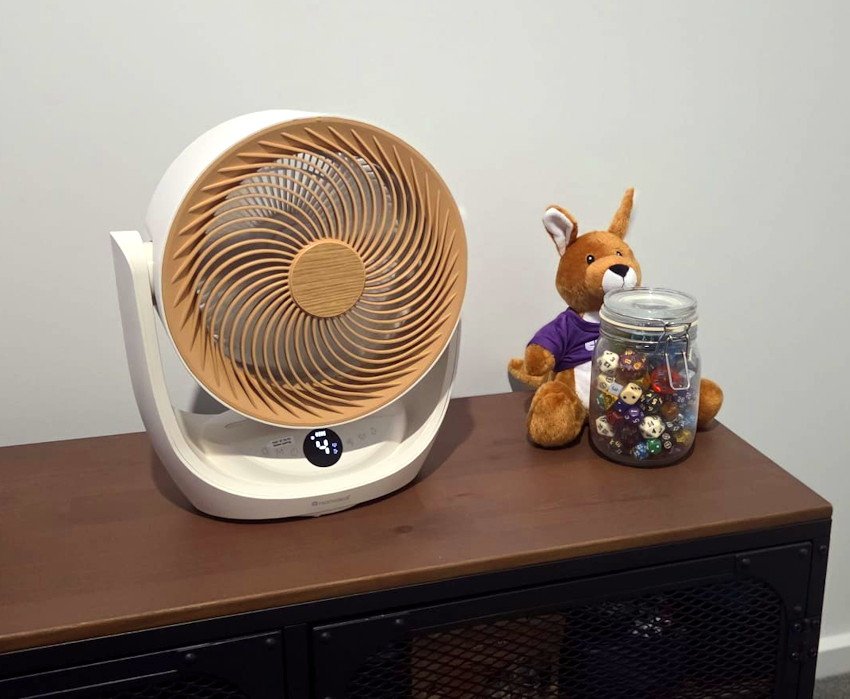
Wait… Nanoleaf Makes a Fan?
Yep. And Nanoleaf hasn’t simply slapped its logo onto a little USB desk fan and sent it out into the world. The Nanoleaf Smart Air Circulator Fan is designed as an actual air circulator, moving air around a room rather than blasting one unfortunate person directly in the face.
It has automatic horizontal and vertical oscillation, nine adjustable speeds and four different operating modes: Normal, Turbo, Natural and Sleep. Nanoleaf rates the maximum wind speed at 6.5 metres per second, with airflow reaching up to 33 metres. Turbo mode can push up to 13.51 cubic metres of air per minute. Those are impressive numbers.
They’re also fan specifications, which is something I never imagined I’d have opinions about. Yet here we are.
The thing is, you don’t really appreciate what those figures mean until you turn the fan on and realise it’s affecting far more than the space directly in front of it. Most cheap desk fans create a very specific zone of comfort. Move thirty centimetres to either side, and suddenly you’re back to negotiating with the laws of thermodynamics.
The Nanoleaf Smart Air Circulator Fan feels different. Instead of creating one privileged cooling seat, it works on moving air throughout the room. After a while, I found myself noticing the room felt more comfortable in general rather than constantly being aware of a fan pointing at me. That’s probably the whole point of an air circulator, but allow me this discovery. Up until now, my benchmark for airflow technology was whatever was available for six dollars and free shipping.
I also appreciate that Nanoleaf hasn’t tried to overcomplicate the basics. Nine speed settings sound excessive when you first hear it. My immediate reaction was, “Surely nobody needs nine levels of fan.” As it turns out, I was wrong again.
This review is becoming dangerous for my ego. The smaller adjustments are actually useful, particularly when you’re sitting at a desk for hours. Sometimes you want a gentle breeze. Sometimes Melbourne decides the forecast is merely a suggestion and you need the fan equivalent of emergency assistance.
Thankfully, the Nanoleaf Smart Air Circulator Fan caters for both situations. And possibly a few weather events in between.
It’s Surprisingly Nice Looking
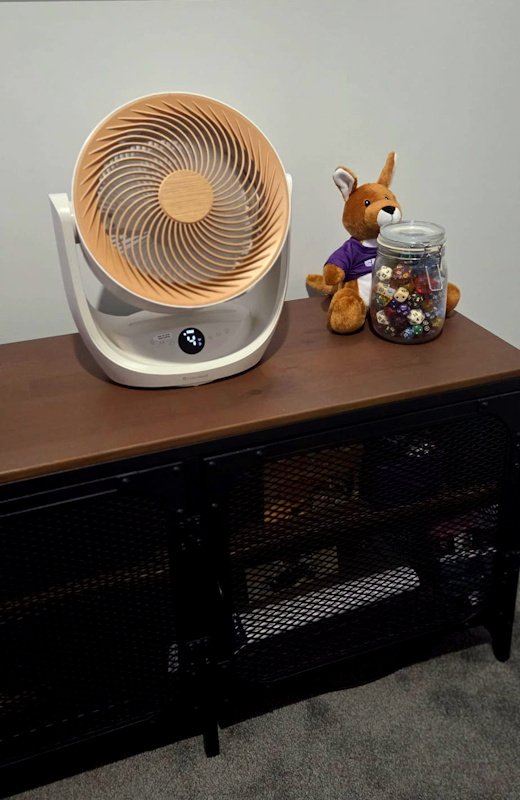
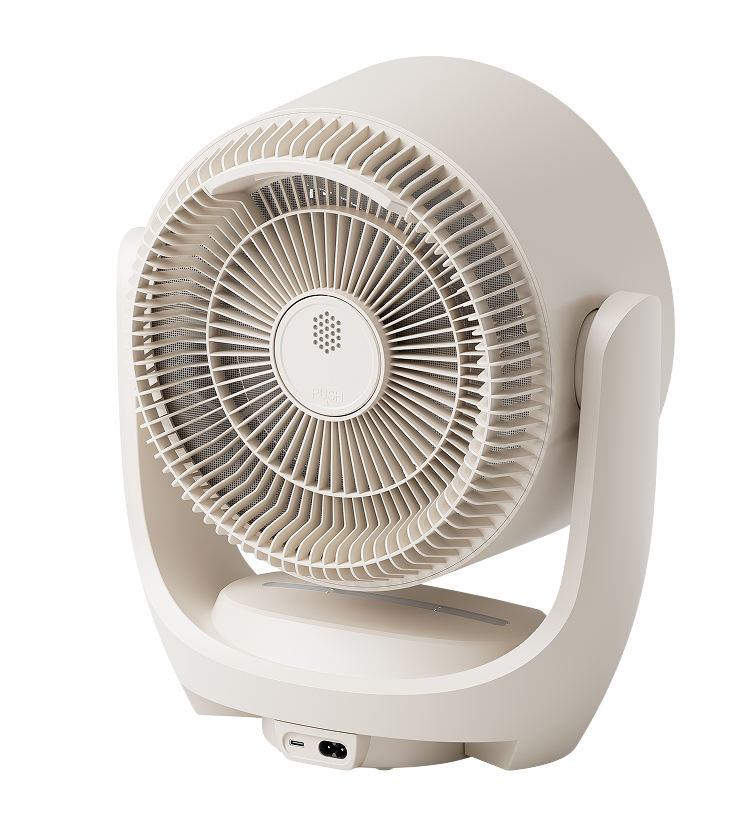
Fans tend to fall into two design categories. You’ve got the boring white pedestal fan that looks like it’s been sitting in Nan’s spare bedroom since 1997 (like the one in my bedroom), and then you’ve got increasingly elaborate bladeless things that look like they were stolen from a spaceship. The Nanoleaf Smart Air Circulator Fan sits somewhere comfortably between the two.
It’s fairly compact and understated, so putting it on a desk, on my filing cabinet or somewhere in the living room doesn’t suddenly make the room feel like you’ve installed industrial ventilation equipment. The cordless design helps here too. You’re not immediately hunting for the closest power point or draping another cable behind your desk.
And I appreciate that more than I expected. Moving it from room to room is a godsend. My desk already seems to generate cables spontaneously. I don’t know where they come from anymore. Adding one fewer permanent cable feels like progress.
What surprised me most, though, was how good the thing actually looks.
Now, whenever new tech arrives at the house, my housemate has developed a fairly predictable response. There’s usually a sigh. Occasionally an eye roll. Sometimes both. The general complaint is that I keep bringing home gadgets that look like gadgets. Apparently not everything needs RGB. Apparently not everything should resemble part of a gaming setup. Apparently there are people who enjoy calm, coordinated home décor.
Who knew?
The funny thing is that we actually agreed on the Nanoleaf Smart Air Circulator Fan. It’s available in both black and white, and if you’d asked me beforehand which one I’d prefer, I’d have confidently said black. I almost always gravitate towards darker peripherals and accessories. White hardware looks fantastic in photos, but I’ve never really been a white setup person.
Then Nanoleaf sent the white version. And now I get it.
The matte finish, minimalist controls and clean lines give it a genuinely premium feel. It looks modern without trying too hard, and the white colour somehow makes it blend into a room rather than stand out. I was fully prepared to spend this section explaining why I’d rather have the black model. Instead, I’m sitting here wondering if I’ve been wrong about white tech all these years.
That’s a slightly uncomfortable revelation, if I’m honest. I know “breathtaking” is a dramatic word to use for a fan. It’s a fan. Yet, it really is.
Even my housemate, who normally greets incoming review products with all the enthusiasm of somebody receiving another Amazon box full of cables, admitted it looked good. Honestly, that’s probably one of the strongest endorsements I can give it.
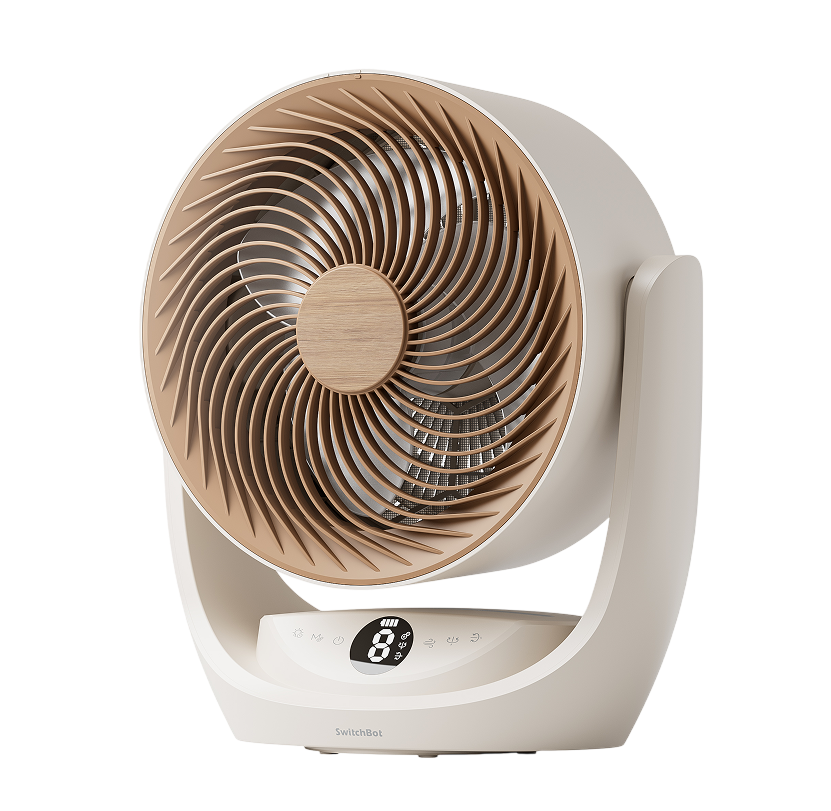 Cordless Is the Bit I Didn’t Know I Wanted
This is probably my favourite part. There’s a rechargeable battery built into the fan, and Nanoleaf claims up to 70 hours of battery life on its lowest setting. Obviously, start cranking things up and battery life will come down. Physics remains annoyingly undefeated.
But being able to pick the fan up and move it around without unplugging anything changes how useful it feels.
Desk getting warm? Move it there. Cooking in the kitchen? Bring it along. Bedroom feeling stuffy? Sitting outside? Fan… maybe I’m going a little too far there.
It’s the portability that makes the whole thing click for me. A regular fan tends to get put somewhere and then lives there forever. Being cordless removes that little bit of friction, so I’ve found myself thinking about where I actually want airflow instead of where there’s conveniently a power point. It also changes the sort of places you’d actually consider using it.
There’s a spot near our back door that turns into a heat trap during summer. Not enough to justify buying another fan for the area. Not somewhere I’d normally run an extension lead. But absolutely somewhere I’d appreciate not slowly melting. With the Nanoleaf Smart Air Circulator Fan, I can just put it there. Problem solved. The whole lounge/dinning room feels livable.
I think that’s what surprised me most. The battery isn’t the headline feature when you first look at the specifications. You notice the oscillation, the airflow range, the smart features and all the other fancy bits. Then you live with it for a week and realise the cordless design is quietly doing most of the heavy lifting.
The fan charges via USB-C too, which feels refreshingly sensible. Everything in my house seems to charge via USB-C these days, including several things that probably shouldn’t. Finding a compatible cable isn’t exactly a challenge. And because the battery is integrated into the design, the Nanoleaf Smart Air Circulator Fan still feels like a normal household appliance rather than some awkward portable gadget that’s making compromises to be cordless.
I wasn’t expecting the battery to be the feature I’d talk about most. Yet every time I move the fan somewhere new without thinking about cables, wall sockets or extension leads, it keeps proving me wrong… which seems to be happening a lot during this review.
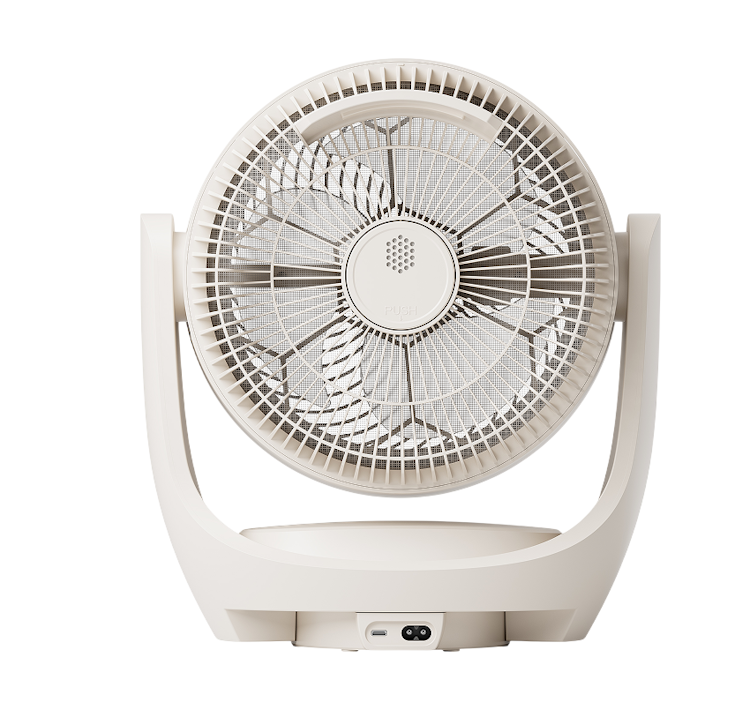
It Actually Moves Some Air
This thing can shift air. The key distinction here is that it’s a circulator, so the idea isn’t necessarily to point it directly at yourself and recreate the wind tunnel scene from every vaguely futuristic movie.
The horizontal and vertical oscillation means it can move air across a much wider section of the room. Nanoleaf says the airflow can reach up to 33 metres, and the design is intended to help keep air circulating throughout a space rather than focusing everything in one direction. That also makes it surprisingly useful alongside air conditioning.
Stick it somewhere sensible and you can use the fan to help push cooler air around the room rather than having one freezing corner while the other side remains approximately the temperature of the sun. In Melbourne, where summer occasionally decides to go from 22 degrees to welcome to hell in the space of a day, that sounds pretty useful.
There’s enough adjustment here that you don’t need to run it flat-out either. Nine fan speeds initially sounds excessive. I mean… nine? Apparently three wasn’t enough anymore.
In practice, though, I quite like having the finer control. What I found myself doing most often was settling somewhere around the middle of the range. Speeds one and two are great when you just want a bit of air moving through the room. Speeds four, five and six seem to be the sweet spot for everyday use. Then you get into the higher settings, and the Nanoleaf Smart Air Circulator Fan starts reminding you that it has a Turbo mode for a reason.
The vertical oscillation deserves a mention too. Most fans move left and right, and that’s generally where the innovation stops. Here, the fan can automatically tilt up and down as well, creating a much broader circulation pattern. It sounds like a small feature until you see it in action. Then you realise the fan is covering areas that traditional desk fans simply don’t reach.
I also noticed that rooms felt less stuffy after the fan had been running for a while. Not just cooler, but fresher. Air was moving around instead of sitting there doing absolutely nothing, which is apparently what I was doing too during some of the hotter afternoons.
And because the airflow is being circulated the room rather than fired directly at your face, it feels surprisingly comfortable over longer periods. I could happily have the Nanoleaf Smart Air Circulator Fan running beside my desk for an entire workday without eventually feeling like I’d spent six hours riding a motorcycle at highway speeds with my mouth open.
It feels effective without constantly reminding you that it’s being effective.
Normal, Natural, Sleep and TURBO
There are four modes.
Normal Mode is exactly what you’d expect. Pick a speed. Fan does fan things. No surprises. No learning curve. No AI-generated airflow recommendations based on your mood, calendar, or star sign. Just air. Honestly, there’s something refreshing about that.
Natural Mode varies the airflow to mimic a natural breeze, which sounds slightly silly written down, but I actually like it. The changing airflow feels less aggressive than having a constant stream of air hitting you. It’s one of those features I expected to use once, nod politely at, and never touch again.
Instead, it became one of my most-used settings. The subtle variation makes a bigger difference than I expected, particularly during longer work sessions. A constant breeze can eventually fade into the background, but it can also become strangely fatiguing after a few hours. Natural Mode feels, well… more natural. I realise that’s not exactly groundbreaking analysis. But sometimes the obvious explanation is the correct one.
Sleep Mode calms everything down and keeps things quiet. Considering the Nanoleaf Smart Air Circulator Fan can drop as low as 21dB, Sleep Mode makes a lot of sense for bedrooms or late-night use. You still get airflow, but without feeling like you’ve parked industrial cooling equipment beside the bed. Or, in my case, beside the pile of clothes that I swear is a chair.
Then there’s Turbo Mode. Turbo is for when Australian summer has kicked in the door and chosen violence. The fan’s Turbo Mode can push airflow up to a claimed 13.51 cubic metres per minute.
You’re probably not going to sit six inches in front of it while Turbo is running. Well. You can. I did. And I actually felt the wind through my hair… and being bald, that is impressive.
Turbo Mode also gave me a very important realisation. This fan does not have a “Ludicrous Speed” setting. Which is probably for the best. Because the moment I saw the word Turbo, my brain immediately went to Spaceballs. Somewhere deep inside me was a completely unreasonable desire to keep pressing buttons until the Nanoleaf Smart Air Circulator Fan launched itself across the room yelling, “They’ve gone to plaid!”
Thankfully, Nanoleaf’s engineers showed considerably more restraint than Mel Brooks.

What impressed me most is that the higher speed settings still feel useful rather than existing purely for marketing purposes. Plenty of fans have a maximum setting that feels like it was included simply so the box could contain a bigger number. The Nanoleaf Smart Air Circulator Fan’s Turbo mode genuinely moves a substantial amount of air.
Would I run it constantly? Probably not.
Would I be very grateful it exists on a 38-degree Melbourne afternoon when opening the front door feels like standing too close to a pizza oven? Absolutely.
Quiet Enough That It Doesn’t Annoy Me
This was one of my bigger concerns. A powerful fan is great until it sounds like you’ve parked a small aircraft beside the bed.
In Sleep Mode, Nanoleaf rates the fan as low as 21dB. It’s pleasantly quiet. There’s obviously still some sound because rotating blades moving air aren’t magic, but at the lower settings it fades into the background reasonably quickly.
That’s important if you’re using it beside a bed, during work, while gaming or while trying desperately to hear somebody in Discord explaining why the entire team wiping was apparently your fault. It wasn’t. Probably.
I’ve always been one of those people who likes falling asleep with a fan running. Partly for the airflow. Partly for the white noise. Partly because Melbourne weather enjoys playing dice with human comfort and I prefer to stack the odds slightly in my favour.
My housemate, meanwhile, is the complete opposite. She hates sleeping with a fan on. Not dislikes. Hates.
I’ve had fans in previous rooms where I’d deliberately turn them down before going to bed because she could still hear them from her room, and it drove her absolutely insane. The fan wasn’t even in her room. It was apparently committing crimes against her sleep schedule from a distance.
So when the Nanoleaf Smart Air Circulator Fan arrived, I already knew this was going to be the ultimate test of this so called quiet mode. And then something very unexpected happened. One slightly warm and stuffy evening, she stole it. Not borrowed. Stole.
I walked past and there it was, sitting in her room, happily circulating air as it had always lived there.
The next morning I asked how it went. Apparently she fell asleep almost immediately. Even more impressively, she woke up a few hours later, forgot the fan was running, and went straight back to sleep.
For somebody who normally treats fan noise like a personal attack, that’s about as glowing an endorsement as you’re likely to get. I was honestly more surprised by that than I was by some of the airflow figures. The fan eventually made its way back to my office.
But the fact that somebody who actively dislikes sleeping with fans ended up keeping the Nanoleaf Smart Air Circulator Fan beside the bed for the night says quite a lot. It’s now become the closest thing this review has to a scientific study.
Sample size: one reviewer and one highly fan-sceptical housemate.
Results: unexpectedly successful.
Peer review is ongoing.
More Useful Than I Expected
Putting “smart” in the name creates certain expectations these days. Thankfully, the Nanoleaf Smart Air Circulator Fan genuinely benefits from being connected.
Scheduling is the standout feature for me. Fans are exactly the sort of appliance that suit automation because most of us are fairly predictable creatures. We sleep at roughly the same time, work in roughly the same place, and inevitably complain about the weather in roughly the same way. Having the fan automatically start before a warm afternoon or switch to a quieter mode at night feels genuinely useful rather than technology desperately searching for a problem to solve.
There’s also an integrated warm-white nightlight rated at 3000K and 50 lumens. I didn’t exactly unbox the fan and think, “You know what this needs? Mood lighting.” But after using it for a while? Yeah, okay. It’s quite handy.
The bigger surprise, however, was how much I ended up using Natural Mode. I fully expected it to be one of those features I’d try once for review purposes before immediately returning to Normal Mode forever. Instead, it became my preferred setting during long days at the desk. It sounds like marketing nonsense right up until you try it. Then it actually makes sense. The airflow feels softer and less intrusive, especially over several hours. It feels less like I’m being attacked by weather. That’s about as scientific as I can make it.
The more I used the Nanoleaf Smart Air Circulator Fan, the more I realised cooling yourself is only part of the story, too. Because it’s designed as a circulator rather than a traditional desk fan, it can help move conditioned air around a room, reduce stuffiness and generally keep air flowing where it needs to be.
The laundry use case was the one that caught my attention. Living in Melbourne means drying clothes outside occasionally feels like gambling against a particularly spiteful weather deity. Put washing outside because it looks sunny? Immediate thunderstorm. It’s like Murphy’s law
The fan isn’t going to magically replace a dryer, obviously, but adding some airflow indoors certainly helps move things along. It’s one of those little benefits you don’t really think about when buying a fan, then end up appreciating once it’s there. Which, come to think of it, describes quite a lot of my experience with the Nanoleaf Smart Air Circulator Fan.
Is a Smart Fan Slightly Ridiculous?
Perhaps. I mean, it’s a fan. Humans successfully operated fans for a very long time before somebody decided they needed apps, scheduling, and wireless connectivity. But I think that’s also underselling what makes the Nanoleaf Smart Air Circulator Fan appealing.
The smart features aren’t really the thing I like most about it. What won me over was the combination of the rechargeable battery, the surprisingly quiet operation, the amount of airflow it can move, and the freedom to place it wherever it makes the most sense without worrying about cables or power points. The smart controls simply make all of that easier.
And that’s probably how smart-home products should work. Less “LOOK, IT CONNECTS TO THE INTERNET!” and more quietly improving something you’d already use every day. The scheduling is handy. The app works well. They’re useful additions, not the main attraction.
In fact, if Nanoleaf removed the smart features tomorrow and left everything else alone, I’d still like the fan. I’d just complain slightly more often when I had to get up and change the settings myself.
Although I won’t pretend I don’t enjoy telling people I have a smart fan. It’s one of those phrases that still sounds faintly ridiculous when you say it out loud.
We’re living in the future. A slightly breezier future. And, for once, I’m completely okay with that.
Final Thoughts
I genuinely didn’t expect to enjoy reviewing the Nanoleaf Smart Air Circulator Fan as much as I did. When it first arrived, I assumed this would be one of those products that does its job perfectly well but doesn’t leave much to talk about. It’s a fan, after all. There are only so many ways you can describe air being moved from one place to another before people start questioning your career choices.
Instead, the Nanoleaf Smart Air Circulator Fan kept finding ways to surprise me.
The airflow is genuinely impressive. The quiet operation makes it easy to live with. The smart features are useful without feeling forced. Natural Mode turned out to be something I actually used. Turbo Mode nearly convinced me I’d entered plaid speed. Even the built-in nightlight ended up being more practical than I expected. But if I’m being honest, the feature that won me over wasn’t any of those things.
It was the battery.
The cordless design completely changes how and where you use the fan. Rather than becoming another appliance that lives permanently in one corner of the house, it follows you wherever the heat happens to be winning. My office. The lounge room. The bedroom. That awkward spot near the back door and the couch that turns into a miniature version of the Australian outback every summer. It just works.
And that’s perhaps the biggest compliment I can give it. The Nanoleaf Smart Air Circulator Fan doesn’t feel like a gimmick, a novelty, or a smart-home experiment searching for a purpose. It feels like a genuinely useful household appliance that somebody put a surprising amount of thought into. It’s also the only fan I’ve ever reviewed.
Hopefully the last thing Work Mama Leigh was right about. Although, given her track record, I’m not particularly confident about that. So yes, Leigh. You were right. Again. Please enjoy this moment, because I’m only writing it once.




Recent Comments