
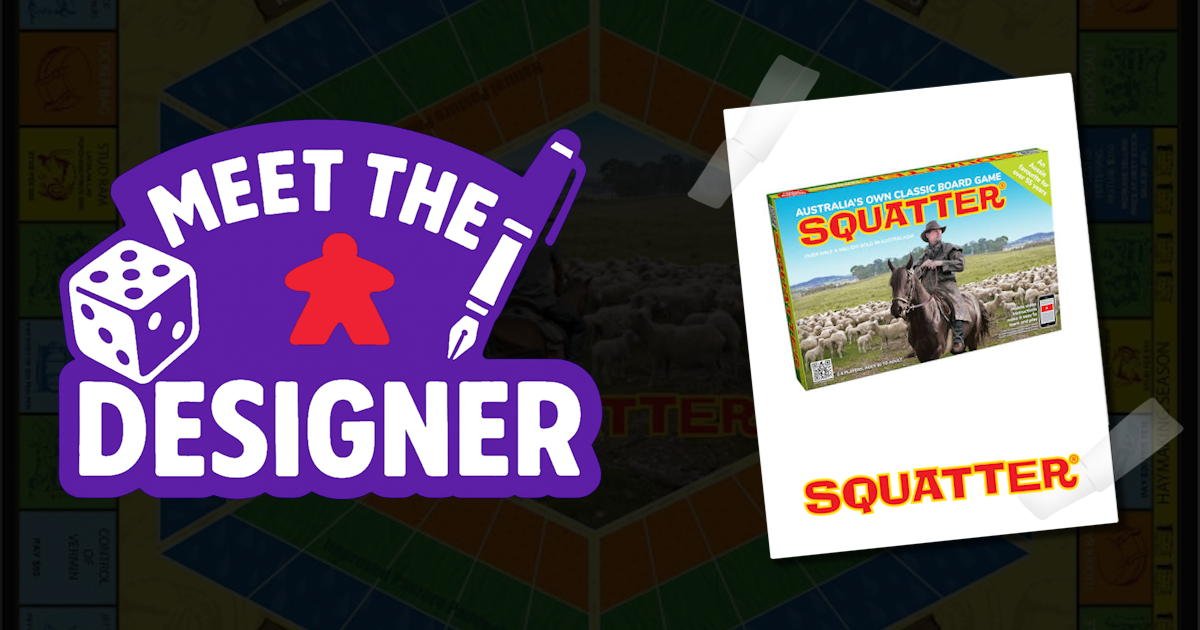
Robert (Bob) Crofton Lloyd invented Squatter, an iconic Australian board game originally launched at the Royal Melbourne Show in 1962. With over 500,000 games sold in Australia by 2007, it cemented its place as one of the most successful board games developed in the country.
The game places players in the shoes of sheep station owners, mirroring the economic highs and lows of the Australian wool industry through a mix of strategy, counting, and probability. Due to its deep cultural resonance, Squatter has been inducted into collections at the National Museum of Australia, the National Wool Museum, and the Australian Stockman’s Hall of Fame. Over six decades after its initial creation, game designer Cheryl Howard has partnered to revive and modernise the classic game for a new generation.
For many Australians, Squatter sits in that rare category of board games people remember seeing long before they ever played it. It occupied bookshelves, holiday houses, family game cupboards, and community halls for decades. Even people who couldn’t necessarily explain the rules often recognised the distinctive box art. That’s the sort of cultural footprint most modern games can only dream about.
Reviving something with that much history attached is no small task. There are expectations. Plenty of them. Long-time fans want the game they remember, while new players expect something that feels approachable and relevant in 2026. Finding the balance between preservation and modernisation feels like the sort of challenge that could either go brilliantly or become a very awkward conversation with nostalgic board game fans.
I caught up with Cheryl at PAX 2026 and had the chance to sit down with the new version of Squatter for myself. What immediately stood out was the genuine passion behind the project. This wasn’t a case of dusting off an old title and relying on nostalgia to do the heavy lifting. There was a clear respect for the game’s history, but also a willingness to make thoughtful changes where they made sense.
Of course, one question kept nagging at me throughout our conversation. Squatter is such a significant part of Australian gaming history that I couldn’t help wondering how someone even begins the process of bringing it back. Tracking down rights for a beloved game from 1962 sounded like an adventure in itself. As it turns out, the story behind the revival is nearly as fascinating as the game itself.
So I asked Cheryl the question I suspect many people would ask: How on earth do you get permission to revive one of Australia’s most iconic board games?
Ben: Alright. Well, I’m here with Cheryl Howard, who has some great news because she’s reviving the 1962 game, Squatter. It’s coming back—Squatter: A New Generation. So Cheryl, how on earth did you get the rights or the permission to redo Squatter?
Cheryl: A couple of years ago, I ran into the son of the original designer at a trade show. He was complaining about sales dropping and how it’s too hard, but mentioned they had a new game coming out and were marketing it there. I said, “Well, I’m a game designer; I can help you out with that.” And he went,“Oh, really? Excellent! Do you have a card?” So I gave him a card, and then heard nothing.
After six months of playing around with some ideas with my dad, who is now turning 90, he said,“Have you gotten in touch with that man again?” And I went, “No, I haven’t.” He said, “Well, write him an email.” So I wrote one, and he said, “Okay, what have you got?” I read it out to him, and he came over, peered at it, and went, “Oh, that’s good! All you have to do now is send it.” He didn’t realise that I had a touch screen on my laptop, so it sent prematurely. I said, “But Dad, I had spelling mistakes, I have to fix that!” Anyway, he said, “Too late, it’s gone.”
I didn’t hear anything until about two weeks before PAX that year, when he said, “Yes, we’d like to meet you. Come around for afternoon tea.” So I went around for afternoon tea, showed him some ideas, and he said, “Can you leave it with us over the weekend so we can work out how to play it?” I went, “Yeah, sure.” Sure enough, they couldn’t work out how to play it because it was built for game designers.
Some of my ideas were pretty tricky and cool; you slide things around, you do stuff, it’s like rearranging your calendar; but he couldn’t work it out. So he said, “You need to simplify this because we want it for a family dynamic.” And I went, “Okay.”
He asked, “Can you come around for an afternoon playing with some new ideas and stay for dinner?” So I went, “Yeah, I’m always up for a baked dinner, and I don’t need Tom Cruise at all.” That’s probably dating us.
Ben: Both of us know that, so you can know the era we’re from.
Cheryl: I ended up playing and experimenting with some new ideas that I’d fixed over the few days before I went to have dinner, and they said, “We like it. We really like this. This is really good. What do you want out of it?” I said, “My name on a box and a royalty.” And he went, “We can work with that.” We shook on it, and we’ve been working together over the last few years on it.
Ben: Excellent.
Cheryl: On Tuesday, I met with his marketer, media, distributor, and publisher person. He was on the fence about whether it would fit into the Squatter family. By the end of a two-hour discussion, we were shaking hands as best buddies, and he said, “Let’s move this forward.” So now, I’m just waiting for him to post it and progress from there.
Ben: So is it fully play-tested? Is it print-ready?
Cheryl: Yes, it has had over 200 play-testers with very few negative results—and the negative ones were only from the very beginning. We’ve streamlined everything now. A six-player game can be played within two hours.
Ben: Is it two to six players?
Cheryl: Two to six. The mechanisms are simple enough that you can teach them to your grandmother. My father is a great-grandfather, well, actually, a great-great-grandfather now. I’ve just become a great-grandmother too, so he gets an extra “great.” Anyone can learn how to play it: if you can choose between three things and make two decisions on a turn, that’s it.
Ben: How true is it to the original? What have you taken from the original to the new generation, or is it a complete rewrite where only the thematic elements remain?
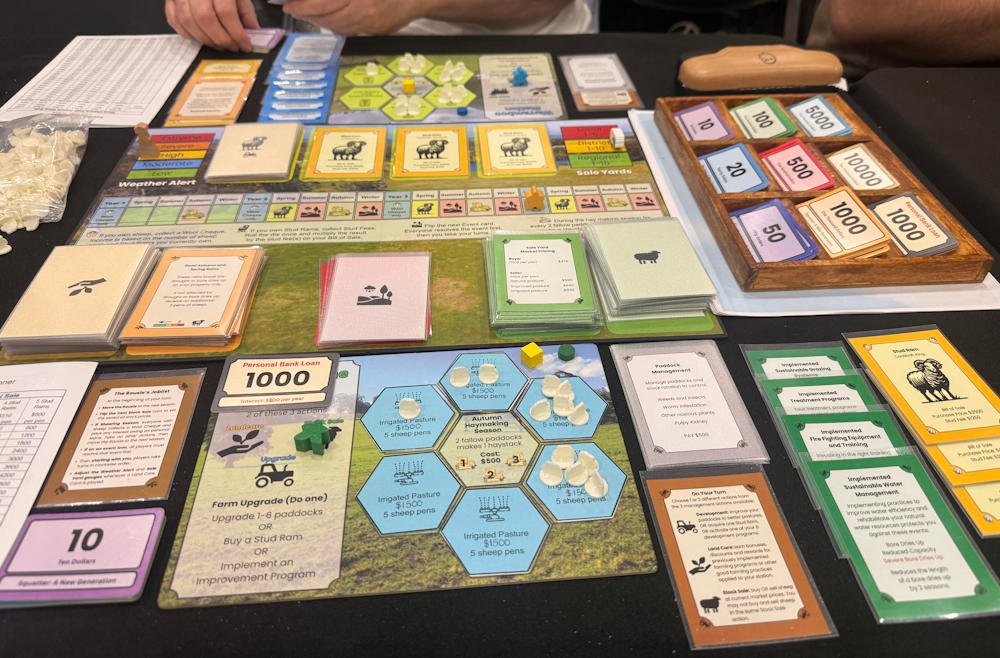
Cheryl: Everything that was in the original has been revised and improved, so all the original content is still there. However, we updated it to include modern farming practices, environmental issues, and organic pesticides. It also adds things like government grants, rebates, and other modern features.
The only major thing we took out is the roll-and-move around the outside that would drive you insane: the Monopoly-style mechanic. Chris and Richard hate it being referred to as Australian Monopoly because it’s better than Monopoly; even the original is better than Monopoly.
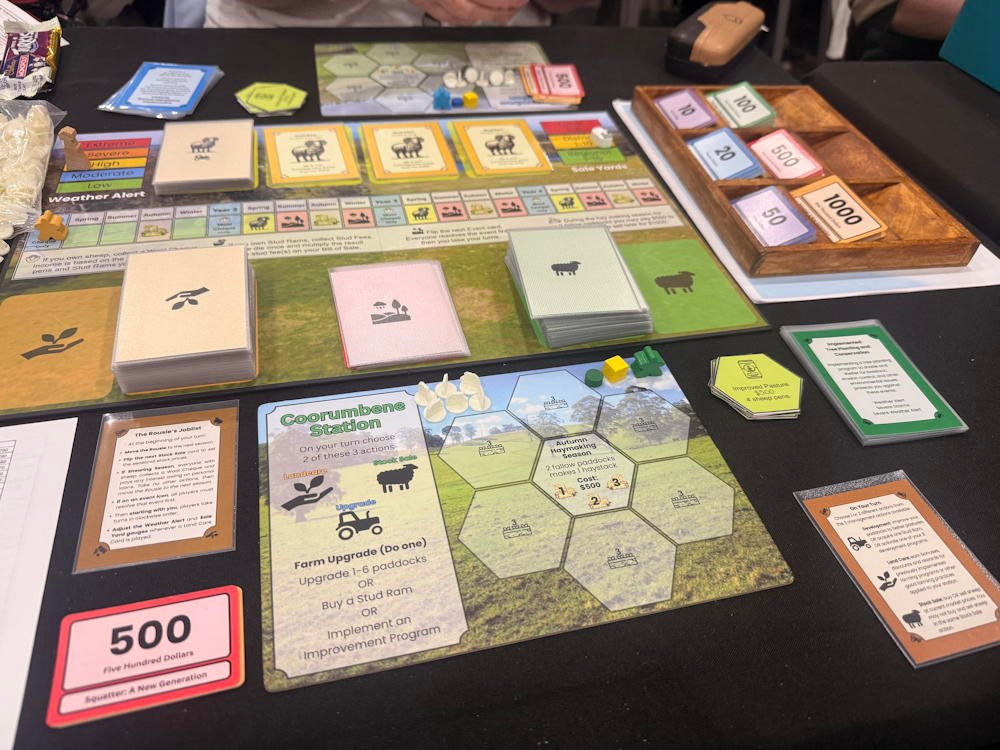
We took the roll-and-move out, so all the bad things that were on the board have been put into an event deck. There are only six of those that occur, but you don’t know what they are because they’re randomly selected each time. You develop your farm by implementing all the good things that were around the board into the decisions you make. You can choose when to invest in firefighting abilities, upgraded treatment programs, soil improvement, or erosion control. Those activities help negate or lessen the impact of events when they turn up.
Ben: Is that through a hand of cards?
Cheryl: Everybody has the same deck, and you can implement them in any order you wish. The Tucker bags are now landcare cards containing expanded new options. They only feature good things now; in the old Tucker bags, you would draw something like, “Oh, wild dogs killed many sheep, lose three sheep,” or a tax would arrive that only affected you. Now, events affect everyone unless you have prepared for them. If you have the firefighting equipment, you can mitigate the impact of a bushfire, for example.
Stock sales work similarly: you buy or sell, but now your landcare cards feature a weather gauge and yard capacity at the bottom of each card. Yard capacity impacts how many sheep you can buy or sell (e.g., 5, 10, or 15 pens), whereas the original allowed up to 15 at will. Now you have a limit. The weather gauge impacts how severe the events are: if the weather is extreme, you can expect the worst possible outcome; if it’s low, it’s still bad, but not as severe.
All the elements are woven together, so making a decision now impacts future events and alters your opponents’ ability to buy and sell sheep. Sometimes you flip a card, and it’s great for everyone else but bad for you, but that’s what life on a farm is like. The randomness comes from the cards, which you can’t fully predict, but you must be prepared for the worst-case scenario.
The end-game condition is the same: you have to have all your paddocks upgraded to irrigated pastures and fully stocked. Because you have six paddocks now instead of five, you have a limit of five pens of sheep per paddock. Someone triggers the end game; it’s not an automatic win, and then everyone else finishes their turn so all players get an equal number of turns.
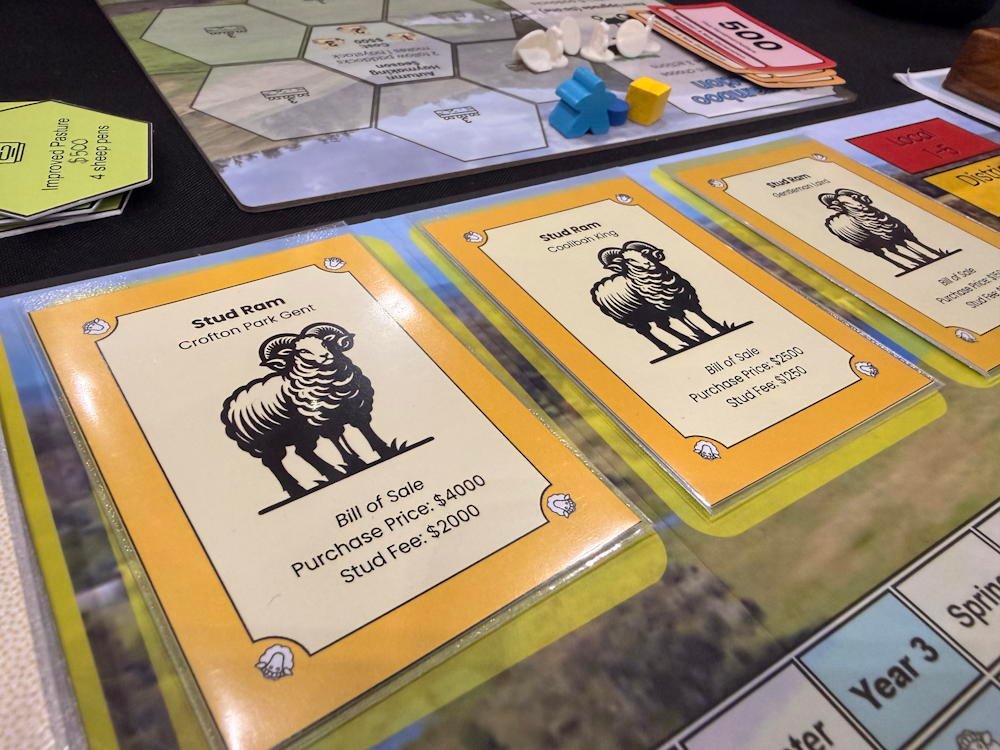
If three or four people reach the end condition, you go to a tie-breaker: stud rams. Stud rams provide a wool check that is now exponential (plus 50, 60, 70, 80, 90), meaning five stud rams can net you $600 a pen. They also provide a stud fee as a second stream of income every spring on the calendar. At the end of the game, the total value of your stud rams breaks ties, meaning whoever invested more money in their stud rams wins. That feels a lot fairer than someone winning just because they got their first, which is how my dad wins nearly all the time.
Ben: When do you think production will happen, in the next 12 months or less?
Cheryl: Yes, hopefully next year. We’ll have to convince Richard and Tony that a booth at PAX in 2027 is a good plan. I think it will be. If not, I’ll have it set up near the Tabletop Game Designers Australia (TGDA) stand, and I’ll be signing copies.
Ben: Looking to self-publish?
Cheryl: Tony has a manufacturer in mind and is getting a price to see if it’s viable. If not, he’ll look around. He has worked in the games industry for a long time, at Milton Bradley, John Sands, and Hasbro. He has a lot of experience and knows people, including being friends with the CEO of Asmodee. As soon as we lock down the publishing path, I’m just excited that it’s officially going ahead.
Ben: As you mentioned, it’s been called the Australian Monopoly, but it is the quintessential Australian game. Being 62 years old, it’s about time it got some new blood and a smaller box.
Cheryl: Feel the weight of that box. We still have the plastic sheep. One edition printed cardboard sheep and received so much backlash that they replaced them with plastic ones. I made the cards euro-sized simply because they are more durable than paper money, and people love the money cards. Even Richard was taken with them on the prototype. My dad even made me a little money tray that fits everything inside, and he made one for Richard too. Whenever we visit, we have a baked dinner and play a game of Squatter.
Ben: Thanks again, Cheryl. It’s awesome to see this coming together, and I look forward to next year.
Cheryl: I played 11 hours of Squatter yesterday and completely squatted out, but the biggest joy to my heart from the play-testers is that it still feels like Squatter, just without being quite so brutal. It’s modernised, but still retains that core feel. Every decision you make is your own choice, so you can’t blame the dice anymore.
Ben: Darn it! Thanks again; it’s always a pleasure catching up with you.



Recent Comments