
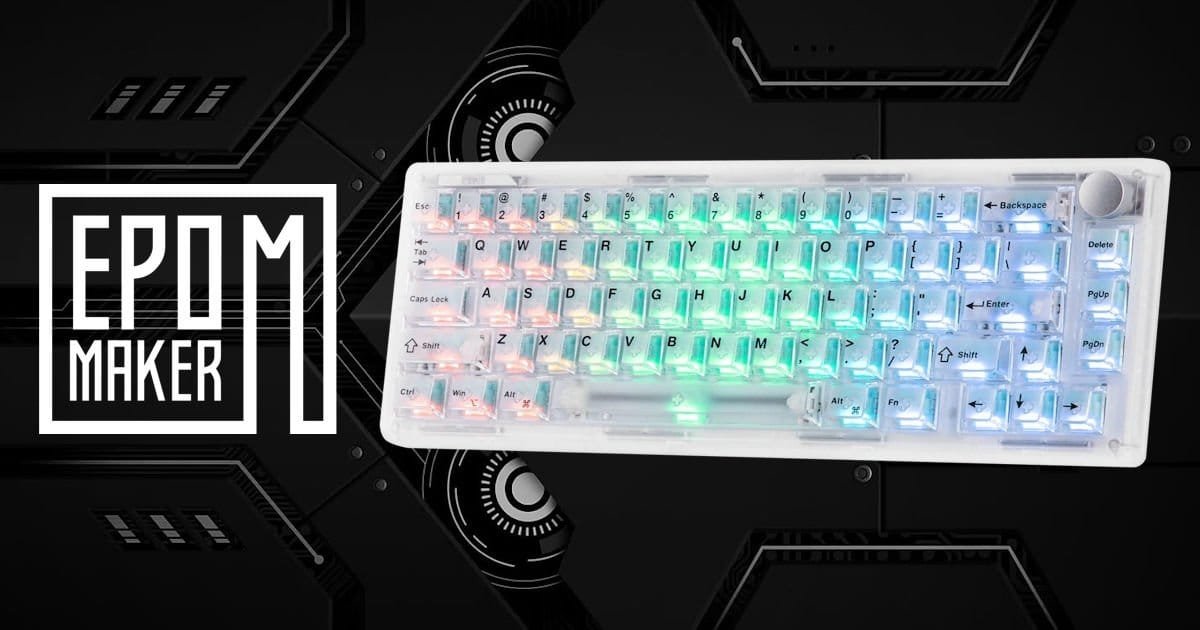
When I first sat down with the Epomaker HE75 V2, it felt like a bit of a turning point. Magnetic switches had been trying to shake off that thin, plasticky reputation for years, and the HE75 V2 finally made it feel like they’d crossed the line into proper enthusiast territory. The board had that full 75% layout, the function row, the volume knob, all the little conveniences that make a keyboard feel complete. What stuck with me was how unexpectedly rich it sounded. Not “good for a Hall Effect board,” just good, full stop. It was the first time I caught myself thinking that it actually belonged on my desk, not just in a review rotation.
The Epomaker HE65 V2 TMR,takes that same idea and trims it right down. It’s almost like Epomaker looked at the HE75 V2, nodded, and said they wanted to see how much of that experience they could keep while shrinking everything else. Moving to a 65% layout changes the vibe more than I expected. You lose the F‑row, sure, but you gain this clean, compact footprint that feels strangely liberating. I didn’t realise how often my mouse bumped into larger boards until the Epomaker HE65 V2 TMR gave me that extra bit of space back.
And the sound. I wasn’t prepared for how thick it would be. There’s a deep, rounded character to the Epomaker HE65 V2 TMR that doesn’t match its size at all. If anything, it feels like the board is punching above its weight, especially considering the $99 USD price tag. I remember pressing a few keys just to test the switches and pausing because it didn’t sound like a budget magnetic board. It had that satisfying density you usually only get from pricier customs, the kind that makes you type a little slower just to enjoy it.
It’s a leaner, tighter take on the same foundation, and I think that’s what makes it interesting. Epomaker didn’t reinvent anything here. They refined it, and somehow the Epomaker HE65 V2 TMR ends up feeling more focused because of it.
Design & Aesthetics: Clean Ice and Crystal Clapper
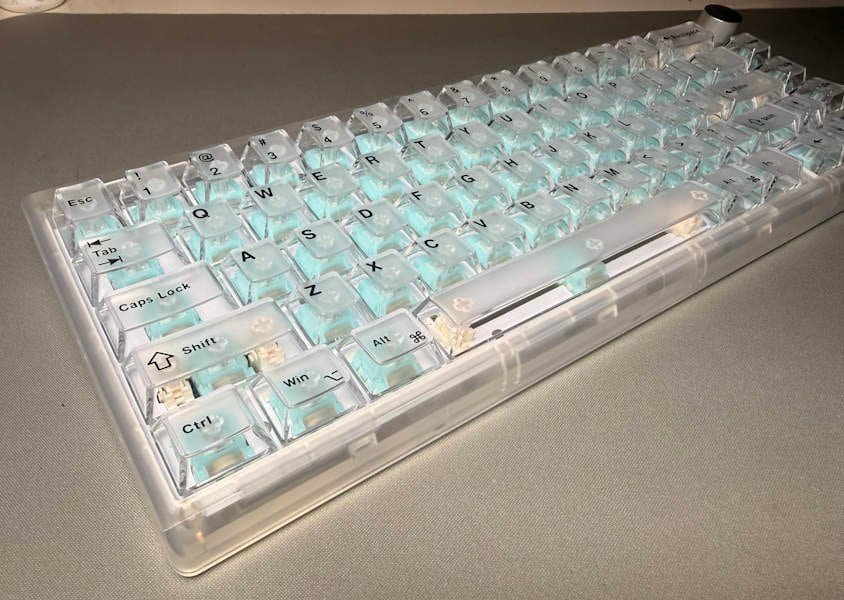
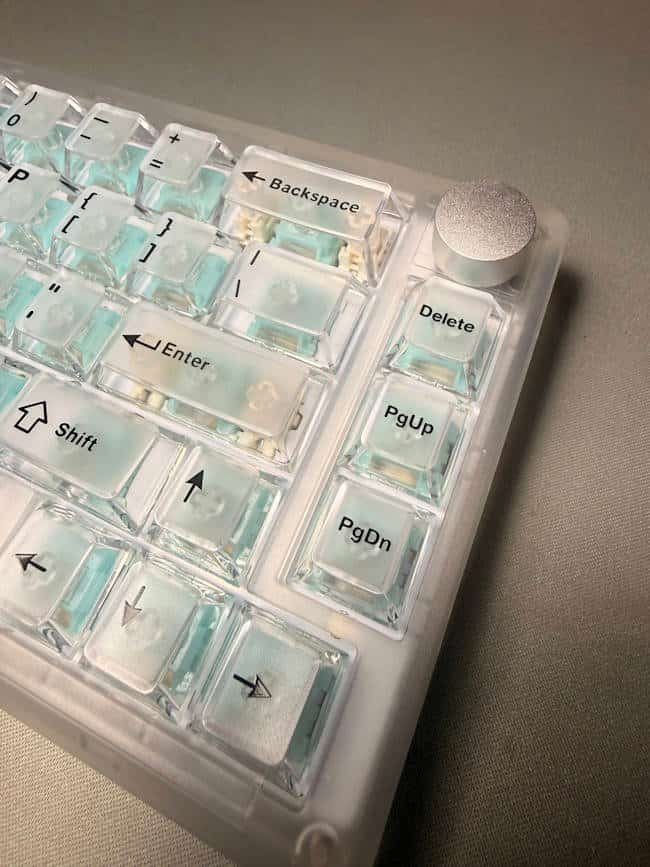
The first thing that struck me about the Epomaker HE65 V2 TMR was the colourway. The whole white and clear theme feels intentional, almost like Epomaker wanted this board to make a statement even before you press a single key. The frosted translucent shell has this soft, icy look that manages to show off the internal layers without tipping into that cheap, glossy plastic vibe some clear cases fall into. It’s subtle, but you can see the acoustic stack and PCB peeking through in a way that feels more like design than gimmick.
The ice‑blue translucent keycaps add to that impression. They have a cool tone that looks calm and understated when the RGB is off, almost like the board is resting. Then you power it on and everything shifts. The whole Epomaker HE65 V2 TMR lights up from within, and the case diffuses the glow so the colours feel like they’re floating rather than blasting straight into your eyes. I found myself toggling the lighting more often than usual just because the board looks different depending on the brightness and colour, almost like it has moods.
Part of that comes from the south‑facing RGB. It’s a small detail, but it makes a difference. The light doesn’t fight with the keycaps or get blocked by the legends, and instead it spreads through the case in a really clean way. I think that’s why the board looks more refined than you’d expect from something in this price range. The lighting feels integrated rather than slapped on.
There’s also the volume knob tucked neatly into the top corner. It’s compact, almost understated, but it’s one of those things you end up using constantly without thinking about it. I liked that Epomaker didn’t try to build a whole control deck around it. It’s just there, easy to reach, and it doesn’t interrupt the clean silhouette of the Epomaker HE65 V2 TMR.
The design leans into this frosted, crystalline theme that feels both playful and deliberate. It’s not trying to be flashy, but it still catches your eye. And once you start using it, the aesthetic becomes part of the experience rather than just something you notice in photos.
Switches, Feel, and Acoustic Architecture
What really shapes the personality of the Epomaker HE65 V2 TMR is its switch choice. Epomaker went with the Creamy Jade Magnetic Switches, and I think that decision carries more weight than it first appears. Early magnetic boards always had this slightly scratchy feel, almost like the switches were rushing to keep up with the technology inside them. The Creamy Jades feel different. They’re smoother, deeper, and surprisingly refined, almost as if they were designed to mimic the warmth and fullness of a custom mechanical build rather than the typical snappy, lightweight Hall Effect sound.
A lot of that comes down to the materials. The POM stem gives the switch this naturally lubricated glide that stays consistent even after hours of typing. I noticed it most when I slowed down and typed deliberately, just to feel the travel. There’s no gritty friction, no sudden change in texture. It’s just smooth, in a way that feels almost effortless. The polycarbonate top housing adds a crispness on the return stroke, and it also helps the RGB glow through the translucent keycaps in a soft, diffused way. It’s one of those small details you don’t think about until you see it working.
The bottom housing is nylon, and that’s where the deeper sound comes from. PA66 has this dense, slightly muted quality that rounds off the higher frequencies. When you bottom out a key, you get a thock instead of a clack, and it’s surprisingly satisfying. The long 20mm spring snaps the stem back up quickly, giving the switch a punchy rebound that feels great during fast typing or quick in‑game movements. I found myself appreciating that spring more than I expected, especially when doing rapid key repeats. It just feels decisive.
The force curve sits in a comfortable middle ground. The initial 30gf is light enough that your fingers glide across the board without effort, but the ramp up to 55gf at the bottom keeps things controlled. It prevents that harsh, finger‑slamming impact you sometimes get with lighter switches. It’s a balance that feels intentional, and it suits the Epomaker HE65 V2 TMR’s mix of gaming speed and everyday typing.
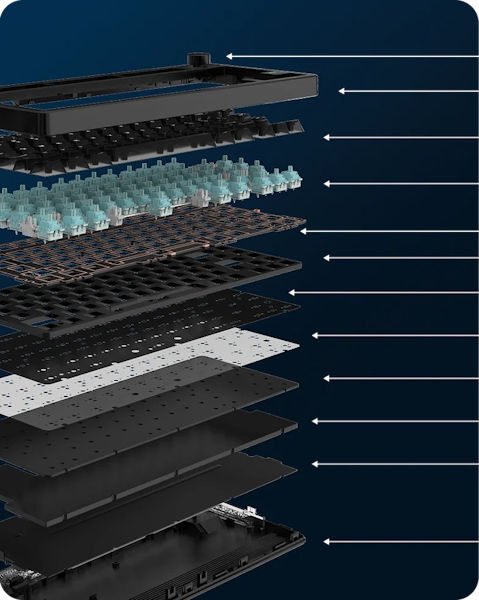
All of this comes together with the board’s internal acoustic design. Epomaker used a gasket-mounted PCB and layered in multiple forms of dampening, including plate foam, case foam, and IXPE switch pads. The result is a sound profile that feels unusually thick for a magnetic board. There’s no hollow echo, no sharp resonance bouncing around inside the case. Instead, each keypress lands with a cushioned, rounded tone that leans into lower mids. It’s quiet enough for late-night typing but still expressive enough to be enjoyable.
The overall feel is one of controlled depth. The Epomaker HE65 V2 TMR doesn’t try to be loud or flashy in its acoustics. It just feels tuned, almost like someone spent time listening and adjusting until the board sounded right. And honestly, that’s not something I expect from a $99 magnetic keyboard, which is probably why it stands out so much.
Switch Customisation: Hybrid Hot-Swap Versatility
One of the things that used to frustrate me about early magnetic keyboards was how locked‑in they felt. Once you bought into that ecosystem, you were basically stuck with whatever magnetic switches the manufacturer offered. If you wanted a different spring weight or a quieter sound profile, too bad. You had to accept the handful of options available and hope they suited your typing style. It made magnetic boards feel a bit experimental, almost like they were meant for people who didn’t mind sacrificing customisation for speed.
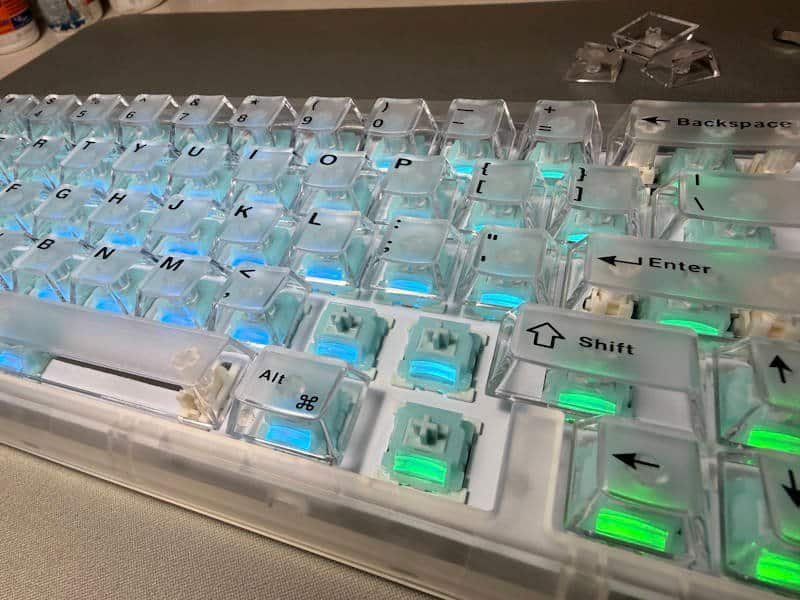
The Epomaker HE65 V2 TMR breaks that pattern completely. Its Hybrid Hot‑Swap PCB feels like a quiet but important shift in how magnetic keyboards can be designed. Instead of forcing you into one switch type, the board accepts both magnetic TMR switches and standard mechanical 3‑pin or 5‑pin MX‑style switches. It’s a small sentence to write, but a huge difference in practice. You can pull out a magnetic switch and drop in a tactile mechanical one without any adapters or awkward modding. The sockets just accept it, and the board behaves exactly as you’d expect.
I tried mixing switches just to see how it felt, and it was surprisingly intuitive. You can keep the magnetic switches on the keys where speed matters most, like WASD or Space, and then fill the alpha cluster with something quieter or more tactile for long writing sessions. It’s the kind of flexibility mechanical keyboard users have enjoyed for years, but now it’s available on a board built for rapid trigger and ultra‑fast actuation. The Epomaker HE65 V2 TMR doesn’t make you choose between gaming and typing. It lets you blend both worlds in a way that feels natural.
There’s also a nice bit of future‑proofing baked in. Preferences change. Maybe you’re deep into competitive shooters now, but a year from today you might be writing more, or you might simply want a different feel. With this board, you don’t have to replace the whole thing. You can convert the Epomaker HE65 V2 TMR into a full mechanical board just by swapping switches. It’s a small reassurance, but it makes the board feel like a longer‑term investment rather than a niche gaming tool.
And I appreciate that Epomaker didn’t cut corners with the hot‑swap design. Some budget boards only support 3‑pin switches, which means you have to clip the extra legs off 5‑pin switches with flush cutters. It’s not difficult, but it’s tedious, and it always feels a bit wrong to modify a brand‑new switch just to make it fit. The Epomaker HE65 V2 TMR includes proper guide holes for 5‑pin switches, so they slot in securely without wobble. It’s one of those details that doesn’t get much attention in marketing, but you notice it immediately when you start swapping things around.
Overall, the hybrid system makes the Epomaker HE65 V2 TMR feel more open and adaptable than most magnetic boards I’ve used. It doesn’t lock you into a single experience. It gives you room to experiment, adjust, and grow with the keyboard over time, which is something I didn’t expect from a board built around TMR technology.
The Acoustic Profile: Unusually Thick for Hall Effect
Historically, magnetic and Hall Effect boards suffered from thin, high-pitched bottom-out sounds due to the hollow cavity needed for magnetic stem travel. The HE65 V2 completely solves this issue.
By implementing a gasket-mounted architecture alongside a 5-layer acoustic dampening stack (including plate foam, case foam, and IXPE switch pads), the board eliminates internal echo. Paired with Epomaker’s factory-lubed Creamy Jade Magnetic Switches, the typing experience delivers a dense, low-frequency “thock” rather than a metallic click. Bottoming out feels cushioned yet crisp, making long writing sessions satisfying without fatiguing your fingertips or annoying anyone nearby.
What is TMR, and How Does It Compare to Standard Hall Effect?
The defining technical upgrade in this model is the shift to TMR (Tunnel Magnetoresistance) technology.
The Underlying Difference: Voltage vs. Resistance
To understand why TMR is being hailed as the next generation of magnetic input, you have to look at how the sensors read a keypress:
- Traditional Hall Effect (HE): Relies on a sensor measuring voltage changes created when a magnet in the switch stem moves closer to or further from the PCB.
- Tunnel Magnetoresistance (TMR): Uses quantum mechanical tunnelling to measure electrical resistance changes across an ultra-thin insulating layer as the magnetic field shifts.
Because measuring resistance changes at a microscopic level yields a far larger signal-to-noise ratio than measuring raw voltage output, TMR offers dramatically higher sensitivity without needing aggressive signal amplification.
Impact on Gaming: Unmatched Consistency & Fine-Grain Precision
While both Hall Effect and TMR boards allow features like Rapid Trigger (keys resetting the micro-second you lift up) and Dynamic Keystrokes (DKS), TMR elevates these capabilities in three critical areas:
1. Zero Jitter at Micro-Actuation Depths
Because traditional Hall Effect sensors produce a lower signal output when reading slight magnet movements, setting an aggressive actuation or reset point (e.g., ) can sometimes lead to misfires caused by subtle electronic noise or sensor heat.
- The TMR Advantage: TMR’s high signal-to-noise ratio means the controller gets a clean, crisp read even at ultra-shallow actuation depths (). In fast-paced FPS titles (like Valorant or CS2), this allows for instantaneous counter-strafing without the risk of ghost inputs or sensor drift during intense sessions.
2. Thermal Stability Under Heavy Loads
Hall Effect sensors are inherently susceptible to temperature changes. During long gaming marathons, as internal PCB heat builds up (especially with RGB lighting on full blast), HE sensor calibration can subtly drift, causing slight variations in actuation points over time.
- The TMR Advantage: TMR sensors are vastly more resistant to thermal drift, ensuring that your actuation distance and Rapid Trigger resetting points remain identical whether you’ve been playing for five minutes or five hours.
3. Off-Axis Sensing & Hybrid Switch Compatibility
Traditional HE sensors require the magnet to move strictly on a single linear Z-axis directly over the center of the sensor. TMR sensors can reliably detect multi-axis magnetic fields.
- The TMR Advantage: This off-axis sensitivity allows board makers like Epomaker to build Hybrid Hot-Swap PCBs. You aren’t locked exclusively to magnetic switches—if you ever want to swap in traditional 3-pin or 5-pin mechanical switches (like Cherry MX-style switches) on certain keys, the PCB architecture supports it.
Impact on Productivity & Writing: Efficiency, Battery, and Feel
While gaming often gets the spotlight for magnetic switches, the jump from HE to TMR delivers tangible perks for long-form typing and daily work routines:
1. Massive Wireless Battery Life Gains
The biggest vulnerability of wireless Hall Effect keyboards has always been power consumption. Continuous voltage sensing across dozens of HE sensors drains battery quickly, often forcing users to stay plugged in or suffer abbreviated wireless runtimes.
- The TMR Advantage: TMR sensors consume roughly 5 to 10 times less power than standard Hall Effect sensors. On a wireless 65% board like the HE65 V2 TMR, this means you can actually enjoy long, wireless productivity sessions—even with 2.4GHz high-polling modes active—without watching the 4000mAh battery drain before the end of the work week.
2. Custom Actuation Profiles for Typists
When writing thousands of words a day, key travel dynamic matters:
- Fatigue Reduction: You can set heavy-use alpha keys (like Space, Enter, or Backspace) to a deeper actuation point () to eliminate accidental taps, while keeping light modifiers at a shallower point ().
- Smoothness: Because TMR requires smaller, lighter internal magnets to achieve precise reads, the physical switch stem faces less magnetic resistance or uneven pull. The result is a buttery-smooth, fluid stroke across every keycap.
TMR vs. Traditional Hall Effect: Quick Summary
65% vs. 75%: Form Factor & Daily Utility
Why Choose 65% for Productivity & Writing?
For long-form writing, coding, and editorial work, the 65% layout is a focused sweet spot. By dropping the dedicated F-row, you bring your mouse significantly closer to your natural typing position, reducing shoulder strain during extended desk sessions. Dedicated physical arrow keys and navigation keys (Delete, Page Up/Down) remain intact, meaning you don’t lose key productivity shortcuts—there are simply no extra function keys cluttering your field of view or muscle memory.
Why Choose 65% for Gaming?
In fast-paced shooters or action titles, desk real estate is directly tied to aim accuracy. Trimming down to 65% grants massive extra sweep area for low-DPI mouse movements, ensuring your mouse never collides with the side of your keyboard during tight flicks.
How It Compares to the Epomaker HE65 V2 TMR
- Layout: The HE75 V2 retains the dedicated F1–F12 row and extra navigation column, making it ideal if your daily workflow constantly relies on software shortcuts or spreadsheet navigation. The HE65 V2 trades those physical keys for a smaller desk footprint and cleaner sightlines.
- Wireless Battery Efficiency: Thanks to the implementation of TMR sensors alongside a 4000mAh battery, the HE65 V2 offers better wireless efficiency than traditional HE implementations.
- Versatility: The HE65 V2 PCB features Hybrid Hot-Swap support, allowing you to swap between magnetic HE/TMR switches and traditional 3-pin/5-pin mechanical switches on the same board.
Final Verdict
After spending real time with the Epomaker HE65 V2 TMR, it’s hard not to see where it lands. It feels like one of those boards that quietly solves a handful of problems at once. You get the speed and precision that magnetic switches are known for, but you also get a typing experience that doesn’t feel compromised or overly specialised. It’s rare for a gaming‑focused board to sound this full or feel this comfortable during long writing sessions, and I kept noticing that balance every time I switched tasks.
If you enjoyed the HE75 V2 and wanted something a little tighter on the desk, the Epomaker HE65 V2 TMR fits that gap almost perfectly. The smaller footprint makes your setup feel cleaner, and the frosted clear aesthetic gives it a kind of understated personality that grows on you. The acoustics are deeper than you’d expect from a Hall Effect board, and the hybrid hot‑swap support means you can shape the feel however you like without being boxed in by magnetic switch limitations.
It’s not trying to be a flagship custom, and it doesn’t need to. It’s a board that delivers strong gaming performance, genuinely pleasant acoustics, and a design that feels considered rather than flashy. For anyone who wants speed without sacrificing sound or comfort, the Epomaker HE65 V2 TMR ends up being an easy recommendation. It just gets a lot right.


One Comment
[…] Lineup (HE75 V2 TMR & HE65 V2 TMR): Built with TMR sensing technology, allowing gamers to mix and match both magnetic and standard […]
Comments are closed.