
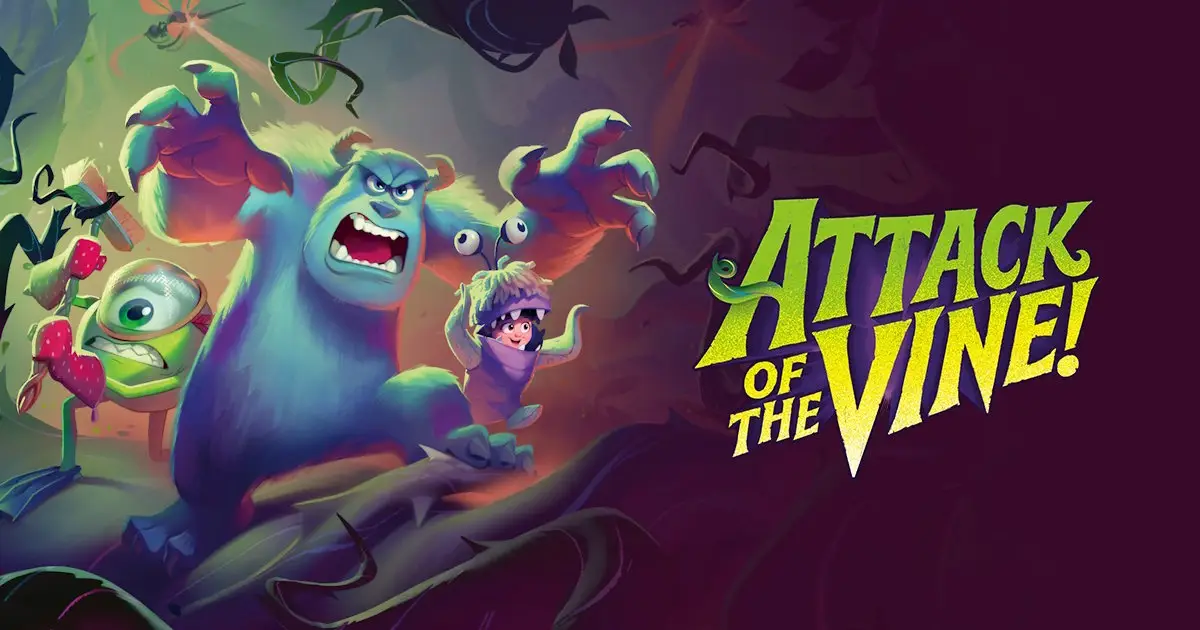
I’ll be honest. I’ve been waiting for this set for ages.
Not because of Monsters, Inc. Not because of the return of dual-ink cards. Not even because Pixar keeps getting more deeply woven into Lorcana. Those are still things to be excited about. Yet, I’ve been obsessed with the Vine ever since it started quietly creeping through card artwork and story beats several sets ago. Every time a new set arrived, I’d find myself scanning backgrounds looking for more signs of it or hoping this will be the set we learn more about it.
Now it’s finally here.
And somehow, after all that build-up, Disney Lorcana: Attack of the Vine! still managed to exceed my expectations.
What’s Available in Disney Lorcana: Attack of the Vine!
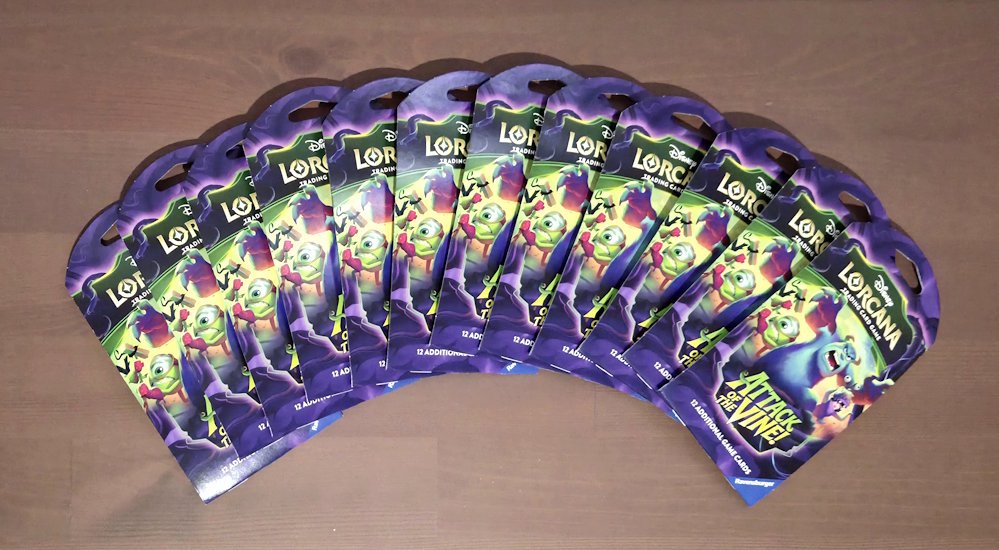
- Booster Packs & Booster Boxes
- Illumineer’s Trove – Attack of the Vine! The premium collector’s box. Includes boosters, lore trackers, deck‑building accessories, and themed storage. My personal pick for every set. I love the Troves
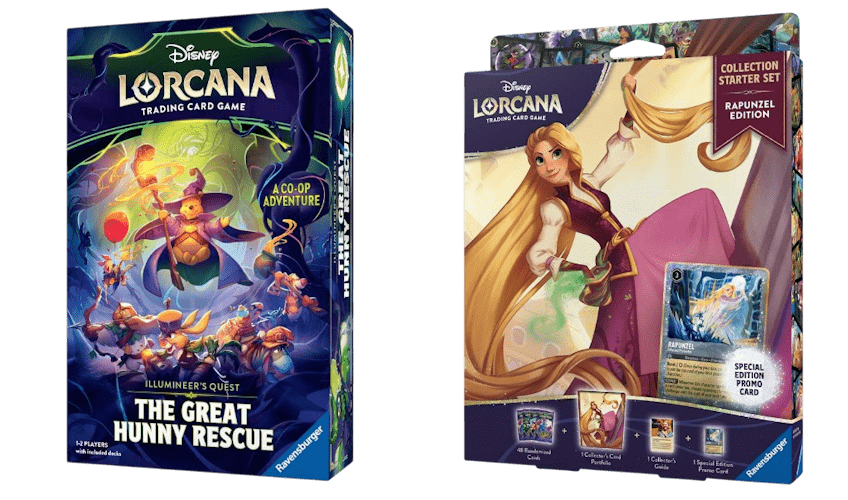
- Disney Lorcana Attack of the Vine! Illumineer’s Quest: The Great Hunny Rescue – is part of the Attack of the Vine! product lineup. And it’s a big one, because it’s the set’s solo/co‑op adventure box, similar to Deep Trouble from Shimmering Skies.
- Gift Set A mid‑tier product featuring oversized foil cards, playable cards, and booster packs. Attack of the Vine! continues the tradition with a Vine‑themed gift set.
- Playmats & Accessories Official themed playmats and small accessories (like deck boxes or sleeves) tied to the set’s artwork and characters.
A Storyline Years in the Making
It’s almost strange how natural the progression feels when you look back. The Vine didn’t crash into the story with a big announcement or appear suddenly and awkwardly from no where. It crept in, almost shyly, until it was impossible to ignore. That slow burn gave players time to speculate, to argue over theories, to notice tiny details that might have been overlooked otherwise. In a way, the community helped nurture the mystery, and that made the eventual reveal feel more personal. Like we’d all been part of the discovery.
I think that’s why the payoff lands so well. It’s not just a new villain dropped into the mix—it’s a culmination of years of quiet storytelling. The Vine has roots, literally and figuratively, in the game’s history. That makes it feel heavier, more consequential, than if it had just appeared overnight.
And there’s something refreshing about that. Trading card games often lean on spectacle, big mechanics, flashy crossovers, sudden twists. Lorcana chose patience instead. It let the Vine grow (get it, grow?) in the margins until the margins became the page. That’s a bold choice, and honestly, it makes me trust the direction of the game more. If they can weave this kind of long‑form narrative, what else might be waiting in the background right now?
Of course, there’s still mystery. We know more about the Vine, but not everything. Its motives, its limits, even its origin, those remain hazy. And maybe that’s intentional. A good villain doesn’t reveal all its cards (get it, Disney Lorcana, Trading Card game? Ok, I’ll stop now) at once. It keeps you guessing, keeps you uneasy. The Vine does exactly that. It feels alive, unpredictable, and just dangerous enough to make the world of Lorcana feel fragile.
That’s why I keep coming back to the idea of “Lorcana lore.” Disney characters will always be the heart of the game, but the Vine proves the world can stand on its own. It’s not borrowed mythology, it’s original, and it’s growing. And I think, perhaps, that’s the most exciting part.
The Set’s Atmosphere Is Fantastic
What struck me first was how cohesive it all feels. The corruption isn’t just in the card art, it seeps into the packaging, the colour palette, even the way the set presents itself. There’s this sense that the Vine isn’t confined to the story; it’s bleeding into the physical product, which makes opening a booster pack feel like stepping into a world that’s already under siege.
Some of the Vineling designs are genuinely unsettling. Not in a grotesque way, but in that uncanny space where something familiar has been twisted just enough to feel wrong. A smile that’s too sharp, a posture that’s slightly off. It’s the kind of detail that makes you pause for a second before realising, oh, that’s intentional. And I think those moments stick with you more than the big, flashy reveals.
The contrast is what makes it work. Disney characters are usually safe, comforting presences. Seeing them tangled up in vines, reshaped into something hostile, creates a tension that lingers. It’s almost like watching a fairytale slowly tilt into a nightmare. Not a full descent; there’s still charm, still light… but enough shadow to make you wonder how far things could go.
I found myself imagining the set as a kind of stage play. The familiar cast enters, but the scenery has changed. The walls are cracked, the floor is overgrown, and suddenly every line they deliver feels heavier because the world around them is collapsing. That atmosphere doesn’t just decorate the cards—it shapes how you experience them.
And maybe that’s why this set feels so distinctive. It’s not just about new mechanics or franchises. It’s about mood. About creating a space where the game feels alive, threatened, and strangely beautiful all at once.
New Disney Characters Continue to Impress
What’s striking is how different each of these Pixar additions feels, yet they all manage to slot into the Vine storyline without feeling forced. Monsters, Inc. is the obvious standout. Sulley, Boo, Mike; these characters already thrive on the tension between fear and friendship, so throwing them against a supernatural plant that feeds on glimmers feels oddly fitting. The mechanics lean into that too, with cards that reward scaring and teamwork in ways that feel both thematic and practical. It’s almost comical when you say it out loud and feels like one of those horrible cheap CGI films from SyFy Channel: monsters versus vines, but in play, it clicks and it couldn’t be more perfect for this set.
Up brings a completely different energy. Carl, Russell, Dug, and Kevin aren’t fighters in the traditional sense, but their cards lean into exploration, adventure, and discovery. That’s refreshing in a set where so much of the atmosphere is heavy and corrupted. The Up cards almost act like a breath of air, reminding you that Lorcana isn’t just about battling threats; it’s also about journeys, companionship, and the strange places you end up along the way. I found myself smiling at the flavour text more than once, which isn’t something I usually notice, or care to read.
Turning Red was the surprise. At first glance, I didn’t think those cards would matter much competitively or thematically. But the more I looked, the more I realised how clever the designs are. Mei and her friends, plus 4Town, bring a social, almost celebratory dynamic into the set. The mechanics emphasise bonds, group synergy, and emotional energy, which feels very different from the usual combat‑driven strategies. It’s playful, but not shallow. In fact, I suspect some of those friend‑focused cards will end up being sleeper hits in decks that thrive on synergy and incremental value.
Together, these franchises expand Lorcana’s tone in ways I didn’t expect. Monsters, Inc. adds tension. Up adds warmth and adventure. Turning Red adds joy and connection. And all of them, somehow, still feel like they belong in a world being strangled by vines. That’s not easy to pull off, but it makes the set feel richer, more layered, and more alive.
The Return of Dual-Ink Cards Changes Everything
The thing about dual‑ink cards is that they don’t just add flexibility; they force creativity. You can’t simply jam them into any deck and expect results; trust me, I know. I’ve tried several times. They demand a plan. A commitment. And that’s what makes them so rewarding when they work. You feel like you’ve built something intentional rather than just a pile of strong cards.
In past sets, dual‑ink cards often ended up defining entire archetypes. They gave players reasons to explore combinations that might otherwise have been overlooked. Disney Lorcana: Attack of the Vine! takes that idea further by offering a spread across every ink pairing. That’s huge. It means no colour combination is left behind, and suddenly the deck‑building space feels wide open again. I can’t wait to see what happens to the meta moving forward and how people break the game open.
Of course, that also means the early weeks of the format are going to be chaotic, and I love it. Brewers will be testing everything, aggressive builds that lean on efficient dual‑ink curves, control decks that stretch into unexpected colours, synergy decks that finally get the support they’ve been waiting for. Some of those experiments will fail spectacularly, more than likely whichever one I pick… so maybe don’t play aggro. Others will quietly become the backbone of the meta months down the line.
And that’s the fun part. Dual‑ink cards don’t just change what’s possible; they change how players think. They encourage risk, reward boldness, and punish laziness. I can already imagine the debates: which pairings are strongest, which archetypes survive, which ones collapse under the weight of too many options. It’s messy, but in the best way. It the reason why I love pre-releases and the start of a new set. It is so unknown, and then you add in dual-inks and the unknown is unknown-i-er… You get what I mean! lol
That’s why their return feels so important. They don’t just add power. They add identity. They make decks feel distinct again. And in a game that thrives on variety, that might be the single most valuable thing Disney Lorcana: Attack of the Vine! brings to the table.
The New Team Characters Look Amazing
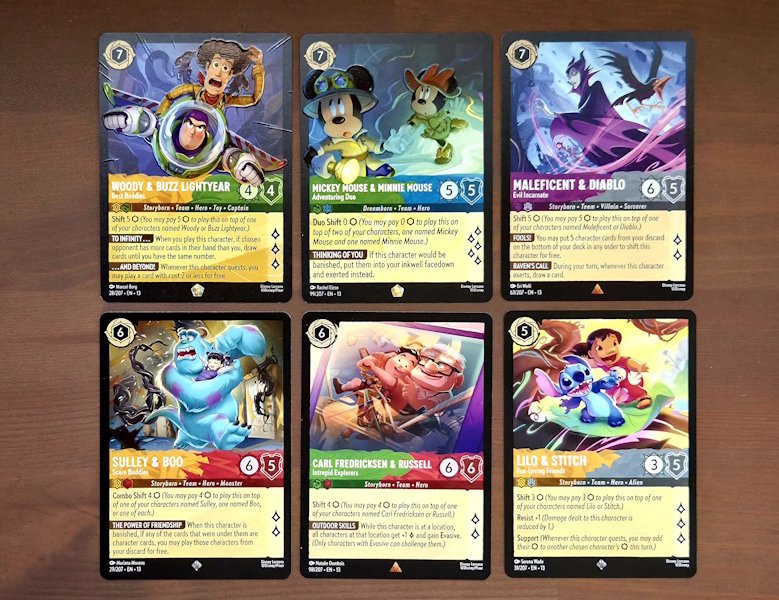
What makes the Team mechanic stand out is how it changes the way you think about risk and reward. Combining two characters into one unit isn’t just a flashy gimmick, or it doesn’t feel like that yet, it forces you to weigh commitment against vulnerability. Sulley & Boo are the obvious showcase, but they’re not alone. Dash & Violet, Carl & Russell, even smaller pairings all push you to ask: how much are you willing to stack under a single card? And what happens if it all comes crashing down?
That tension is fascinating because it creates drama. You’re not just playing numbers on a board, you’re building something that feels fragile and powerful at the same time. Trading card games thrive on those moments where a single decision feels monumental, and Team cards deliver exactly that. They turn ordinary plays into stories.
I can already picture the scenarios. A player carefully layers Combo Shift interactions, watching their Team grow into an unstoppable force. The table gets quiet. Everyone knows what’s coming. And then… one removal card. Suddenly the whole plan collapses, and the mood flips from triumph to disbelief. Those are the kinds of swings people remember long after the match ends.
What excites me most is that Team cards aren’t just mechanically interesting, they’re thematic too. Sulley & Boo working together, Dash & Violet combining their powers, Carl & Russell sharing an adventure. These aren’t arbitrary pairings; they make sense in the world of Lorcana. That blend of flavour and gameplay is rare, and it makes the mechanic feel like more than just another experiment.
And maybe that’s why I think Team cards could end up defining the set. They’re risky, they’re rewarding, and they’re memorable. In a game built on moments, that’s exactly what you want.
Top Cards I’m Most Excited About
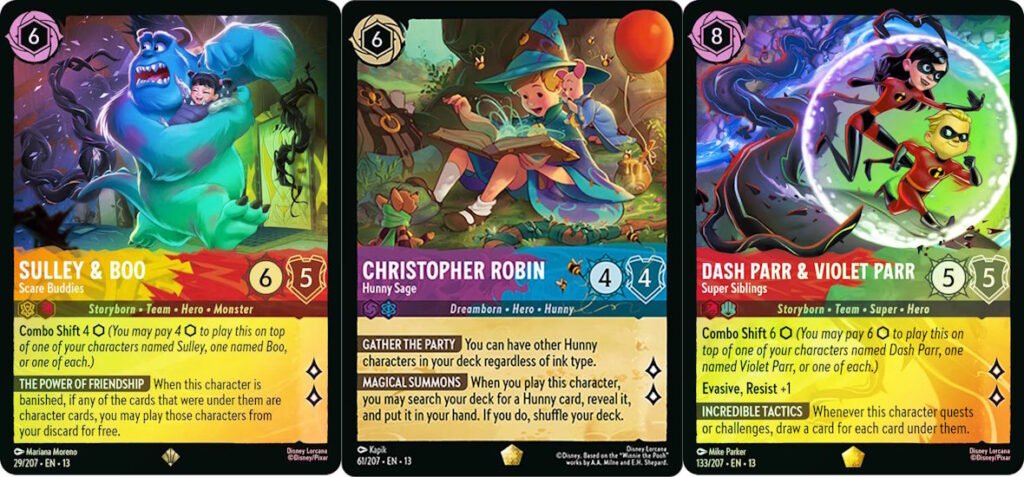
- Sulley & Boo – Scare Buddies – The poster child of the set. The Combo Shift design is clever, thematic, and feels genuinely different from previous Shift cards. When a card manages to be mechanically interesting and flavourful at the same time, that’s usually a good sign.
- The Vineling Characters – The Vine-created versions of existing characters might end up being some of the most important cards in the set. Not only do they tell the story, but many of them appear designed to support broader Floodborn-focused strategies as well.
- Christopher Robin – Hunny Sage – The Hunny archetype finally feels like a real deck rather than a collection of loosely connected cards. Christopher Robin provides the type of support card tribal strategies usually need to become competitive. As someone who loves theme decks far more than I probably should, I’m very happy about that.
- Dash & Violet Parr – The Team mechanic feels especially powerful on cards that generate additional value through questing and challenging. Dash & Violet look like they could become a staple in decks built around Combo Shift synergies.
What It Adds to the Meta
What excites me most about Disney Lorcana: Attack of the Vine! is how unpredictable it feels. For the last few formats, you could almost sketch out the top decks before a major event even happened. Sure, there were always small surprises, but the core strategies were familiar. This set shakes that up in a way that feels deliberate.
Dual‑ink cards alone would have been enough to stir things. They open up combinations that haven’t been viable for months, maybe ever. Add in Team characters, which force players to rethink how they balance risk and reward, and suddenly deck construction feels less like following a solved formula and more like genuine exploration again.
Then there’s Hunny. For ages, that archetype felt like a fun side project, something you’d play casually but never expect to see at the top tables. Now, with Christopher Robin and other support, it looks like a real contender. Floodborn strategies get a boost too, which means players who’ve been tinkering with those synergies finally have more tools to work with.
And we can’t ignore the Pixar additions. New franchises don’t just add flavour, they add mechanics, archetypes, and unexpected synergies. Monsters, Inc. brings fear‑based interactions, Up leans into adventure and exploration, Turning Red adds social dynamics. Each one nudges the meta in a slightly different direction.
Put all of that together, and you’ve got a format that feels wide open. Competitive players will, of course, rush to identify the strongest deck. That’s inevitable. But the real test will be what survives after the dust settles. Six months from now, when the hype has cooled, I suspect we’ll see strange, creative decks emerging from the margins, builds that nobody expected, but that thrive because the set gave them room to exist.
And honestly, those are the decks I’m most curious about. The ones that don’t win immediately, but endure. The ones that prove variety isn’t just a temporary shake‑up, it’s the foundation of a healthier meta.
Final Thoughts
Disney Lorcana: Attack of the Vine! feels significant.
Not because it has the strongest cards ever printed. Not because it introduces a hundred new mechanics. In fact, the set shows a fair amount of restraint. Many of the new ideas build naturally from mechanics that players already understand. The set feels important because it pays off years of storytelling.
The Vine has gone from background decoration to genuine threat. Lorcana’s original lore finally takes centre stage. Pixar continues to expand the game’s universe. Established mechanics evolve without becoming overwhelming.
And perhaps most importantly, the set feels exciting.
I’ve spent months wondering what the Vine would eventually become. Looking at every teaser. Reading every reveal article. Overthinking card art like it was some kind of conspiracy board.
Getting to crack open a few packs early, thanks to Ravensburger for sending them my way, only amplified that feeling. It was enough to wet my whistle, to get a sense of how the set plays in hand, even if I didn’t pull any enchanted cards… again. That little ritual of opening boosters, hoping for something rare, and still finding yourself grinning at the commons and uncommons because they carry the atmosphere so well- that’s part of the magic.
Now it’s here. And honestly? I already want to open another booster pack… or 20. That probably tells you everything you need to know.



Recent Comments