
The stealth genre has languished in a peculiar state for the past decade. It never disappeared, but it did soften. Somewhere along the way, the slow, deliberate tension of classic infiltration gave way to stealth‑lite systems: hide in convenient foliage, trigger an all‑seeing vision mode, follow glowing outlines like you’re ticking boxes off a checklist. It works, I guess. It’s accessible. But it rarely feels earned. I’ve played a lot of modern stealth games where I’m technically hidden, yet mentally checked out.
Enter Ereban: Shadow Legacy, finally making its way onto the Xbox ecosystem. And almost immediately, it feels different. This isn’t a game that politely asks you to crouch and wait for a bar to drain. It pushes you to think differently, to move differently. It doesn’t want you hovering at the edge of light cones. It wants you swallowed by them. This title doesn’t simply ask you to remain hidden; it demands you become the very darkness.
There’s confidence in that design choice. Stylish, kinetic, and quietly demanding, Ereban feels like a love letter to the Splinter Cell era, but it doesn’t chase nostalgia directly. Instead, it reimagines that philosophy through a sci‑fi mystical lens, blending precision with fluidity in a way that feels purposeful rather than retro. It’s the kind of stealth game that assumes you want to engage, not just comply.
The Art of the Shadow Merge
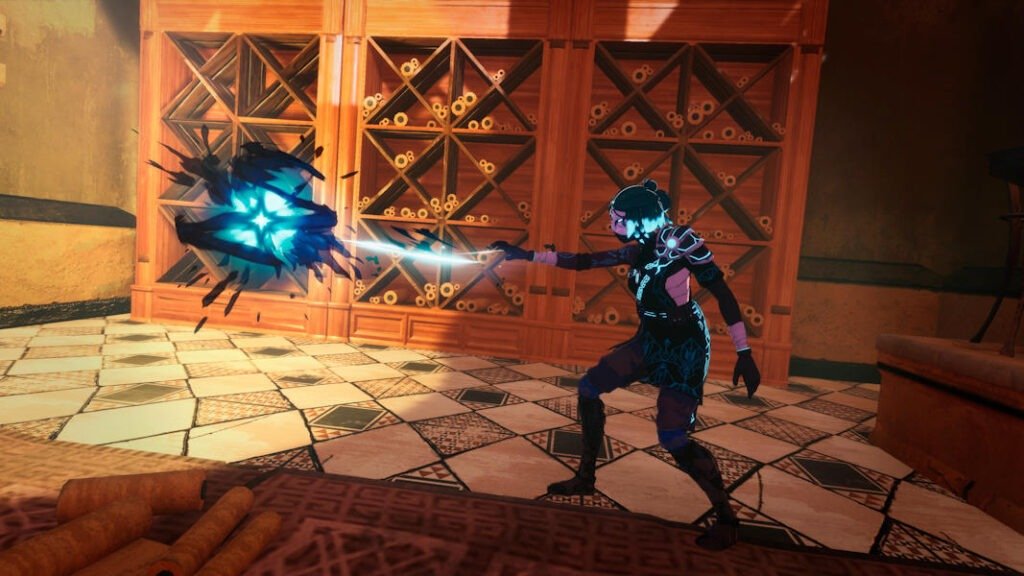
At the heart of the Ereban: Shadow Legacy experience is Ayana, a protagonist defined as much by how she moves as by what she represents. Her Shadow Merge ability is the game’s core idea, and thankfully, it never feels like a gimmick. This isn’t just a fancy invisibility cloak or a panic button you mash when things go wrong. It’s a full rethinking of space, momentum, and verticality.
By diving into any patch of darkness, Ayana dissolves into a shifting, shadowy wisp. From there, she can glide up vertical surfaces, cling effortlessly to walls, slip through narrow grates, and move at roughly twice her standard walking speed. The first time it clicks, there’s a brief “oh” moment. The second time, you start planning entire routes around it. I found myself eyeing light sources more than enemies, quietly switching my priorities without even realising I had.
On the Xbox Series X, the transition into and out of Shadow Merge is instantaneous and buttery smooth. There’s no friction, no awkward animation delay. It just happens. That responsiveness matters more than it sounds like it should. It makes the controller feel like a natural extension of Ayana’s movement, not a translator trying to keep up.
As a result, the Ereban: Shadow Legacy world stops feeling like a series of corridors stitched together with vents. Instead, it becomes a playground of potential paths hidden in plain sight. Ceilings matter. Corners matter. Negative space matters. And once the game teaches you to see those options, it’s hard to go back to stealth that relies on highlighted routes and permission slips.
The Duality of Light: Puzzle Design Reborn
In most stealth games, light is treated as a simple rule. Stay out of it, and you’re safe. Step into it and you’re not. It’s clean. It’s readable. And after a while, it becomes predictable. Ereban takes that assumption and quietly dismantles it. Light here isn’t a warning state. It’s a physical presence, something you can feel pressing against the level design.
Everything is governed by what the game calls the Law of the Shadow, and it’s more than just a thematic hook or some game gimmick that doesn’t really matter. You aren’t simply hunting for convenient pools of darkness anymore. Quite often, you’re responsible for making them. That subtle shift changes how your brain approaches every room. You stop asking “Where can I hide?” and start asking “What can I manipulate?” It truly makes you rethink how you play the game in real time.
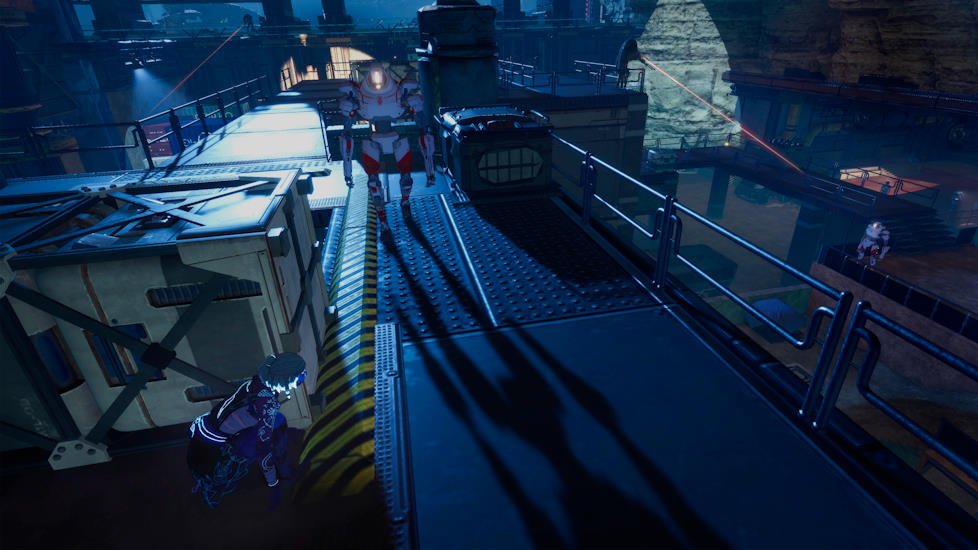
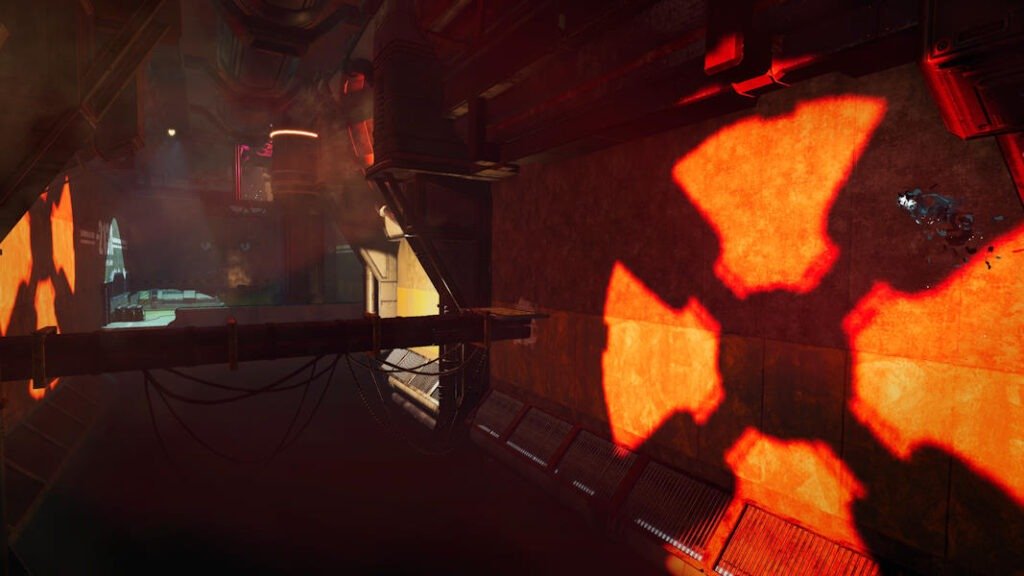
The industrial facilities of the Helios Corporation lean heavily into this idea. Massive fans rotate overhead. Cranes swing back and forth, casting long, sweeping shadows across otherwise exposed ground. Spotlights arc slowly, almost lazily, daring you to misjudge their rhythm. At first, it feels overwhelming. Then, almost without realising it, you begin to sync up with it all.
Success comes from developing a kind of environmental rhythm. You might time a jump so you land precisely within the moving shadow of a crane arm, riding it just long enough to reach safety. In another section, you’ll trigger a remote switch to cut power to a floodlight, giving yourself a brief, fragile window to cross an open plaza before everything snaps back on. These moments don’t feel scripted. They feel earned, like you spotted an opening that wasn’t explicitly advertised.
It turns each space into a clockwork puzzle where survival depends on predicting motion, not memorising routes. Light moves. Shadows breathe. You’re constantly reading the scene a few seconds ahead, thinking about where darkness will be, not where it currently sits. It’s surprisingly engaging, and occasionally nerve‑wracking, but in a way that feels intentional rather than punishing. I messed up more than once because I rushed. Ereban doesn’t like rushing. It just waits for you to understand why patience mattered. Which, for me, took me a lot of getting used to. I thought I was a patient person, but this game made me patient-i-er. That’s a word, right?
Gameplay: Learning the Shape of Darkness
There’s a rare satisfaction in finding a game like Ereban: Shadow Legacy that respects your time while still pulling you into something deeper and more mysterious. Ereban: Shadow Legacy struck that balance almost immediately for me. It delivers high‑concept sci‑fi ideas without burying you in exposition, and stealth mechanics that feel deliberate and intuitive rather than overwhelming. It fits surprisingly well into a modern gaming rhythm, where sessions might be short, interrupted, or unplanned, yet still meaningful.
What stood out most is how little friction there is between curiosity and execution. I never felt like I was fighting the game to do what my instincts told me was possible. When I failed, it usually made sense. That quiet fairness goes a long way, especially in a genre that can sometimes feel eager to punish curiosity.
The opening hours are thoughtfully paced, and that matters more here than in most stealth games. Traditionally, the genre has a habit of demanding mastery before offering comfort. Complex guard routes, overlapping detection systems, and punitive resets can make those first hours feel like homework. Ereban takes another approach, and it’s immediately noticeable.
The start is patient. Almost gentle. You’re given space to exist as Ayana before the game starts, pushing back. Learning Shadow Merge doesn’t feel like progressing through a tutorial checklist. It feels closer to discovering a new sense, something you didn’t realise you were missing until it quietly becomes natural. You experiment. You make small mistakes. You learn without being told you’re learning.
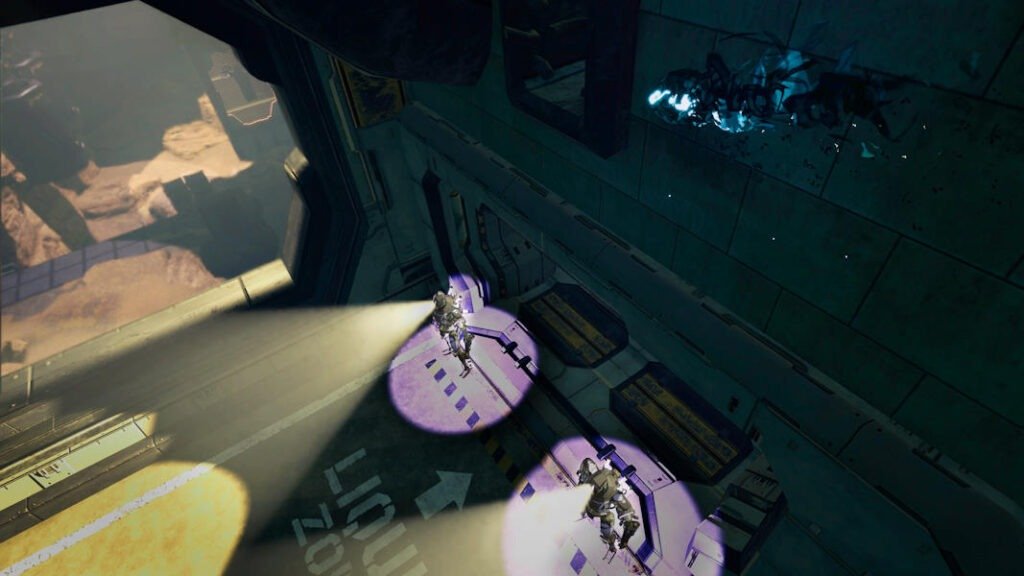
By the time Ereban: Shadow Legacy introduces more elaborate industrial spaces and vertical challenges, slipping in and out of shadow is already muscle memory. I stopped thinking about button inputs entirely. Instead, I was thinking about options, angles, and timing. That shift is important. It keeps frustration at bay and lets your focus land where it should: on creativity, observation, and calm decision‑making rather than raw execution.
And yes, I still panicked occasionally. Old habits die hard. More than once, I bolted when I didn’t need to, only to realise moments later that patience would’ve solved everything. The key difference is that the game never punished me for learning at my own speed. It let those moments breathe.
While the mechanics are the hook, the story provides the quiet pull that keeps everything moving forward. The mystery surrounding the Ereban, Ayana’s own people, and the nature of the world unfolds with surprising restraint. You’re not drowned in lore. Instead, it reveals itself through environmental details, ancient systems, and fleeting, often cryptic moments that reward attention rather than demand it.
Crucially, none of it feels like narrative decoration. Every terminal you hack, every fragment you uncover, feels earned. A payoff for careful play rather than a cutscene granted for simply reaching the next checkpoint. The idea that Ayana may be the last of her kind carries a weight that sneaks up on you. I didn’t feel it immediately. It settled in gradually, somewhere between jumps and near‑misses.
That sense of personal stakes reshapes how the gameplay lands. Stealth stops being an abstract challenge and starts to feel purposeful. You aren’t just avoiding detection to clear an area. You’re reclaiming pieces of a lost history, pulling them back from the cold, clinical grip of the Helios Corporation.
The narrative and the mechanics feed into each other in subtle but meaningful ways. Hiding in the shadow stops feeling like a trick and starts feeling symbolic. Every successful traversal carries the sense that you’re drawing power from something ancient, something that never quite disappeared. It turns movement into quiet storytelling, and that cohesion lingered with me long after I put the controller down on Ereban: Shadow Legacy.
Clarity, Contrast, and the Xbox Experience
Visually, Ereban: Shadow Legacy is a good reminder that strong art direction still carries more weight than brute‑force fidelity ever could. This isn’t a game chasing photo‑realism or flexing polygon counts for screenshots. Instead, it commits to a clean, cel‑shaded style that feels deliberate, even purposeful. The sharp lines and high‑contrast presentation aren’t just there to look nice. They’re doing real work. In a game where reading shadow boundaries is the difference between progress and failure, clarity becomes a mechanic in its own right.
Playing on Xbox, even in the pre‑release build I spent time with, the HDR presentation stood out almost immediately. Deep blacks sit confidently against the stark, clinical whites of Helios Corporation’s labs, with neon accents cutting through just enough to guide your eye without turning the screen into visual noise. Shadows feel dense. Light feels invasive. That contrast does a lot of invisible heavy lifting, especially during tense traversal moments where misjudging a boundary can undo minutes of careful setup. I caught myself leaning closer to the screen more than once, not out of confusion, but because the visual language encouraged it.
Performance sells that confidence further. On Series X, the game runs at a locked 60fps, and that consistency matters once the platforming starts asking more of you. I noticed it most when chaining movement through shifting shadow patterns, where timing isn’t forgiving and hesitation is punished. There’s no stutter to blame, no dropped frame to second‑guess. When you mess up, it’s usually on you. Frustrating in the moment, sure. I still muttered at the screen occasionally. But mostly it just bruised my ego.
The Xbox ecosystem quietly elevates the experience in ways I didn’t fully appreciate until a few sessions in. Quick Resume, in particular, feels almost tailor‑made for a game like this. In a life where long, uninterrupted gaming sessions are increasingly rare, being able to pick up a controller and be exactly where I left off in seconds is genuinely liberating. I’d sit down thinking I had twenty minutes, slip into a facility, and suddenly be far deeper than planned. No loading screens. No mental reset. Just momentum preserved. When life interrupted, suspending the game felt effortless, and returning to it later never broke the spell.
The controller mapping also deserves credit. Shadow abilities mapped to the triggers and bumpers feel immediately natural on the Xbox controller, especially during high‑speed movement and reactive platforming. There was never a moment when I felt like I was fumbling for the right input or second‑guessing the layout. Everything sat where my hands expected it to be. That ease matters more than it sounds like it should. It keeps tension focused on the game world instead of your fingers, allowing the experience to remain fluid, immersive, and quietly satisfying for longer sessions than I originally intended to play.
Intuitive Mapping
Accessible Stealth
The Verdict
Ereban: Shadow Legacy is a refreshing reminder of what stealth can be when it isn’t afraid to be a little strange. It’s confident in its ideas and comfortable moving at its own pace. This is a game that values agility, observation, and restraint over brute force and loud solutions. Whether you grew up on the classic stealth era or you’re coming in fresh, looking for a puzzle‑platformer that actually treats shadows as something meaningful, this one earns its place in an Xbox library.
It’s smart without being smug. Fast without feeling frantic. And most importantly, it understands a simple truth that many stealth games forget: the most powerful thing in any room isn’t the person holding the gun. It’s the shadow they aren’t looking at.
Key Features
- Dynamic stealth: Use the environment to cast shadows, manipulate light, and create your own exits rather than follow fixed routes.
- Fast‑paced platforming: Blend mystical abilities with fluid parkour for expressive, high‑speed infiltration.
- Moral choice: Decide the fate of your enemies, whether that means eliminating them or disappearing without a trace.
- Optimised for Series X|S: Smooth performance, high frame rates, and striking cel‑shaded visuals built for modern consoles.
Ereban: Shadow Legacy launched on 16 April 2026. The acclaimed stealth-action platformer arrives digitally on PlayStation 5 and Xbox Series X|S, alongside beautifully crafted Physical Standard and Collector’s Editions exclusively for PlayStation 5.




Recent Comments