
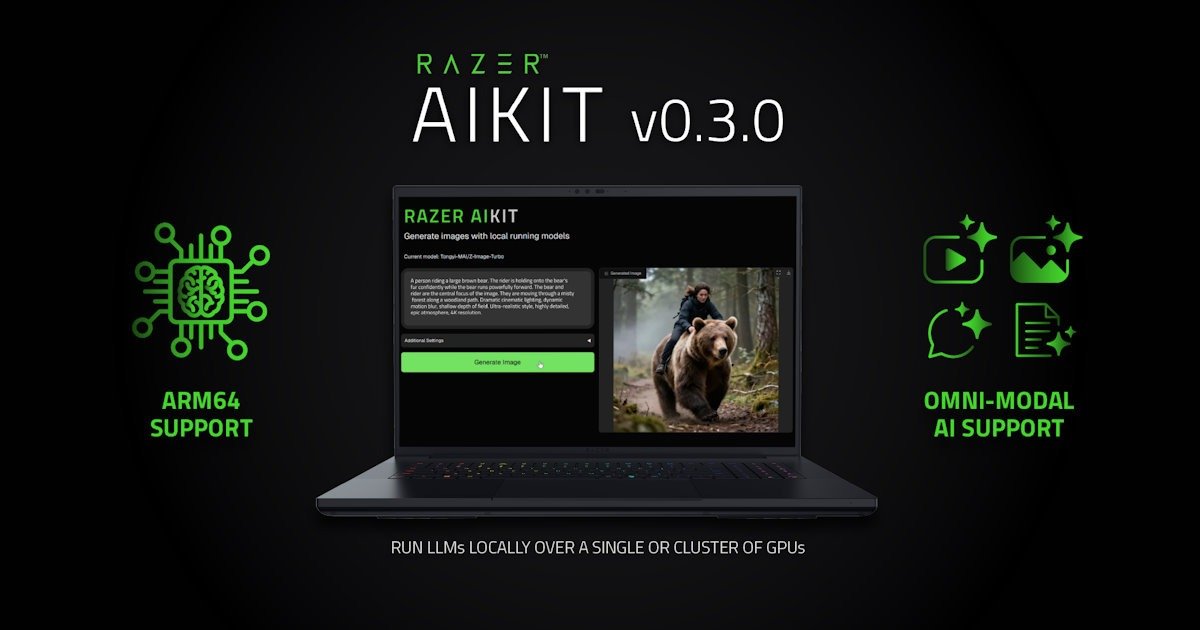
Razer announced the latest release of Razer AIKit, Razer’s free, open-source AI development toolkit available for any developer to download and use. Introduced at CES 2026, this update significantly expands AIKit beyond text-based workflows, adding native support for image, video, and audio AI models, alongside broader hardware compatibility, including Arm64 architectures.
Razer also revealed that AIKit powered Razer AVA Mini, the company’s 2026 April Fool’s campaign, demonstrating how the same AI development toolkit used locally by developers can support large-scale, consumer-facing AI deployments while markedly reducing operating costs.
“Razer AIKit is about removing friction for developers as their ideas grow,” said Quyen Quach, Vice President of Software, Razer. “It’s designed to help teams move faster without needing to re-tool as they scale. AVA Mini demonstrated how a single development foundation can support everything from early experimentation to a live, global consumer deployment.”
More Models. More Hardware. One Unified Workflow.
Razer AIKit enables developers to build, run, and deploy advanced AI models directly on their own hardware, without cloud subscription. The toolkit automatically manages GPU discovery, configuration, and performance tuning, enabling faster iteration, predictable costs, and full control over data and deployment environments.
With this release, AIKit evolves into a fully omni-modal AI development toolkit, supporting image generation, video, and audio models through a single, consistent workflow. These workloads run locally across supported systems, including Razer’s latest Blade laptops such as the Blade 16 (2026) and Razer Blade 18 (2025), bringing powerful generative AI capabilities typically requiring cloud infrastructure onto local and edge hardware.
AIKit now supports image generation models including Tongyi-MAI/Z-Image-Turbo and FLUX.2-klein-base-4B, allowing developers to prototype, test, and deploy generative experiences using the same tooling from experimentation through production.
The tool also introduces support for Arm64 architectures, including systems built on NVIDIA’s latest professional AI platforms such as NVIDIA DGX Spark™ and systems powered by the NVIDIA Grace Hopper and NVIDIA Grace Blackwell Superchips. Teams operating across x86 and Arm-based environments can deploy AIKit consistently across their infrastructure without changing workflows or re-platforming applications.
Powering Razer AVA Mini At Global Scale
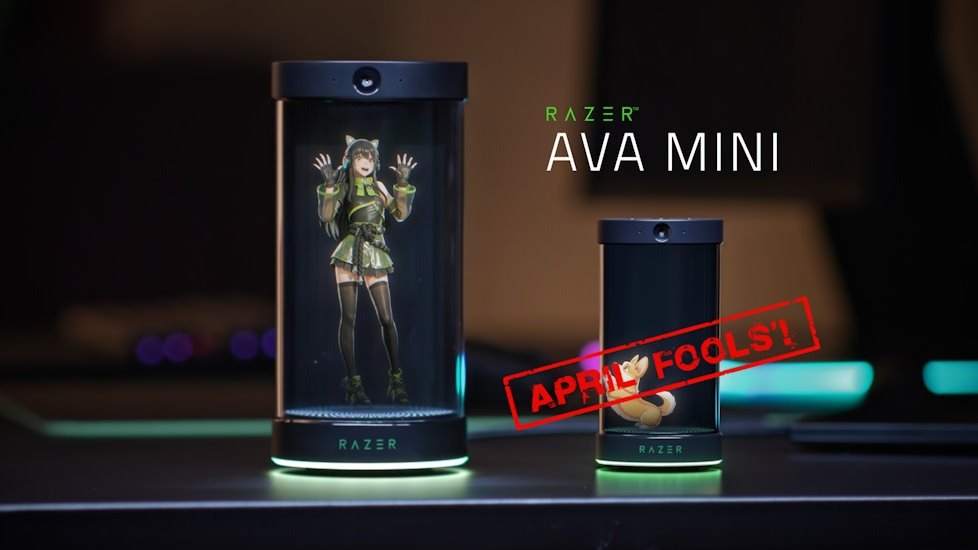
Razer launched AVA Mini, a 3D AI pet companion for Razer AVA, its flagship AI desk companion, in March 2026. The experience invited users to upload photos of their real pets and receive unique, personalised AVA Mini characters generated in seconds. Razer actively promoted the experience across its channels, driving significant engagement ahead of the campaign reveal in early April.
The image-generation experience was powered end-to-end by Razer AIKit, with the same toolkit used during development supporting the live consumer deployment at scale.
Running a free, high-volume image generation campaign is typically cost-prohibitive, with conventional cloud APIs charging between US$0.03 to US$0.15 per image. To make the campaign viable at scale, Razer partnered with Akash Network, a decentralised GPU marketplace, to deploy AIKit across Akash’s global pool of consumer RTX 4090 and RTX 5090 GPUs via AkashML, its managed inference service.
Running from 31 March through 4 April 2026, the campaign delivered:
- Over 11,000 image generations
- 3.24 seconds average end-to-end turnaround per image
- Peak throughput of 30 images per minute
- Zero manual interventions across the full five-day campaign
By deploying the same AIKit containers used during development across Akash’s distributed GPU network, Razer reduced inference costs to US$0.01 per image, representing up to 15x lower per-image costs compared to standard cloud-based APIs.
A joint whitepaper published today by Razer and Akash Network details the system architecture, unit economics, and engineering decisions behind the deployment. The full paper is available at rzr.to/aikit-akash.
Availability on Akash Console
Razer AIKit is now also available on Akash Console, Akash Network’s web-based interface for deploying and managing applications without the need for command-line tools. This provides developers and GPU operators with a more streamlined, browser-based way to deploy AIKit workloads across Akash’s decentralised compute marketplace, using the same deployment architecture that powered the AVA Mini campaign.
What’s Next
The Razer AVA Mini campaign offers an early look at what AIKit can enable beyond development environments. Upcoming releases will introduce voice and video support, allowing developers to build voice-driven interactions and video-generation workflows through the same unified AIKit experience.
As part of Razer’s broader AI developer ecosystem, AIKit serves as the core software foundation for building, scaling, and deploying local-first AI across devices and environments.
AIKit is available now on GitHub, with ongoing support from Razer’s engineering team and a growing global developer community. To download AIKit and get started, visit razer.ai/AIKit.



Recent Comments