
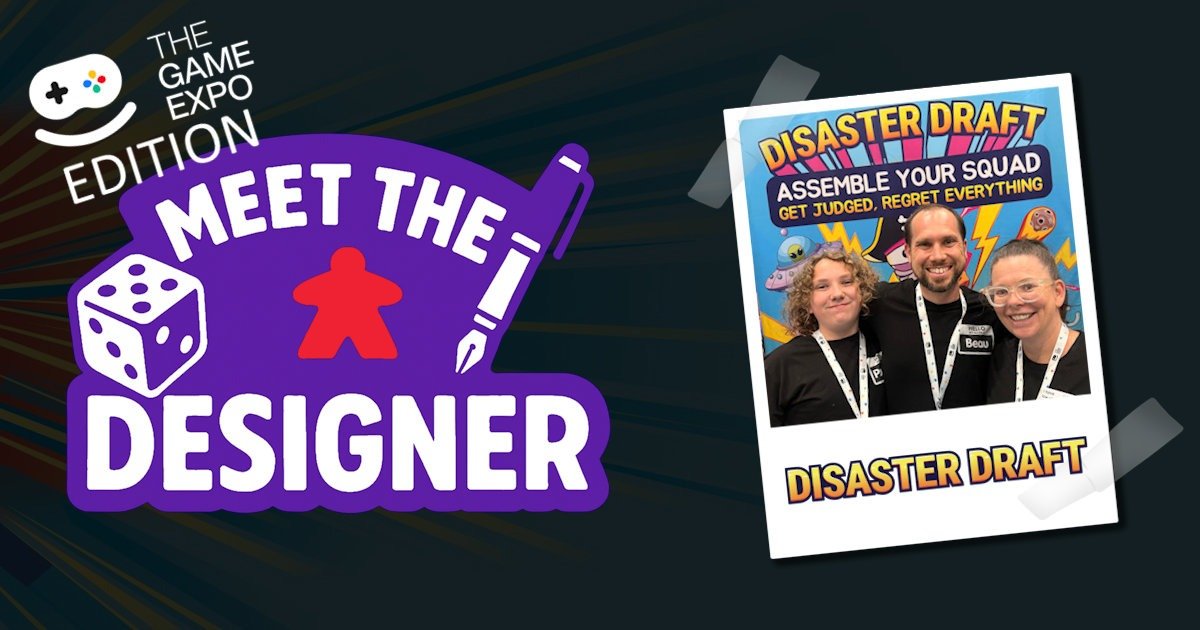
A four‑hour road trip is a long time when the tablet’s dead, the music cables have mysteriously vanished, and the back seat contains a 10‑year‑old with a very active imagination. That’s usually where things go sideways. Complaints, boredom, maybe a dramatic sigh or ten. For Margo and her family, though, that stretch of road turned into something else entirely. Somewhere between “are we there yet?” and the next service stop, a game idea started to form.
That idea eventually became Disaster Draft, a tabletop hybrid built around ridiculous hypotheticals and even more ridiculous debates. You draft a crack team of pop‑culture icons, then throw them headfirst into 200 chaotic survival scenarios. It’s the kind of game that starts calmly, and then, five minutes later, you’re passionately arguing why the 12th Doctor would absolutely carry the team, or why Bluey’s dad might be quietly overpowered. To keep things from descending into total anarchy, the winner is decided by JANET, a custom‑coded AI (short for Judgment and Analysis Nexus for Evaluating Teams), which somehow manages to feel both impartial and deeply judgmental.
In this interview, we sit down with Margo to talk about how a bored‑in‑the‑car brainstorm grew into a real, shipped game, complete with a debut at the Game Expo. It works as a family game. It also works when the mood shifts a bit feral on a Friday night. Somewhere along the way, Disaster Draft became both, and honestly, that feels very on brand.
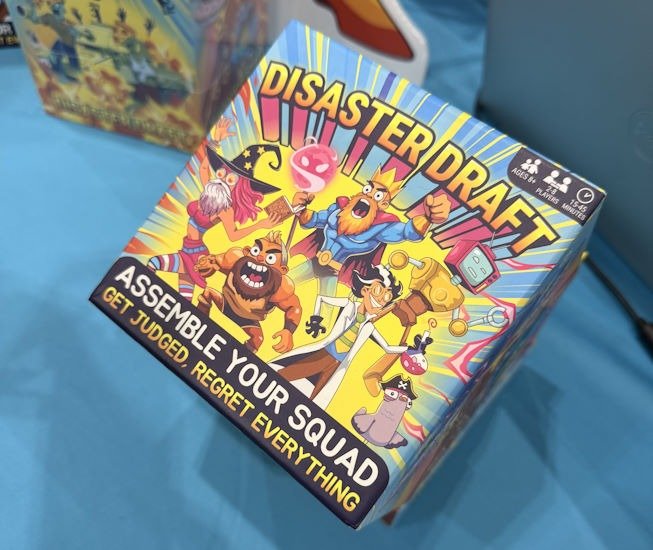
Ben: Alright, I’m here with Margo Lee. She’s going to chat to me all about disaster drafts. Welcome. Thanks for having a chat. Could you give us a bit of history on how disaster drafts originated?
Margo: So my son (Paxton, now 12), who was about 10 at the time, was in the car when we were driving from Toowoomba to St George in outback Queensland. It was a four-hour drive and I hadn’t connected to YouTube, so we had no music.
B: Oh, no.
M: Without internet access, he couldn’t play any games. So we brainstormed wild scenarios, and I distinctly remember we were debating being trapped in a cabin surrounded by every horror villain imaginable. We could choose five to survive until morning and then leave. Who would they be? We discussed this for about four hours until we got home, then wondered how we could determine a winner.
We decided to enlist his dad’s help in creating an AI to evaluate the scenario’s outcomes. Every night at bedtime, we posed different questions and argued for an hour before inputting the results into Beau’s program to determine the victor. One day, Paxton suggested turning it into a real game. Beau and I agreed, so we essentially took out a second mortgage on our house and committed to completing it.
B: Great! So the game includes a set of scenarios. Do you choose them or create your own?
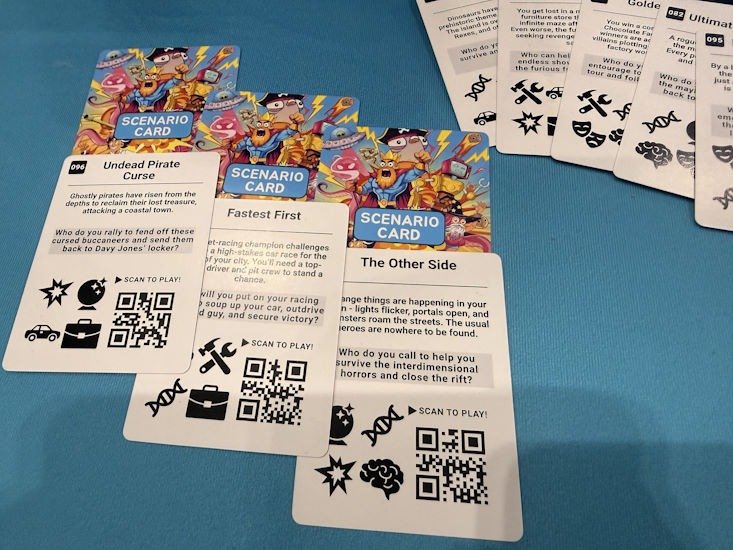
M: Yes, there are 100 ridiculous scenarios included in the core pack and two additional expansion packs, each containing 50 cards. This totals 200 scenarios, all programmed into the companion app available on Android, Apple iOS and web browsers. The app is custom-coded to incorporate all this information and determine the ultimate survivor.
B: Great! So you’re presented with a scenario, and then each player selects a hero or villain. You can choose one or multiple people, forming your own crack team to survive the situation. For example, you could select all the Avengers from Marvel or perhaps He-Man. Alternatively, you could create a unique hero, like a knight.
M: Yes, you can be even more specific. For instance, you could choose Batman specifically from The Dark Knight.
B: Oh, cool! Or perhaps a particular episode of Doctor Who. Well, the Doctor will always win, though.
M: Actually, it’s funny you say that because Paxton, the only person he ever recruits for his team, is the Doctor.
B: The fifth doctor, or the 10th, or the 12th,
M: Yes its the 12th
B: Right, that’s fine. That’s another debate for another day. My 10th and 4th are mine, but we’ll leave that aside.
M: Well, Janet, could decide who would win out of those two doctors. (More on Janet later)
B: Well, we’ll have to see. So, how does the AI work? Is it programmed with each hero or villain, or does it search for material about them and then bring it back?
M: Yes, every question has strict parameters about the scenario and what it’s looking for to score against. However, it also spreads online. Therefore, if someone has an online presence, they can be drafted into your team. For example, if you have a popular social media friend, you can draft them, and the AI will find them.
B: Cool. So you could do Stephen Curry if you’re into basketball.
M: Absolutely.
B: So, how does that gameplay work? Do you discuss it before pushing it into the AI, or is it all up to the machine? You’ve got the scenario, and I’ve chosen the hero slash villain. I want to represent or protect myself or help with that specific mission. Is there a discussion point, or is it all then up to the AI?
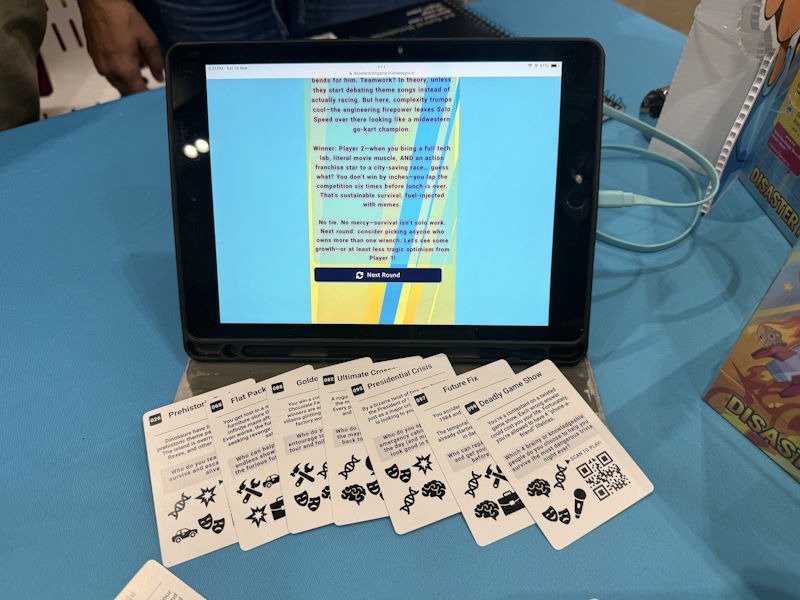
M: There’s a discussion point here. Once every player has chosen their team, it will appear and display every other player’s team. However, it doesn’t reveal who has chosen which team – that’s intentional. This allows you to try and guess who’s chosen what. You can discuss why those other teams are weak, and yours will win, or it might remind you of a crucial character you’ve missed and leave you shaking your head, wondering what you’ve done.
B: There’s also something else on the bottom of the cards with those little icons. Is that part of the whole thing?
M: Yes, the physical cards feature icons representing various jobs or types of recruits, such as mercenaries, scientists, doctors, and fighters. These visual guides help players understand the scenarios presented in the app. Once a scenario is presented, the app provides a more detailed breakdown and additional information about what’s being evaluated. While these options offer guidance, you’re free to select your own players or draft one if you feel it’s adequate.
B: That’s cool.
M: Yes, that’s before you select your team or anything. You’ll see all that information. Each player will receive a scenario on their device – phone, tablet or laptop – depending on their preference.
B: Everyone gets to see everyone else’s answers and have a bit of a friendly debate about which one will defeat the other or whether they think this one will be better. Then you realise you’ve missed a clear error.
M: Absolutely. Then there’s Janet, and I probably should explain. Our AI’s name is Janet. Janet stands for Judgement and Analysis Nexus for Evaluating Team.
B: Cool. Janet the AI.
M: There are four different modes. The 8 years and over mode is friendly and great for younger kids. The default mode is for those 14 and over and is the roast mode, where Janet will roast you hard in some cases. So choose wisely.
We have two 18-plus modes: one is not safe for work, and the other is unhinged. These 18-plus modes are slightly hidden in the profile section and need to be turned on to be displayed on the front screen for easy selection. We’ve done this for families to prevent children from finding these modes.
B: So you can enable it when you set your profile. That is great, it’s off by default.
M: That’s really for your uni students or older. Perhaps some teens might enjoy it. What about those Friday nights when you’re having a few drinks with mates and just want to have some fun? It’s a lot of fun because it’s fast-paced and hilarious. Some of the things that come out of it.
B: How long would a typical game last? Is it one or two rounds?
M: The great thing about this game is you can play for a short while or as long as you like. For example, if you’ve got 20 minutes in a doctor’s waiting room, you can enjoy a quiet round with your family. Alternatively, if you have two hours on a Friday night and want to make it a special occasion with snacks, drinks and all the trimmings, you can play right through.
B: That sounds great. It’s got that party game feel as well as something more…
M: Absolutely. It’s been designed to be simple and intentionally so. The game’s core idea is connection with others, which is why we chose the hybrid model. We have young children and notice they and their friends are all so device-heavy. Generation Alpha, as they’re called, is that way. We wanted to introduce them to tabletop gaming and thought this gentle approach would be effective. Hopefully, they’ll get hooked and move on to more role-playing and challenging games. However, it’s also great for playing with parents, grandparents and exploring shared interests like music and movies. We know people gravitate towards genres they enjoy.
B: Yeah, I can see it has that generational appeal. It’ll break down those barriers. For example, an older person might choose James Bond, perhaps the best one, Sean Connery. Meanwhile, a younger person might prefer a recent film like One Movie starring Keanu Reeves or even Bluey.
M: Bluey has been selected many times.
B: Oh, Bluey would win every time.
M: Absolutely.
B: But that makes sense. Bluey’s Dad as well, I think he definitely wins in parenting.
M: Yeah, that’s another fun thing we discovered when we started playing: people choose characters from their generation. For example, when playing with younger players and we’ve chosen Bruce Willis, they might not recognise him. This opens up opportunities for conversations about the characters and movies. If you can’t recall a character’s name from a film, you can use a similar approach. For instance, if you’re playing a heist on Christmas night and choose Bruce Willis, but they can’t remember him from that movie, you can use Bruce Willis from Die Hard. It works out, and you can then explain that you need to watch Die Hard.
B: I love that element. Where can people find you and the game?
M: We’re super easy to find at disasterdraft.com and also on Instagram as Burnt Kernel Studio.
B: Cool. And are you in shops at all, or is it all direct sales?
M: You can buy directly from us online. We’re currently at the Game Expo, and this is our official launch.
B: Oh, cool, we got to catch you at your first event.
M: I’m completely new to the scene, and I hope many people will join us and enjoy our game as much as we do.
B: I’m sure they will, thanks again.



Recent Comments