
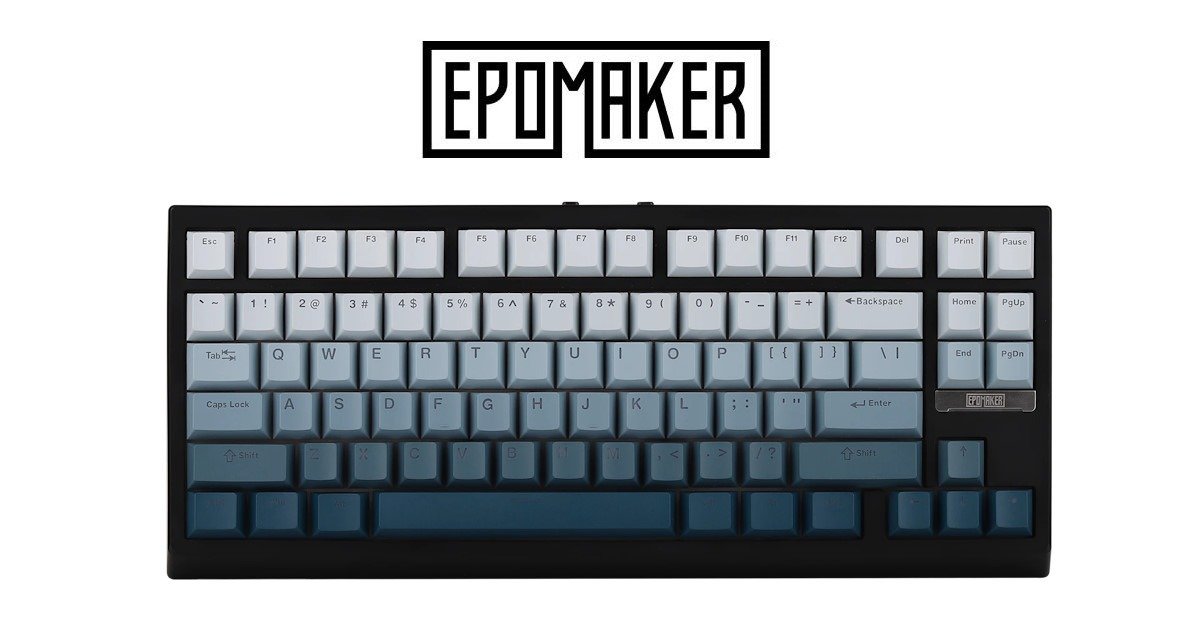
If you’ve been following my desk setup journey for a while, you already know this about me: I’m always chasing that elusive “Goldilocks” keyboard. Something comfortable enough for long stretches of typing, but not so wide that my mouse ends up awkwardly nudged toward the edge of the desk. I’ve tried a few that came close. Some almost worked. After living with the Epomaker G84 HE as my daily driver for the past couple of months, though, I’m starting to think this might finally be it. Or at least… it feels closer than anything else I’ve used recently.
It shares some DNA with the Epomaker HE 68 Lite, especially with its Hall Effect switches, and that part feels familiar in a good way. What surprised me was how right the layout feels day to day. Mornings disappear into Word documents, emails, the usual grind. Then later, without changing anything, it slides comfortably into casual gaming sessions. No mental adjustment. No reaching for keys that aren’t there. I didn’t expect to notice that as much as I did, but once you do, it’s hard to ignore.
Epomaker G84 HE at a Glance
- Incredible battery life (2 months, 1 charge).
- Perfect 75% layout for writers.
- “Hard hit” with a cushioned, satisfying sound profile.
- Seamless switching between three devices.
- Beautiful ambient LED under-lighting.
Cons:
- No Mac-specific keycaps included in the box.
- Software for HE tuning can have a slight learning curve.
The 75% Layout: A Writer’s Best Friend
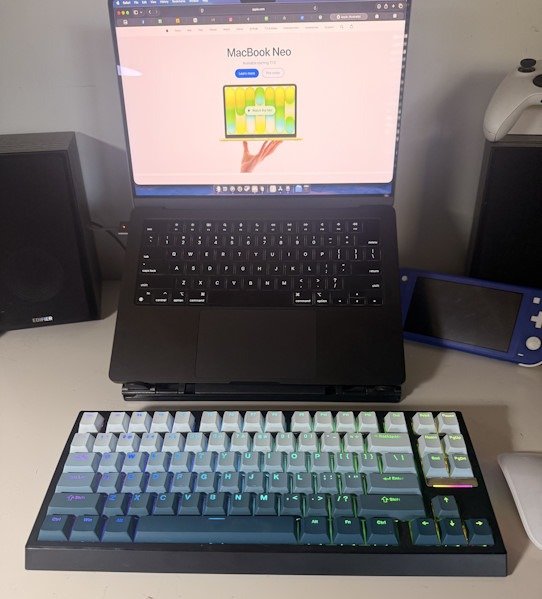
The Epomaker G84 HE uses an 84‑key, 75% layout, and this size keeps proving itself to me over time. It feels efficient without feeling stripped back. Everything I reach for during a normal workday is right where I expect it to be, which sounds obvious, but it’s not something every keyboard gets right. I don’t think about the layout while I’m typing, and that alone says a lot.
I’ve gone down the ultra‑compact road before. Sixty‑percent boards look clean, almost elegant, and I wanted to believe I could adapt. In reality, I kept breaking my own rhythm. Hunting for arrow keys. Pausing to remember a function layer. It sounds minor, but those little interruptions stack up, especially when you’re deep into writing. With the Epomaker G84 HE, that tension just isn’t there. Arrow keys are present. The function row is visible. My hands move without hesitation.
After roughly 60 days of daily use, the board feels familiar in a quiet way. Articles, emails, messy drafts, even those notes that start as ideas and never quite turn into anything. The dedicated function row has become part of how I work, almost accidentally. Refreshing tabs, jumping between windows, muting audio when I realise too late that something’s playing in the background. I noticed I was leaning less on the mouse, which I didn’t expect, but I’m not complaining.
It does take up space. There’s no getting around that. It carries that same desk‑dominating presence I mentioned in my Yunzii AL80 review. The difference here is intention. The Epomaker G84 HE uses its footprint well. I didn’t feel like I was sacrificing usability just to keep things compact, and I didn’t feel like my desk was being overwhelmed either. Everything settled into place naturally after a few days.
Every now and then, usually late in the evening, I’d wonder if I’d eventually want to downsize again. That thought never really lasted. The next morning, back in Word with a half‑finished sentence waiting for me, the keyboard felt exactly right. It blends into the routine, and once that happens, it’s hard to imagine going back.
The Sound: A “Hard Hit” with a Cushioned Soul
One of the first things that caught me off guard with the Epomaker G84 HE was the sound. I’d seen other reviewers describe it as “creamy,” and that word gets thrown around a lot in keyboard circles, sometimes a little too freely. Still, in this case, I get it. There’s a softness to the sound that comes through almost immediately, even before you really settle into a typing rhythm.
Day to day, the typing experience lands in an interesting middle ground. Each keypress feels firm and intentional. There’s a clear sense of impact when you bottom out. At the same time, that impact doesn’t bounce back at you. The internal gasket mount and the stack of sound-dampening Poron (a high‑quality microcellular polyurethane foam), IXPE (IXPE stands for Irradiated Cross‑Linked Polyethylene foam), and the rest step in at exactly the right moment. The result is a deep, rounded thock that feels controlled rather than sharp. It reminds me a bit of the first time I typed on a properly dampened board after years of hollow-sounding cases. You don’t realise how much noise you’ve been tolerating until it’s gone.
I noticed it most during longer writing sessions. Late at night, the house is quiet, fingers moving faster than I probably should admit. The sound stays consistent, even when I’m typing aggressively, which I tend to do when I’m in a rush… or during those “As per my last email” work emails. There’s feedback in every press, a sense that the board is keeping up with me instead of rattling under pressure. It made me slow down at times, oddly enough, just to enjoy the feel and sound pairing.
What I appreciate is how the acoustics never demand attention. The Epomaker G84 HE doesn’t try to announce itself with every keystroke. Instead, the sound settles into the background and becomes part of the rhythm of work. After a while, it almost fades from conscious notice, replaced by that subtle satisfaction that keeps you typing longer than you planned. I caught myself opening a blank document more than once just to put a few more lines down, which feels like a good sign, even if it wasn’t entirely intentional.
Magnetic Precision: The Hall Effect Difference
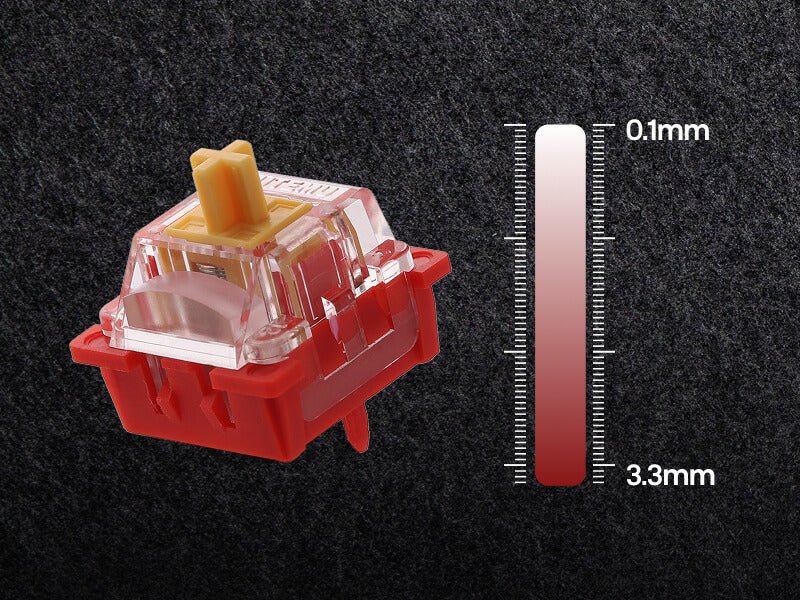
The “HE” in Epomaker G84 HE stands for Hall Effect, and this is where things start to feel a little different from a standard mechanical board. Instead of relying on physical contact inside the switch, these use magnets to detect keypresses. There’s something oddly satisfying about that idea on its own. In practice, it means adjustable actuation. You can set the keys to respond the moment you brush them, or dial things back so each press feels more intentional. I found myself tweaking this more than I expected, depending on what I was doing that day.
I kept thinking back to my time with the Keychron Q16 HE while using this board. That was my first real stretch with magnetic switches, and I remember being impressed by how forward‑thinking it felt. The concept sounded almost overengineered at first, but it won me over quickly. Epomaker’s implementation here feels just as confident, if not a little more refined in places. The switches respond cleanly and predictably, without that vague uncertainty you sometimes get when new tech is still finding its footing.
What stood out most to me was the consistency. Whether I was inching a character through a dungeon or halfway through a dense paragraph that required more focus than I’d planned for, the switches never felt out of place. There’s a smoothness to the motion that makes fast inputs feel effortless, but it doesn’t sacrifice control when I slow things down. I didn’t have to think about how hard I was pressing, which sounds minor, but it changes how relaxed your hands feel after a long session.
Over time, the durability aspect started to matter more than the novelty. Magnetic switches don’t wear in quite the same way as traditional ones, and there’s a quiet reassurance in that. I caught myself being a bit less precious with the keyboard, typing harder when I was in a rush, trusting that it could take it. That’s something I appreciated with the Keychron Q16 HE as well, and it carries over nicely here.
The Epomaker G84 HE doesn’t push Hall Effect switches as a gimmick. They’re simply part of the experience, working in the background, doing exactly what they’re supposed to. After a while, you stop thinking about the technology and just enjoy how the board responds. And honestly, that’s when you know it’s been done right.
Daily Driver Stories: Versatility in Action
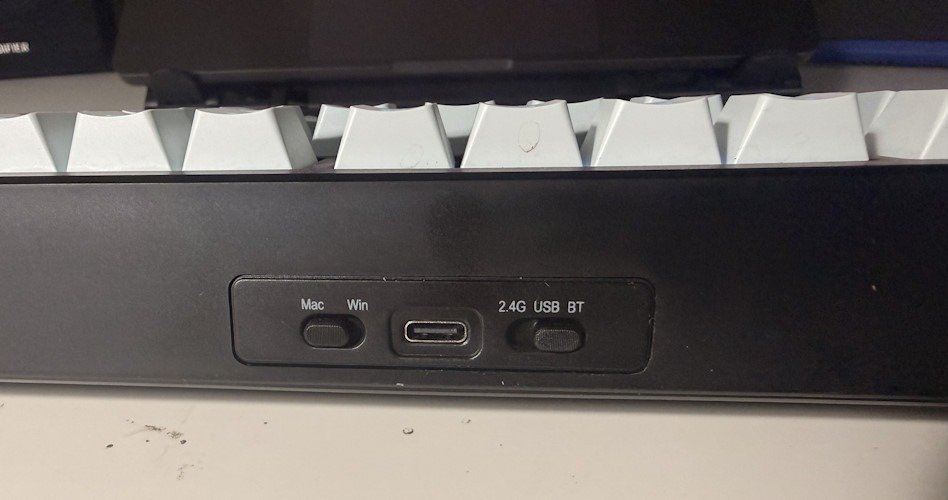
A typical Tuesday for me is a bit chaotic, device‑wise. I bounce between my work PC, my personal MacBook, and, every now and then, an iPad when I convince myself it’ll help me focus. This is where the Epomaker G84 HE quietly proves its worth. The tri‑mode connectivity, Bluetooth, 2.4G wireless, and wired USB‑C, sounds like a spec-sheet flex or some marketing fluff, but in practice, it just makes life easier. Switching between devices feels natural, almost boring in the best way. I stopped thinking about connections after the first few days, which is usually a good sign.
What surprised me was how quickly it folded into my routine. Morning emails on the PC, a draft or two on the MacBook, then a quick tablet check without having to reshuffle cables or pair things all over again. I’ve used boards in the past where multi‑device support felt fragile, like it might fall apart if I relied on it too much. That hasn’t been the case here. The Epomaker G84 HE has been consistent, even when my workflow definitely isn’t.
One small detail I didn’t expect to care about as much as I do is the LED under‑lighting. A lot of keyboards stop at per‑key RGB, which is fine, but this one adds a subtle side‑glow that spills out beneath the chassis. It creates a soft halo across my desk mat, especially noticeable late at night when everything else is dimmed down. It’s not distracting. If anything, it makes those late writing sessions feel calmer, a little more intentional. I caught myself leaving it on even when I didn’t really need it, which probably says enough.
I’ve had keyboards before where my first impressions were all over the place. Excited one day, slightly annoyed the next. A bit of a rollercoaster. The Epomaker G84 HE hasn’t done that. It’s been steady from the start, and that consistency has grown on me. It doesn’t demand attention or constant tweaking. It just shows up, does what it’s supposed to, and fits into whatever strange mix of work and downtime the day throws at it. Over time, that reliability starts to matter more than any single feature.
The Marathon Battery
Wireless keyboards usually come with a bit of low‑grade anxiety, at least for me. The Epomaker G84 HE sidestepped that completely. In the two months I’ve been using it daily, I’ve only charged it once, which still catches me off guard. Even with the LED lighting on during work hours, the battery just refuses to quit.
After the first few weeks, I stopped checking the charge level altogether. No warnings, no scrambling for a cable mid‑sentence. It quietly does its job and stays out of the way. It’s one of those rare pieces of tech you genuinely can set and forget, and that alone makes it stand out.
Aesthetics: That Ombre Blue Glow
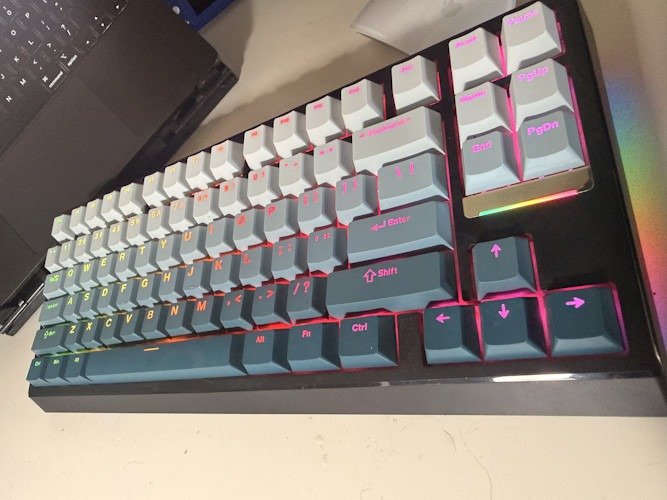
Visually, the Epomaker G84 HE stands out the moment it hits the desk. The ombre blue gradient does a lot of the heavy lifting here, fading from a soft, almost airy light blue at the top into a deeper navy toward the bottom. It’s a smooth transition, not flashy or abrupt, and it gives the board a sense of depth that photos don’t fully capture. I remember setting it down for the first time and pausing for a second longer than usual, just taking it in.
The overall look feels calm and deliberate. There’s something refined about it, like it was designed to sit in a workspace rather than dominate it. It reminds me more of a carefully chosen desk object than a typical peripheral. I’ve had louder keyboards visually, ones that demand attention. This one feels confident enough to stay composed.
The LED execution is what really pulls everything together. Instead of hiding the lighting beneath opaque caps, the shine‑through legends let the RGB come through cleanly, illuminating each character without overwhelming the gradient. When the side‑strip under‑lighting kicks in, the effect becomes surprisingly cohesive. The glow spills gently onto the desk mat, and the transition from light to dark blue feels more alive, almost layered.
I noticed it most during evening sessions, when the room lights are low and the keyboard becomes part of the atmosphere. The lighting doesn’t scream for attention, but it’s present enough to set a mood. It carries an elegance that reminds me of more premium, significantly more expensive keyboards I’ve used before, though the palette here feels cooler and more calming. It’s the kind of design that grows on you. The longer it sits on your desk, the more it feels like it belongs there.
The Missed Opportunity: The Mac Gap
It’s not all sunshine here. While the Epomaker G84 HE does include a physical toggle for switching between Windows and Mac modes, a feature I actually use daily, there’s a small but noticeable omission once you open the box and really take stock of what’s included.
Epomaker throws in spare switches, which is appreciated and honestly not something every brand bothers with anymore. But there are no Mac‑specific keycaps. No Command. No Option. For a keyboard that clearly positions itself as cross‑platform, that absence stands out more than it probably should. Every time I glance down and see a “Win” key while working on macOS, it pulls me out of the illusion just a little.
It’s not a dealbreaker. I’ve lived with it without any real friction, and muscle memory does the heavy lifting anyway. Still, it feels like a missed opportunity rather than a conscious design choice. Other keyboards at this price point have shown that including alternate Mac legends is possible, even expected. Once you’ve had that option elsewhere, it’s hard not to notice when it’s missing.
If you’re deeply embedded in the Apple ecosystem and care about visual consistency, this might be a minor annoyance that lingers. You can work around it, or replace the caps yourself, but it’s something you shouldn’t really have to solve on your own. The Epomaker G84 HE gets so many small details right that this one omission feels more frustrating than it otherwise would.
Final Verdict
The Epomaker G84 HE feels like a statement piece that earns its place on the desk. It looks considered, but it never feels like performance was an afterthought. Everything about it points toward balance. This is a keyboard for someone who wants the precision and flexibility of magnetic switches for gaming, but still needs a layout and typing feel that can carry them through a full workday without friction.
It lands squarely in that prosumer space. Fast and configurable when you want it to be, calm and comfortable when you don’t. I could game on it without feeling held back, then roll straight into writing without changing a thing. That kind of versatility isn’t always easy to pull off, and it’s where the G84 HE quietly shines.
The lack of Mac‑specific keycaps is still a miss, especially given how well everything else is thought through. It doesn’t ruin the experience, but it does feel slightly out of step with an otherwise polished package. Thankfully, the strong battery life, tasteful under‑lighting, and genuinely reliable multi‑device connectivity outweigh that shortcoming in daily use.
After a couple of months with it, the Epomaker G84 HE has settled into my setup without any drama. No quirks I had to excuse. No habits I had to relearn. It simply works, and it does so with a level of refinement that’s hard to overlook. All things considered, it’s one of the easiest recommendations I’ve made this year, especially for anyone trying to bridge the gap between serious typing and relaxed gaming.




One Comment
[…] Read the full review: Epomaker G84 HE: The 75% Sweet Spot […]
Comments are closed.