
There’s a certain pull that drags you toward the back of a convention hall. You feel it once you pass the glowing RGB towers and the steady clatter of very serious mechanical keyboards. It’s quieter back there. Slower. Rows of neatly boxed games, stacks of fresh rulebooks, and a scattering of “Coming Soon” signs taped slightly crooked. This is where the indie scene really lives. Or maybe breathes is the better word. And it’s also where the biggest, slightly uncomfortable question hangs in the air: what happens after the crowdfunding campaign wraps up?
That’s how I ended up talking with Dylan from Indiverse, right in the middle of that controlled chaos. While most conversations around us were buzzing with launch hype and stretch goals, ours drifted somewhere else entirely. The after. The part no one posts about. Indiverse isn’t pitched as just another shopfront, and Dylan was pretty clear about that. It’s closer to a proper digital home for indie tabletop creators. A place where a game can go once the campaign hype fades, without being chewed up by the usual retail friction that tends to drain both energy and enthusiasm.
I kept ducking away to stare at Hall Effect switches I absolutely did not need, then coming back to the conversation. Dylan, meanwhile, stayed locked in on what he kept calling “low‑friction” distribution. It sounds simple, almost obvious, but it really isn’t. We talked about the post‑hype lull, that quiet stretch where great games risk slipping into the void. Potion Society came up. Dragon Dice, too. Very different games, very different vibes, but the same shared problem. Momentum is fragile. Once it’s gone, getting it back is hard. Sometimes impossible.
What stuck with me is that the conversation never felt like a pitch. There was some business talk, sure. Margins got mentioned. Briefly. But it kept circling back to people. Designers trying to stay afloat. Players are trying to find something interesting without digging through endless noise. The idea that “hidden gems” shouldn’t have to stay hidden forever felt less like a slogan and more like a quiet frustration bubbling up.
So before the next crowd surge hit the artist alley and every demo table was filled, we grabbed a moment. We talked about building bridges between crowdfunding and an actual, sustainable career. About how a completely non‑copyright‑infringing t‑shirt can become a surprisingly important talking point. And about why indie tabletop games probably belong right where players already are, casually browsing, curious, and maybe just a little bored with seeing the same familiar names every time.
Ben: I’m here with Dylan from Indiverse. How are you going?
Dylan: Doing really well today. It’s been a splendid day so far. Enjoyed so many new and interesting games.
B: It’s been awesome. Have you been before?
D: We’ve been coming for about four years now. It’s a really solid gaming community.
I love the huge artists’ gallery – it’s a point of difference and adds something special to the event. I hope everyone is getting something out of it. I must admit I’ve been spending a bit more time at the games this year.
B: I am guilty as charged. Although I have been looking at the keyboards! So tell me a little bit about yourself, Indiverse and what you’re doing?
D: I’m a co-founder of Indiverse.io, an online marketplace designed to support crowdfunded and self-published games as the crowdfunding hype fades. It provides a dedicated space for games to live, eliminating the need for designers to manage a sales platform. Retail and brick-and-mortar are vastly different from crowdfunding environments, as are other online spaces like Amazon. The crowdfunding space is so different that a smooth transition is crucial. Indiverse offers no friction; you can simply move from crowdfunding to listing on Indiverse the same day. This means you could be featured on Indiverse the next day, establishing your presence even after the campaign concludes.
B: You’re direct to a consumer or to wholesalers?
D: Direct to consumer. It’s a marketplace, think of it like Amazon or Etsy. People jump on, as a consumer, they see a cool new game they want to buy. They hit buy, you get an order, you send it out.
B: Do you do distribution and warehousing, as well?
D: That’s the thing that makes the bigger places, like Amazon, really difficult. Some of those have locked-in distribution. They force you into things, and they may start raising their percentage. We want you to take the environment you made in crowdfunding, but all you’re thinking about is how much is the crowdfunder taking?
We want to have that same environment, so you don’t have to change your process, you don’t have to change the distribution person. Nothing at all. You can just absolutely lift and shift straight into Indieverse.
B: That’s really simple. If you have a distributor, can that order go to them and then to the customer?
D: Yeah, it’s like a standard email train. You can set it to send automatically wherever you want. You can have an email and one to your distributor.

B: So the process doesn’t change for you. That’s really good. Is this something that the Australian tabletop game designers have jumped onto, or is it still a work in progress?
D: It’s such a funny environment. One thing we’ve noticed is the hype around crowd-funded projects. People realise they need to build that buzz and get noticed. I’m excited about releasing something, and I want everyone involved when they can. These are the people we meet most often because they’re active on social media. They’re constantly pushing for a follow or helping spread the word about the campaign to raise more funds. We often meet people with games in three, five or six months. We’ve become quite good at promoting them. We do short interviews that give a bit about the creator and the game, though they’re a bit behind the scenes.
B: That’s really cool, helping them get recognised
D: For consumers, visiting the indiverse page is a natural progression after they’ve purchased a game. They’re eager to stock up on more. However, this often leads to a reduction in the hype surrounding the game. Consequently, finding these individuals becomes significantly more challenging.
Conventions like this provide a platform where people proudly display their finished games. This is where we encounter many post-crowdfunding creators. Unlike the pre-crowdfunding phase, there’s no pressure to actively market or stockpile. Instead, the focus shifts to securing distribution, reducing costs, and managing expenses associated with venue fees for buying and selling.
B: What do designers think of the platform?
D: It’s a mixed bag. Some people really connect with it and feel it’s a perfect fit. Others believe it’s too good to be true, sensing something’s off but not quite understanding what. It’s similar to crowdfunding, with a similar percentage of people taking it up. To be with us, it’s just a 10% opt for a standard buy and sell.
This is a great transition because Kickstarter is the main platform, usually taking 10-15% depending on the product. We want to replicate that experience as closely as possible.
B: Does this include all the marketing from your side, or does the designer or publisher handle their own traditional marketing while you simply manage the platform that sells it?
D: It’s a mixed bag, so we approach designers when we believe they have something that will promote the marketplace. This is a big deal for us, as we promote our work to consumers and designers alike. It’s a crucial part of our strategy. We balance this by finding things that will attract customers, particularly those with great visual aesthetics.
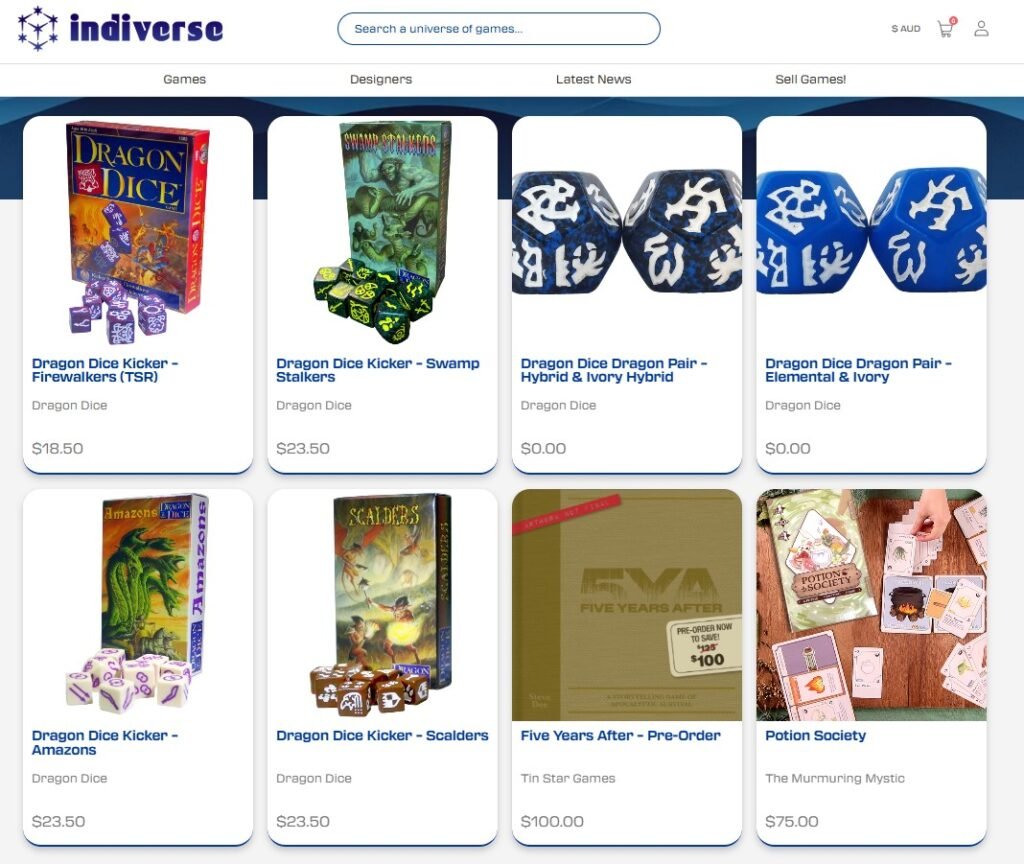
For example, we recently supported a game called Potion Society. It’s highly recommended and a phenomenal game. It’s one of the most in-depth yet accessible strategy games I’ve ever played. You can enjoy it with someone who’s played four-x games for 30 years or a young person. The strategic depth and the chaos of spells and other elements make it truly amazing.
Artistically, it looks beautiful. Honestly, I think it’s a bit too cosy, but there’s so much hardcore strategy you can apply to it that you don’t have to. However, its visual appeal is undeniable. It draws people in, showing them something cool and intriguing. This encourages them to visit the site and explore our games. I often do this when I visit crowdfunding sites. I see something interesting, and it leads me to explore other games within the ecosystem.
My colleagues have threatened me for getting a non-copyright-infringing shirt. I want it to say “Steam of Indie Tabletop Games,” so it’s the name you think of. Imagine wanting a new game and not being able to go to a board game store. I don’t want to sift through hundreds of Amazon or Etsy pages because they don’t promote indie games at the top. You’d expect to see playing cards everywhere, right? We want to be a space dedicated to indie games, giving you the most visibility for what we offer.
B: Would a publisher link directly to you from their website, or are they still taking sales separately on their site?
D: That’s right. We don’t want to discourage people from selling directly because they organise their own events and manage their website. It’s a great place to showcase everything they do. So if someone discovers them organically through social media, they can still do that. However, if they’re specifically looking for large events and want to use our space, they can come directly to us.
B: When did you start?
D: I joined in 2023. We were just ensuring the idea wasn’t crazy and feasible, as we hadn’t realised how severely underserved the post-crowdfunding and post-self-publishing market truly was.
My colleague, who had the original idea, had already supported another fantastic game called Dragon Dice. It’s a tabletop war game where custom dice with unique faces and abilities are used instead of minis. This minimalist and unique styling makes it a phenomenal game. I’ve played it about a dozen times, and it has a similar system to TCGs, where you buy boosters of dice to create better competitions and have multiple armies. Trading and swapping items is also encouraged.
The event itself was amazing, with a lively atmosphere among tabletop designers. Even if someone’s game didn’t appeal to you, your friend over there might have something similar. It’s a space for sharing and encouraging others to buy games with their friends.
My colleague was struck by the concept of a marketplace. It’s physically present at the event, but an online marketplace allows people to connect and share that same energy from anywhere. That’s when it hit him.
We’d been working together at our previous jobs, and he called me about two or three weeks after I finished. He had this idea, and I had a moment with a beloved game I couldn’t afford anymore. It wasn’t available in print at the time. That sparked something, and that’s how it all began. We spent about 12 months sanity checking, which is a bit of a misnomer. It involved proofreading and ensuring everything worked perfectly. Last year we were still alive, and here we are, almost a year later. I was talking to someone else earlier who started the same project on the same date. They’re now at the point of their second major event, and it’s fantastic.
B: That was great, I love an origin story. If I’m a designer and I’m looking to come and join with you, how would I do that?
D: You can go to indiverse.io, or you can reach out and email us at hello@ndieverse.io.
B: Brilliant. Thanks again, Dylan.



Recent Comments