
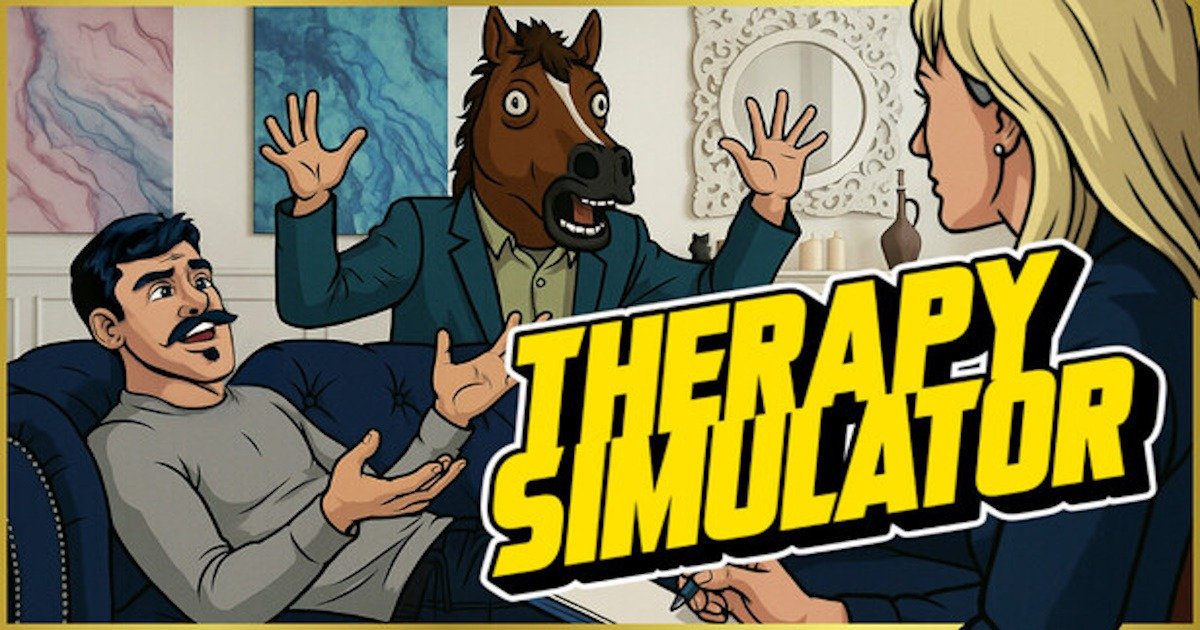
Therapy Simulator drops you straight into the therapist’s chair and lets you navigate a colourful swirl of human emotions, oddball personalities, and the occasional “wait… did they really just say that?” moment.
It’s a narrative-driven experience where every patient session feels like a miniature story. Sometimes it’s touching. Sometimes it’s weird. Sometimes you sit there wondering if you should be the one booking the appointment.
As the “therapist,” you guide conversations, make branching choices, decorate your cozy Manhattan office, shuffle around your schedule, and nudge patient lives in one direction or another. Sometimes for the better, sometimes… not so much.
Gameplay & My Experience
One of the first things that won me over in Therapy Simulator was how it refuses to shove you out the door once the main story wraps up. Most games roll credits like they’re politely escorting you off the premises or you are getting played off the Academy Award stage. But Therapy Simulator just leans back in the therapist’s chair and says, “You’re still enjoying yourself? Great. Take another patient.”
That alone bumped it out of the “quick play and uninstall later” category. Instead, it turned into one of those games I found myself launching in the tiny gaps of my day, the five minutes while coffee brews, the awkward time while waiting for my friend to pick me up, or those evenings when I want something chill without committing to a multi-hour epic.
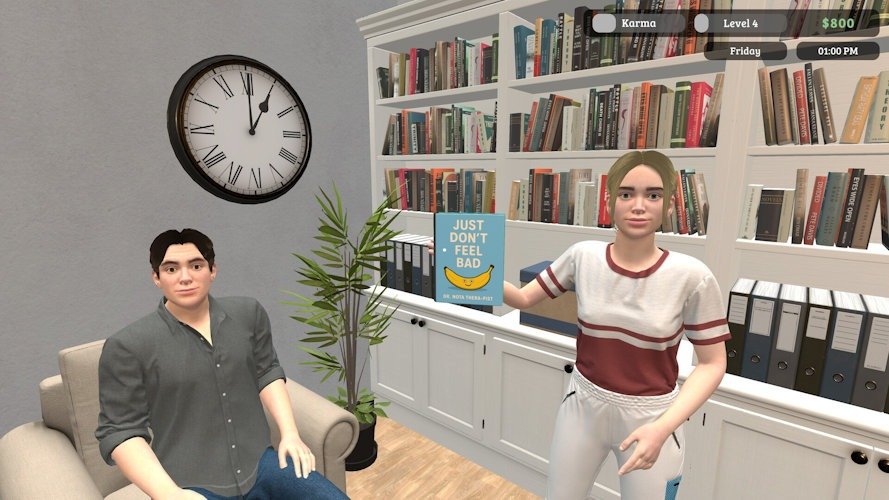
There’s also this odd, irresistible thrill every time a new patient walks in. Therapy Simulator keeps you guessing, Will this person lay out their deepest emotional scars? Or will they confidently explain that they’ve developed a telepathic bond with their houseplants?
Honestly, I’m not sure which one I prefer. Both made me laugh harder than I care to admit… and yet one made me question my own relationship with my dying houseplant. kidding…. I think.
Half the fun is reading their opening line and immediately trying to guess what kind of chaos you’re about to walk into. Sometimes it’s wholesome, sometimes it’s bizarre, and sometimes it feels like you should be the one lying on the couch. But that’s exactly where Therapy Simulator shines, it embraces the unpredictability of human behaviour and turns it into a gameplay loop that’s equal parts relaxing and ridiculous.
Therapy Simulator also throws a surprising variety of real emotional struggles your way, with patients dealing with things like health anxiety, workaholism, emotional repression, perfectionism, and even death anxiety, all of which show up across gameplay sessions
After a while, I caught myself thinking about the game the way a real therapist might: “I wonder how my next appointment is going to go…” Except in this version, no one’s life is actually in my hands, and I can guilt‑free select the dialogue option that causes just a bit of chaos.
Story & Tone
The story in Therapy Simulator leans into one very specific fantasy, the quiet question almost everyone has asked themselves at some point: “What does a therapist really think during a session?”
The game doesn’t just dabble in that idea; it jumps right in with both feet and invites you to do the same. Every patient session feels like its own quirky vignette, and your choices swing wildly between thoughtful professionalism and… whatever the opposite of that is, Khaostic Kelly? Sometimes you’re delivering genuine moments of empathy, and sometimes you’re just one click away from saying something that would get a real therapist escorted out of the building.
And the game knows it. It encourages it. Every dialogue option feels like it’s giving you a small nudge and whispering, “Are you sure you want to be responsible today?”
One minute you’re helping someone unpack their emotional repression or perfectionism, and the next you’re navigating a spiral of health anxiety or workaholism that makes you wonder whether you should be billing double for the emotional labour. Patients show up with surprisingly real issues, things like death anxiety and burnout, but they’re wrapped in enough humour and absurdity that it never gets heavy or clinical. It’s just the right kind of silly.
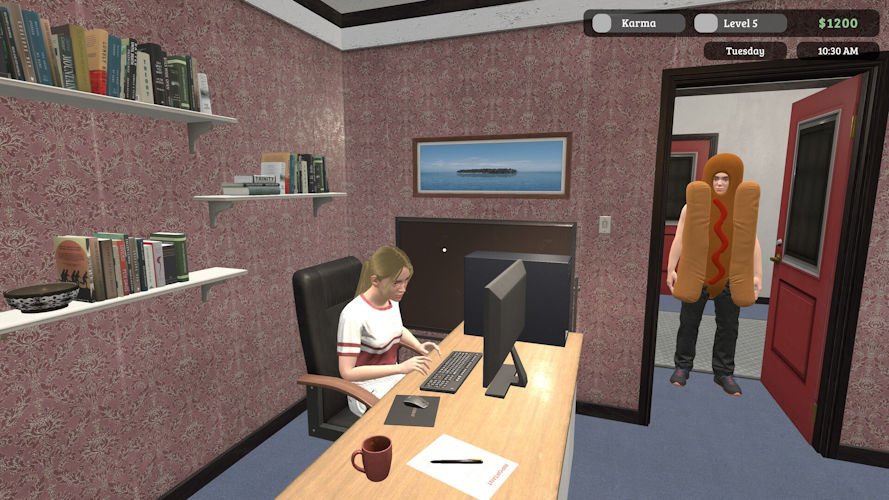
That’s part of the charm: Therapy Simulator isn’t here to teach therapeutic methods or model real counselling techniques. It’s here to be enjoyable chaos. Lighthearted. Occasionally unhinged. The kind of game where you can give the “good” response… or the response you wish you could say in real life but absolutely shouldn’t… Even in the privacy of your own home.
Because of that, I never took any decision too seriously, and honestly, based on some of the things I said to patients, that’s probably for the best. The game thrives on that tension between doing the right thing and doing the funny thing, and half the entertainment comes from seeing just how far you can push the boundaries before the patient quietly decides they’ve had enough of your “professional” guidance.
Graphics & Presentation
The graphics in Therapy Simulator strike this amusing balance between cozy charm and “yep, this is absolutely an Early Access game.” And honestly? It works. The moment you step into your tiny Manhattan office, the visual style sets the mood: warm lighting, clutter that feels intentionally placed, and a window view that quietly reminds you the city is buzzing along without you. It’s simple, but in a way that makes the whole space feel oddly comforting, like a therapist’s office should be.
The character models? Well, they’re a whole other layer of fun. Patients walk in with expressions that sometimes match the situation… and sometimes lag half a second behind, which somehow makes their emotional confessions even funnier. I watched one patient tell me they were having an existential crisis while their face did the animation equivalent of a long blink. It shouldn’t have been funny, but it absolutely was.
The game has its share of small visual quirks, the kind that scream Early Access. A hand might twitch, a chair might clip into the desk if you look too closely, or a character’s eyes might have a brief disagreement about which direction they want to face. At one point, my couch lodged itself halfway into the wall, and my patient went from sitting on absolutely nothing to having their legs casually sticking out of the wall before snapping back onto an invisible chair. It was hilarious, like I’d asked a serious question and they decided to answer it from another dimension.
But these aren’t the kind of bugs that ruin anything. If anything, they made me laugh because they fit perfectly with the offbeat personality of Therapy Simulator. It’s almost as if the game is gently whispering, “I’m still growing… please be patient with my glow‑up.”
What surprised me most is how expressive the environment feels, even without ultra‑realistic textures or complex animations. The office slowly becomes an extension of your choices and your chaos once you start decorating. Adding a plant, changing your wall art, or adjusting your furniture layout actually brings your little therapy space to life in a way that feels personal. I didn’t expect to care about décor in a game where I spend half my time trying not to give unhinged advice, but here we are.
The visual style isn’t trying to be cinematic or dramatic. It knows what it is: light, cozy, a bit quirky, and charmingly functional. It gets the job done while making sure the spotlight stays on the characters, their stories, and your increasingly questionable decisions.
Controls
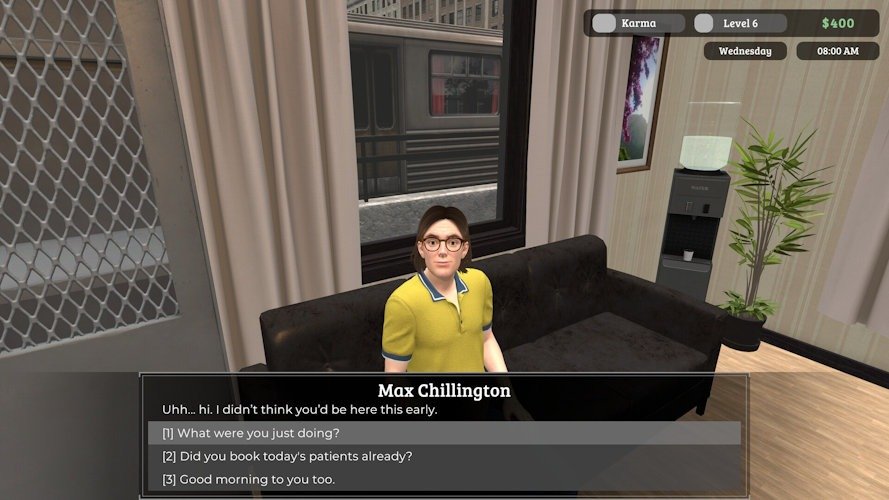
The controls in Therapy Simulator are about as straightforward as they come, which honestly feels perfect for the kind of game it is. You’re mostly clicking through dialogue choices, interacting with patients, and navigating your office, so there’s no steep learning curve or complicated keyboard gymnastics. It’s the sort of setup where you can sit back, relax, and play with one hand on the mouse and the other wrapped around your coffee mug, the true mark of a cozy sim.
Everything feels intuitive right from the start. Scheduling appointments, inviting patients in, or flipping through office menus is all handled with clean, simple interactions. There’s no moment where you’re fumbling through menus trying to remember which key does what. Instead, the controls quietly stay out of the way, letting you focus on the part that actually matters: deciding whether to be a model therapist or unleash pure conversational chaos. It’s smooth, it’s accessible, and it fits the vibe of Therapy Simulator perfectly.
Final Thoughts
After spending time in the wonderfully chaotic world of Therapy Simulator, I can safely say it’s one of those games that manages to be charming even when it’s misbehaving. And to be clear, it did misbehave. Before the first big update, the game had enough bugs to qualify for its own therapy session. There were moments where it was a little unplayable, the kind where you’re clicking on things and the game politely declines your request, or your office objects decide gravity is optional. But once that first update rolled out, it became more playable and through there were still bugs, it wasn’t completely unplayable. It’s far smoother now, and those rough edges have been buffed down to “endearing quirks” instead of “why won’t you just work, I’ve clicked it six times.”
With that sorted, Therapy Simulator really shines as a cozy, quirky escape. It never tries to be a serious mental‑health tool, it just wants to make you laugh, think a little, and occasionally wonder why your patient’s problems sound suspiciously like your own at 2 a.m. Every session feels like a fun mystery: who’s walking through the door, and what wonderfully odd issue are they about to unload?
The simple controls, unpredictable dialogue choices, and delightfully messy personalities make it incredibly easy to sink into. And despite the bugs, and there are still quite a few, the game’s personality carries it. The humour, the chaos, and the moments of unexpected heart all blend together into an experience that feels light and replayable.
If you’re looking for a uniquely entertaining side‑quest of a game, something warm, a bit weird, and always unpredictable. Then Therapy Simulator is absolutely worth keeping on your radar, but maybe wait until its out of early access or be ready for the quirky bugs that add some charm.d humour. Games are meant to be fun after all.



Recent Comments