
There’s a particular kind of focus that settles over a designer’s table long before anyone even whispers the words “final box art.” It’s quiet but not really silent, the scratch of a pencil trying to fix a mechanic that almost worked, the soft rumble of a playtest group arguing over whether a rule should stay or go. I always find that energy strangely comforting. It’s the same feeling I had when I sat down with Harry Metcalf, the creative mind behind Doopy Games, at The Game Expo.
Harry builds games, yes, but that feels like the simple version of what he does. He builds these little ecosystems where players end up becoming creators without even noticing the shift. If you’ve been anywhere near the Australian tabletop scene lately, you’ve probably caught the chatter around Fantasy Map Maker. It takes something that can feel a bit overwhelming, world‑building from scratch, and turns it into something tactile and oddly soothing. I think that says a lot about his design philosophy. He leans toward clarity, toward community, toward making sure people feel invited rather than tested.
Talking to him, you get this sense of how messy and strangely vulnerable the whole process is. Moving from a loose “what if” to something you can actually hold in your hands isn’t a straight line. We ended up diving into that space, the feedback loops, the moments where you have to listen to players but still protect the spark that started everything, the slow layering of ideas that eventually becomes a finished game. There’s a kind of magic in that iteration, especially when it’s tied to something as personal as a love for maps and tiny imagined worlds.
And honestly, whether you’ve been designing for years or you’re still staring at a blank sheet of hex paper wondering where to put your first river, Harry’s approach feels grounding. A reminder that the best games grow through trial and error and a fair amount of erased lines. Maybe even because of them.
So grab your favourite 0.5mm fineliner, or whatever pen you trust when you’re trying to think clearly, clear a bit of space on your desk, and settle in. This is a conversation about mapmaking, yes, but also about the grit and gentle chaos of game design with Harry Metcalf.
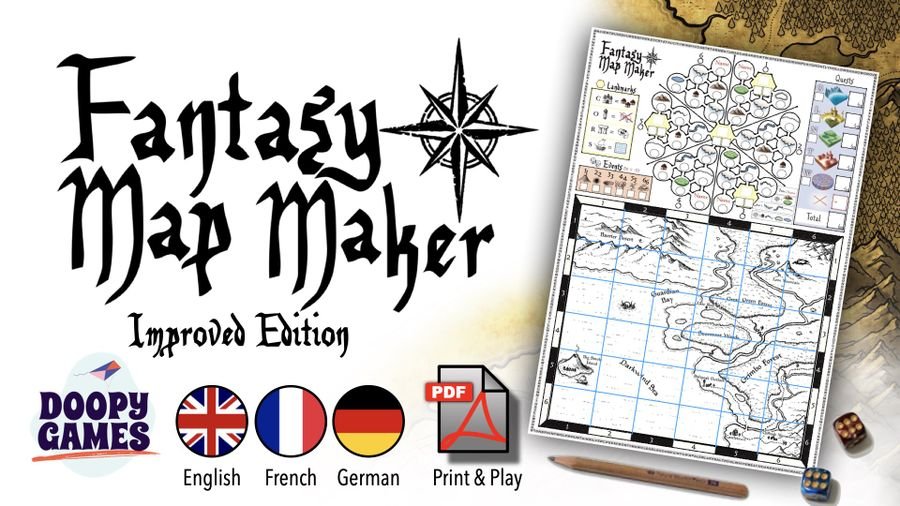
Ben: I’m here with Harry Metcalf of Doopy Games here at the Game Expo. Are you here showing off a game, or are you here play-testing?
Harry: I’m here presenting Fantasy Map Maker, which is at the pre-production stage. I would say, we started designing it maybe three years ago, I entered into a contest, and then developing it, releasing it as a print-and-play a couple of years ago. Now we just funded on Kickstarter earlier this month.
B: That’s awesome.
H: Thank you. We’re going to do the print run. Hopefully, maybe even get a few late pledges this weekend, that’ll be available until we open the pledge manager. The game is pretty much set in stone. It’s now a matter of doing the product design things. Such as where to put the barcode on the box, and that’s all that jazz. The actual game content is all done.
We just want to share it with folks this weekend.
B: Is this the first game that you’ve brought to publish?
H: This is the this was the first print and play game that I, quote unquote, published. It always feels a bit strange to say that with a print-and-play game.
Then last year we did the follow-up game, Dungeon Map Maker, which is kind of trying to fill all the mapping needs that you might have. As a role player or someone who just likes drawing maps.
That game was more about designing a dungeon blueprint, it’s available as a print and play. Fantasy Map Maker is available for print-and- play., but it’ll be the first physical game that we produce. I am really looking forward to seeing how it turns out and actually seeing the box on a shelf somewhere.
B: That is an awesome feeling. I think I’ve seen you at Collabatory at PAX AUS.
H: I’ve been to one.
B: Was that part of the design process? How important is it to get the early games into players’ hands, so to speak?
H: I think it’s super important, particularly, something like the collaboratory where you’re reaching a target audience, but also a wide spectrum of a target audience. While some people are more video gamers that drop by, some of the other designers that drop by or some people are board game fans.
You also get random people who just sit here and just check it out as well. I think that’s really important too. It’s better than just the general public, if that makes sense, because you get people who would potentially be more interested in a game.
It’s also better than just designers, which is also good; it’s always good to get feedback from designers, of course, but sometimes they kind of can focus on the minutiae of things that the average gamer doesn’t really care about. The Collaboratory was awesome. I actually didn’t show Fantasy Map Maker at the collaboratory. I showed a different game.
B: Ah, okay. But that was really good for that, for that game.
H: I got a lot of great feedback. It actually meant that I’ve shelved that game for a while, but, you know, being a publisher, you also have to weigh up like how commercially viable something is. That game was called Demons on Roller Skates. I thought the theme was a bit quirky, but it was like, how do I even market this?
It’s a bit of a weird one. So I’ve just shelved that for now. Coming soon or maybe never, but it was, yeah, doing the collaboratory was well worth it. Regardless of where what stage your game is at.
B: It’s great to get that real public view, as you said, great to go to an incubator or a playtaster thing where there are designers. Giving you more mechanical feedback. But whereas in an event where you’re with the public, like today, you’ve got all sorts of different people. They were coming at it in all sorts of different ways.
H: Yeah, and their goal is to have fun. Not to slice up a mechanic. I guess the other thing I would say, with like the collaboratories, it’s probably pretty self-explanatory, but the one advantage you have of going to incubators is that you can turn up with, like, a dog shit prototype. Hand-drawn stuff, and people will be able to see through that to the game behind it.
I think you probably do want to add as much polish as you can to your prototype when bringing it to the collaboratory. I think for one, so people like actually take you a little bit seriously, they’re not getting bogged down.
B: The average person, I think, will get bogged down by things like, “oh, yeah, this card, it says that, but actually, it doesn’t mean that because I just changed it this morning.”
H: Yeah, I mean, most people are chill, like they’re not going to get annoyed by that or anything, but it will help you not get bogged down in those kinds of little things. I don’t mean the prototype has to be amazing, and I’m certainly not advocating using AI for it.
Please don’t do that for sure, that’s horrible.
Just making sure that the actual cards are printed to some kind of standard can really help people take a game seriously. Then you’ll be able to see what you need to do as well. I’ve taken some things to design days that have been really rough-looking. Sometimes people get caught up in things. Things that I will fix, and then you’re wasting a lot of time explaining how you’re going to fix something that you could have just fixed beforehand, and not have to worry about that.
B: Can you give me an elevator pitch on what Fantasy Map Maker is? What is the game, and how does it work?
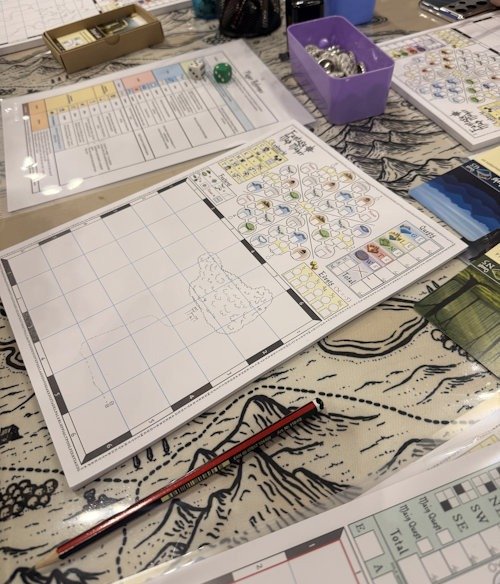
H: Yeah, it’s a roll and write style game for one or more players. It was originally designed as a solo game. So, it does work quite well in a solo mode.
You are essentially rolling 2 dice choosing a feature to draw based on your dice results and then adding that to your map. Then, similar to a Cartographer, scoring is based on five different scoring cards at the end of the game.
B: It’s endgame scoring. Do you know those at the beginning?
H: Yeah, you do. You can choose those. There are lots of different combinations, which means that you’re always, if you’re focusing on scoring, you’re always going to end up with different maps, and types of maps as well. One card might encourage you to add a lot of mountains, so you’ll have more of a mountainous realm. Other cards might not reward that at all. Or be focused on plains and forests and such.
B: So there’s the mechanical challenge of trying to score points, but there’s also the game as a creativity tool of trying to generate map ideas.
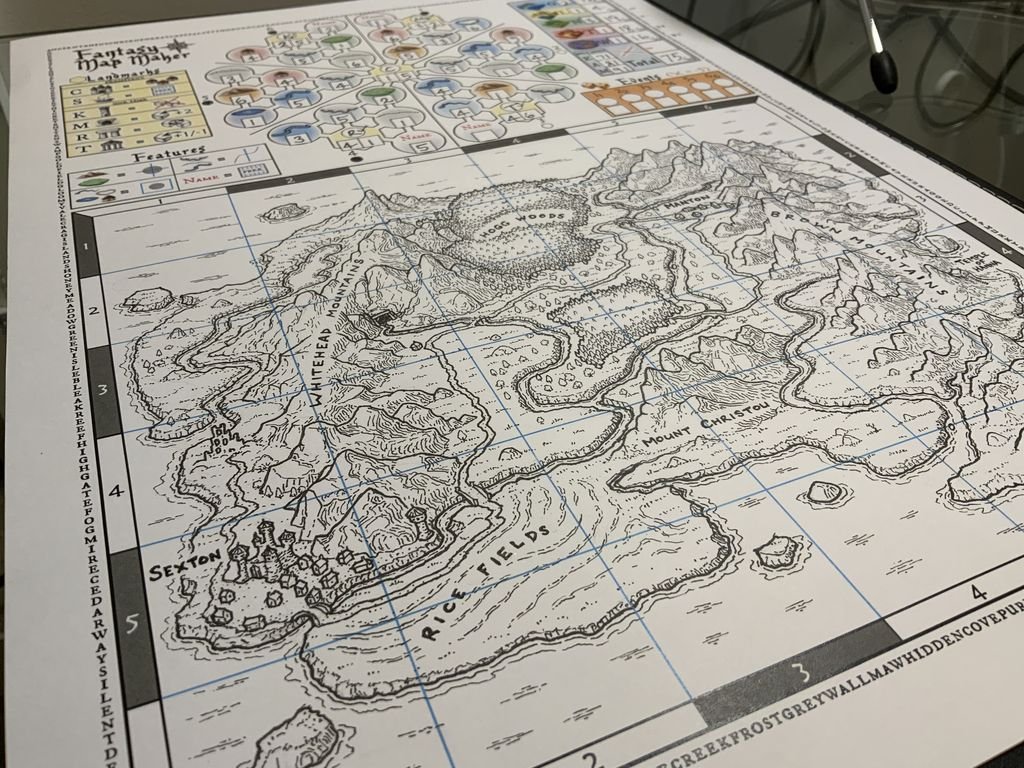
H: That’s kind of where the game came from, really, it’s like playing Cartographers and wanting the finished results to actually look like a map. Which makes the game very different from Cartographers. That was the genesis of the idea. After you play the game, it takes about an hour, then you’re left with a map that you could cherish.
B: Put it on your fridge, use it for a role-playing campaign or your next novel or something like that?
H: I always really liked dual-purpose designs, like designs that have that element to it, regardless of the result, your time was meaningful. Because you created something. I hope that it achieves that.
B: Do I have to have drawing skills, or can I just sort of do very basic shapes and things?
H: No, absolutely, you don’t need drawing skills at all. I think the only thing you need is you have to not to hate drawing. If you’re happy to draw and you can laugh at things when they look a bit strange. That adds to the fun, in my opinion. You definitely don’t need drawing skills, but there’s there are also drawing guides in the rule books, so if you’re really lost about how to draw something, say, draw a tree.
B: Is that a simple triangle and stick?
H: Yeah, exactly. You do get better at it as well. It definitely requires no drawing skills, but you will acquire them from playing the game.
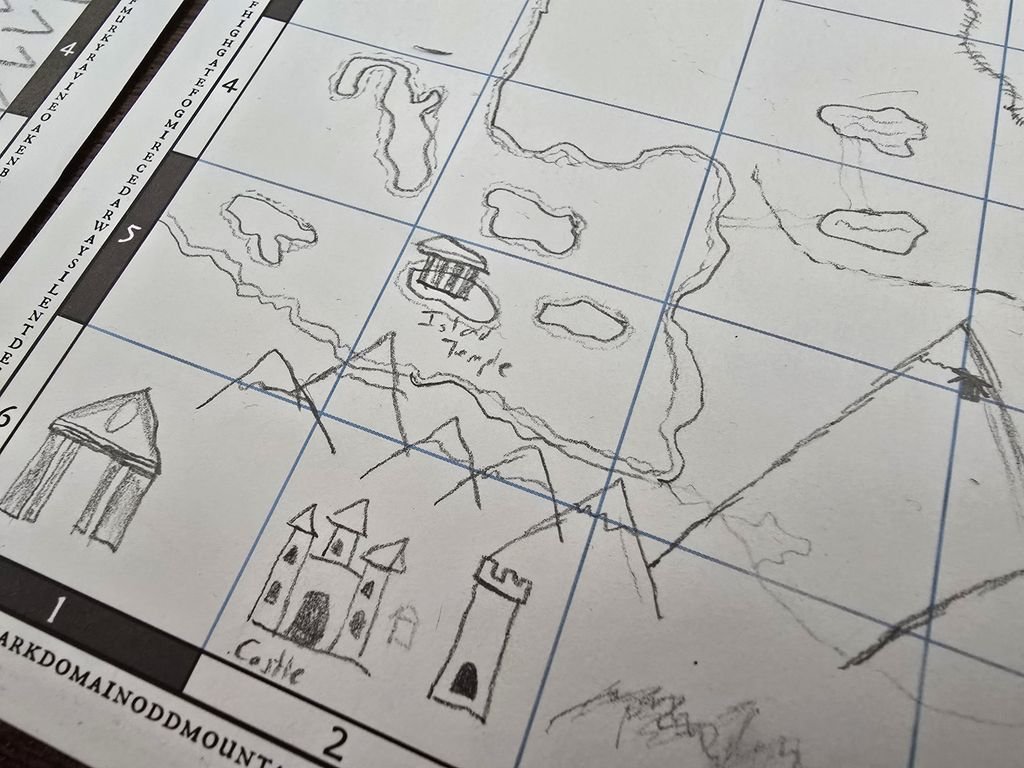
B: In the new printed version, I’m thinking of (Australian-made) Floodlands, which was also a print-and-play, then they published that for PAX. They came with about 50 sheets of blank sheets to get started. Is that something that’s gonna come with your physical game?
H: The physical game will have 100 double-sided sheets. You’ll have so many games you can play with that. The cardstock will be quite good as well. It’s not going to be something where you’re drawing on crepe paper or something. The game does take about an hour to play. I think it’s important that it actually feels nice to draw on. The game will also include pencils and all the cards to the game, as well as some sheet protectors.
Because the game cards are double-sided. After you played a game, you could then use a sheet protector to put it in and then come back and play the next side later. Or if you only have 10 minutes, you can start a game, then put it in the sheet protector to come back and play again later.
B: You include the dice, too?
H: Yeah, of course! Importantly, it comes with 80 of the game sheets, which are the standard game, and there are variations on the features wheel on each of the game sheets. Essentially means the distribution of the features is a bit different; it’s gonna feel different each time, depending on the sheet. Think Castles of Burgundy, they have like different maps that you can play on. Not a huge change, but just enough to make them different.
Then, the other 20 of the double-sided game sheets are for the continent expansion, which also has its own 6 cards. Which is a game spread over 4 sessions where you’re making 4 different maps and then get merged into one giant map.
B: You can play that with 3 friends.
H: Yeah. Or in pairs collaboratively.
B: It’s a cooperative version where you’re making a map together. A mega map!
H: Exactly.
B: It means you can work together and make it in one session, which is kind of satisfying.
Does it have good interactivity in that mode?
H: Yeah. For example if my coastline’s going to come into your map a little bit, you might need to set your forest in another part of the your map.
B: That’s awesome. Thank you for your time. Please tell us where can we find you?
H: you can find me at doopygames.com. We still have late pledges open for the Kickstarter.



Recent Comments