

In our household, the dinner table pulls double duty. Most nights, it’s where we eat, sometimes quickly, sometimes with lingering stories. But on game night? It turns into a battleground. A friendly one, mostly. Though someone almost always ends up mock-pouting over a blocked move or a stolen card. Lately, our go-to has been Hot Pot, a fast-paced board game built around soup.
Not actual soup, though we’ve joked about trying it with real broth. For now, it’s just a playful, culinary theme that somehow works. You load ingredients into a shared pot, scoop them out for points, and try not to get sabotaged. It’s simple, chaotic, and surprisingly strategic.
The first time we played, there was confusion, laughter, and a lot of dramatic “STOP” cards. Now it’s a weekly ritual. Everyone has their favourite bowl, their petty strategies, and their own way of pretending not to care while quietly plotting revenge.
It’s not just a game, it’s a moment we all look forward to. And yes, imaginary soup has become weirdly important in our house.
How It Plays
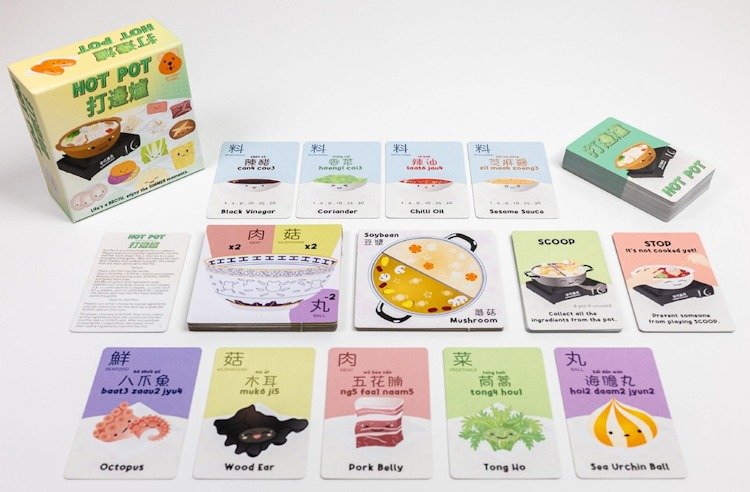
The rules are refreshingly simple. Players take turns adding ingredients to a shared pot, then attempt to scoop them out to earn points. That’s the core loop. But beneath the surface, there’s a surprising amount of nuance, timing matters, and so does reading your opponents.
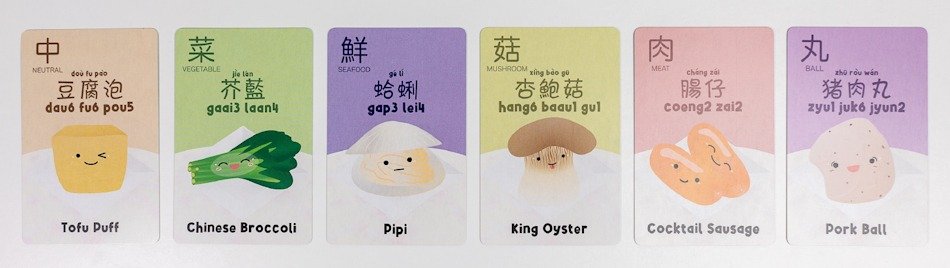
The game’s visual style is part of the charm. My kids are drawn to the bright colours and silly illustrations, especially the tofu card, which one of them insists looks passive-aggressive. I’ve stopped trying to convince them otherwise. Personally, I’m more into the mechanics: streamlined, intuitive, and just unpredictable enough to keep things lively.
Each round has a rhythm. Add, scoop, block. Repeat. It moves quickly, but never feels rushed. Even when it’s not your turn, you’re watching, calculating, maybe quietly scheming. There’s always something unfolding.
The creators, Jono and Ando of Quokka Games, are brothers working across Brisbane and Canberra. Despite the distance, they’ve built something that feels cohesive and personal. I first came across their earlier game, Yum Cha, at PAX AUS in 2022. It was a quick demo, nothing flashy, but it lingered. Something about the pacing, maybe the theme, stuck with me.
So when I heard Hot Pot would be featured at PAX AUS 2025, I didn’t hesitate. Picked up a copy early and I’m glad I did. It’s earned its place at our table, not just as a novelty, but as part of the rhythm of our week.
What’s in the Box
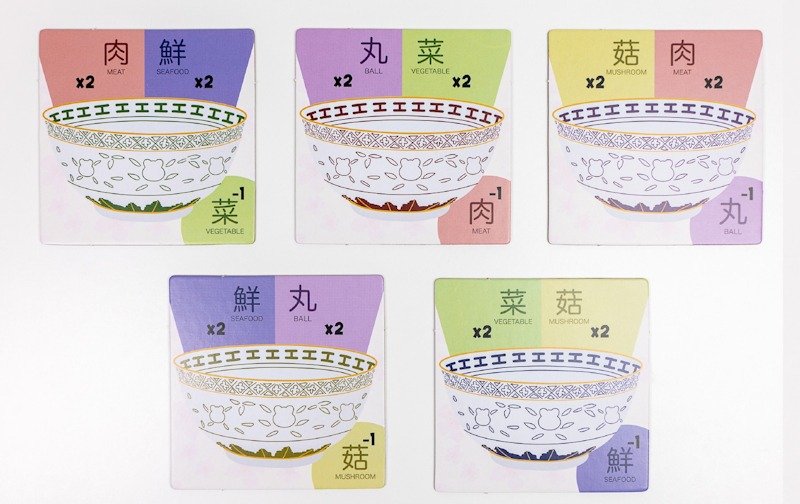
The game supports 3 to 5 players, which makes it flexible enough for family night or a quick round with friends. Setup is straightforward: you get a central Hot Pot, individual bowls, and a deck of action and ingredient cards. The bowls aren’t just decorative; they come with their own quirks. Some reward specific ingredients like tofu or dumplings, while others penalise things like mushrooms or chilli. One of my kids always picks the bowl that punishes mushrooms, purely out of principle. No one’s sure why. It’s become part of the ritual.
Each player starts with two scoops, and from there, it’s a race. You’re watching the pot, eyeing the ingredients, trying to time your move just right. But it’s not just about grabbing the most, it’s about grabbing the right ones. Some combinations score big, others backfire. And when you think you’ve lined up the perfect scoop, someone plays a “STOP” card and ruins everything.
There’s a tension to it, not stressful, but playful. You’re constantly weighing your options: do you scoop now and risk getting blocked, or wait and hope no one beats you to it? The pot fills up, the cards shift, and suddenly your plan doesn’t look so clever anymore. It’s fast, it’s unpredictable, and it keeps everyone leaning in, even between turns.
Scoop vs. Stop: The Chaos Mechanic
The real drama kicks in when someone plays a “SCOOP” card. That’s when they try to grab everything in the pot, every last dumpling, tofu, and chili. It’s a bold move, often timed with theatrical flair. But if another player throws down a “STOP” card? Instant chaos. The table erupts. There’s groaning, fake outrage, and sometimes a bit of smug satisfaction from the blocker. We’ve had rounds where someone’s entire strategy crumbled because their scoop got blocked at the last second. And yes, sometimes the block is just for fun. Or spite. Depends on the mood. There’s no shortage of petty plays in our house.
One time, my youngest waited until the pot was absolutely overflowing, like, cartoonishly full, then played a SCOOP with a grin that said, “I’ve got this.” They didn’t. The STOP came from across the table, casually, like it was no big deal. It was a big deal. The betrayal was felt. The drama was real. And the laughter lasted longer than the round itself.
It’s the kind of mechanic that invites laughter and groaning in equal measure. You think you’ve got the perfect scoop lined up, and then, BAM, someone ruins it. And somehow, that’s part of the joy. It’s not just about winning. It’s about the timing, the reactions, the little moments of chaos that make the game feel alive.
Even when you’re the one getting blocked, it’s hard to stay mad. Well, mostly. There’s always the next round. And maybe, just maybe, your revenge will be perfectly timed. Or not. Either way, the pot keeps bubbling, and the drama never really stops.
Scoring That Keeps You Guessing
Scoring is a mix of basic math and sneaky multipliers. Most ingredients are worth a point, straightforward enough. But then you’ve got the special ones, like seasonings, which scale based on how many you collect. One seasoning? Meh. Four? Suddenly, you’re racking up points faster than anyone expected. My kids love chasing those, even when it’s not the smartest move. They’ll ignore high-value combos just to hoard seasonings, convinced it’ll pay off. Sometimes it does. Sometimes it doesn’t. But the satisfaction of watching those numbers climb? That’s hard to resist.
There’s also a kind of quiet tension that builds as the game progresses. You start noticing what others are collecting. You wonder if you should pivot. You second-guess your bowl’s bonuses. And then there’s the SCOOP card dilemma.
Even unused SCOOP cards have value at the end, eight points, which is nothing to sneeze at. But playing one mid-game can be a game-changer. Or a disaster. Do you go for it now, hoping no one has a STOP card? Or do you hold onto it, knowing it’s a guaranteed bonus later? There’s no perfect answer. Just a lot of internal bargaining and playful regret.
We’ve had rounds where someone held their SCOOP too long, missed their moment, and ended up with a pot full of ingredients they couldn’t use. And others where someone played early, got blocked, and spent the rest of the game muttering about “wasted potential.” It’s all part of the rhythm, small decisions that feel bigger than they are, and the kind of scoring that keeps everyone just a little bit anxious, in the best way.
Why It Works
I wouldn’t call Hot Pot groundbreaking. It’s not trying to reinvent anything. But it’s warm. It’s clever. And it’s become something we genuinely look forward to. There’s a kind of intimacy in playing it together, laughing, arguing, trying to out-scoop each other. It’s not really about winning. It’s about the shared silliness, the little rituals, the inside jokes that quietly build over time.
As my kids get older, it’s moments like these I know I’ll hold onto. And it’s games like this, simple, joyful, just structured enough that keep those moments coming, week after week.
There’s comfort in the repetition. Someone always forgets their bowl’s penalty. Someone else always tries to scoop too early. And someone, usually me, gets blocked and spends the rest of the round muttering about timing. It’s predictable, but in the best way. Like a favourite show you rewatch not for the plot, but for the familiarity.
We gave it an informal rating: 8 out of 10 bowls of soup. Not scientific. Just a gut feeling. The kind of score you give when something fits into your life without forcing itself. It’s not perfect, but it doesn’t need to be. It’s earned its place at our table, and that’s more than enough.
For the Gaming Crowd
For my regular gaming group, Hot Pot works perfectly as a filler. Three players minimum, five max; it hits that sweet spot where you don’t need a full crowd, but it still feels lively. It’s ideal for that awkward window when someone’s running late or we’re between heavier games and just want something quick to reset the mood. Quick setup, quick laughs, and just enough depth to keep it from feeling like filler in the dismissive sense. It’s light, but not empty.
We’ve had nights where we played one round and moved on, and others where we looped through three or four games without even noticing. It’s flexible like that. You can lean into the strategy or just play casually and enjoy the chaos. Either way, it never drags. It doesn’t demand your full attention, but it rewards it if you give it.
It’s also one of those games that doesn’t overstay its welcome. You can play a round, reset, and go again or pack it up and move on. No lingering setup, no drawn-out scoring. Just a clean finish and a table that feels lighter. And honestly, that’s a rare thing. Most games either feel too short or too long. Hot Pot somehow lands right in the middle—just enough to feel satisfying, never enough to feel like a chore.
Catch It at PAX
If you’re heading to PAX Rising this October (Melbourne Convention Centre, 10–12 October 2025), definitely swing by and give Hot Pot a try. You’ll know it by the pot in the middle of the table and the laughter nearby.
Whether you’re a seasoned board gamer or just wandering through looking for something light and unexpected, it’s worth sitting down for a round. The rules are quick to learn, the gameplay is fast, and the vibe is pure joy. Plus, if you’re anything like us, you might walk away with a new weekly ritual and a few inside jokes of your own.
Please consider supporting the author through his “Buy me a Coffee” page.





Recent Comments