

Doom: The Dark Ages is one of those games you just have to try. At least, that’s how it felt for me—a guy in his late 40s who grew up with the original Doom melting our family PC.
Back then, it was groundbreaking. Almost 3D graphics, horror elements that felt genuinely intense (even if they were just 2D sprites), and that sense of discovery—finding secrets, swapping the keyboard and mouse between friends after each death, trying to push just a little further each time. It was chaotic, and brilliant.
Now? I’m more of a casual gamer. I dip in when I can. Mostly RPGs like Baldur’s Gate 3, Cyberpunk, that sort of thing. But I have Xbox Game Pass, and I like to test out new releases when they drop. So when Doom: The Dark Ages launched, I figured I’d give it a go.
And… I got hooked.
Doom Guy Returns
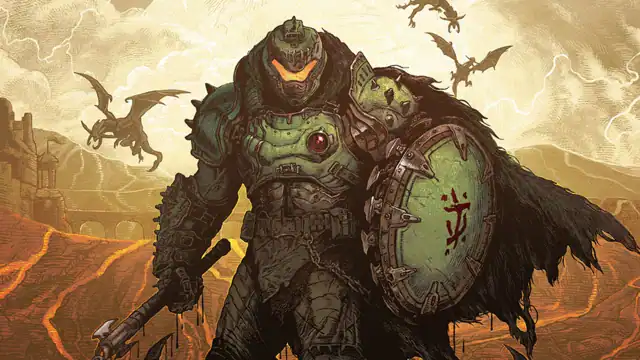
There’s something about Doom Guy. Or the Slayer, as he’s known here. He’s still that lone, unstoppable force, but this time there’s a twist. The story places him in a world that’s part medieval, part sci-fi. Think chainmail meets plasma rifle. It’s a strange blend, but it works.
You’re dropped into a planet under siege by demonic forces. The humans are barely hanging on, and you’re their last hope—though not exactly by choice. The lore hints at alien overseers pulling the strings, which adds a layer of mystery I didn’t expect.
Weapons are a mix of the familiar and the bizarre. The shotgun’s back, of course, but now you’ve got energy weapons, spiked maces, ball-and-chain launchers, and a version of the BFG that… well, I won’t spoil it. Let’s just say it’s not what you’re expecting.
The Shield That Shreds
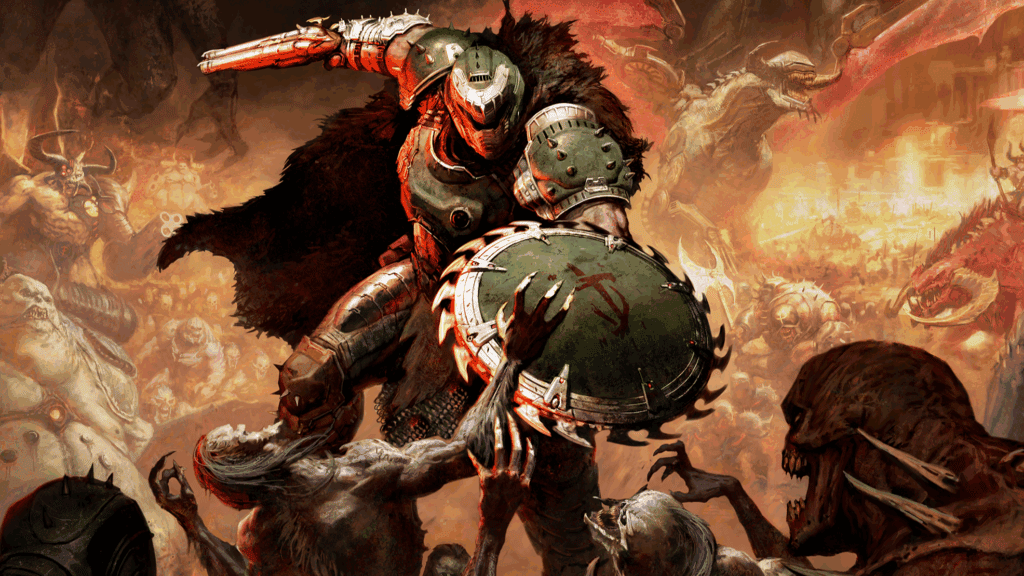
One of the biggest changes, and honestly, the one that stuck with me most, is the shield. In classic Doom, it was all about the chainsaw. That raw, up-close brutality. Making me feel like Ash from Evil Dead, revving it up and tearing through demons like it was personal.
Here, you still get that same energy-ripping satisfaction, but it’s been reimagined into something smarter. More versatile. And yeah, kind of brilliant.
The shield isn’t just for blocking. You can reflect projectiles, bash enemies back, or, my personal favourite, throw it. Once upgraded, it gets a chainsaw edge that embeds itself into enemies. It stuns them, leaves them wide open, and gives you just enough time to unload whatever weapon you’re holding. It’s brutal. It’s satisfying. And it’s surprisingly strategic.
I didn’t expect to lean on it as much as I did. At first, I thought it’d be a backup tool—something to use when I was out of ammo or cornered. But it quickly became central to how I played. It’s not just defense. It’s control. It lets you shape the fight, slow things down when you need to, or open up space when it’s getting too crowded.
It’s one of those mechanics that feels so natural, you wonder why more games haven’t done it. Or maybe they have, but not quite like this.
Secrets, Upgrades, and That Familiar Loop
As with any Doom game, secrets are everywhere. Hidden rooms, puzzle doors, skull keys, moving platforms; if you can think it, it has it. I spent way too much time combing through maps after clearing out enemies, trying to find that last elusive collectible. And no, I didn’t find them all. Not even close.
But that’s part of the charm. The game encourages replay. The main story spans 22 chapters, and while you could speedrun it in 12 hours, a more thorough playthrough will take closer to 20. I clocked in around 18, hitting about 70% completion on most maps. I got 98% on one and still can’t figure out what I missed. It’s maddening. In a good way.
Upgrades are tied to gold and gems, which you collect throughout the levels. Weapons and melee tools each have their own upgrade paths, and the shield has its own track too. It’s not overly complex, but there’s enough there to keep you engaged.
Dragons, Mechs, and Mayhem
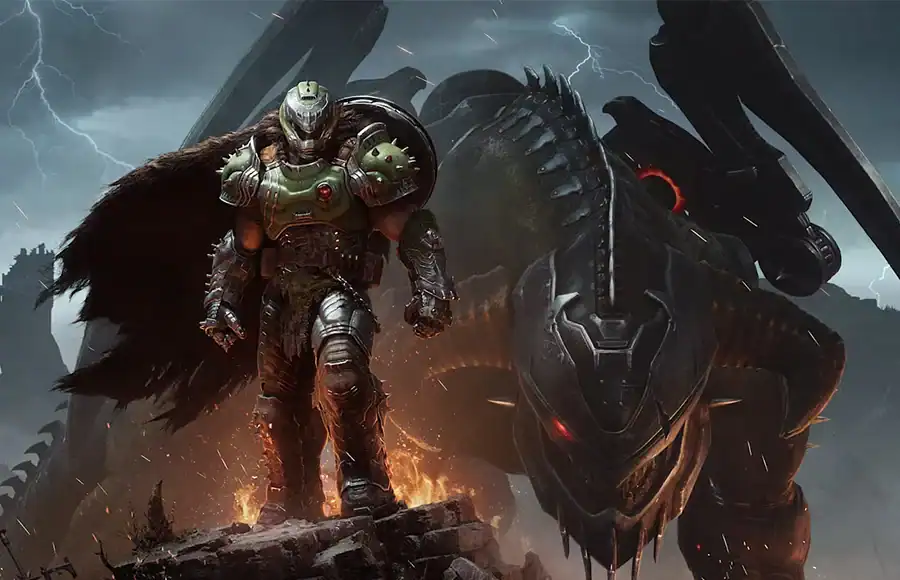
You get to fly… a DRAGON!
Yes, you heard that correctly, you get to ride a dragon. This is only in a few small sections of the game, but these were good fun, and it was enjoyable to have a different play style added in. The flying sections are simple but effective; just enough to break up the pacing and give you a breather from the usual carnage.
You also get to pilot giant mech-style suits to combat the HUGE monstrous demons and other things from the pits of hell. Again, not the core of the game, but a welcome change of pace. Although with the different weapons (ranged and melee) and the shield, there was plenty to keep me engaged without feeling repetitive.
Gameplay and Flow
I played on Xbox with a controller and had no issues with responsiveness. Movement felt smooth, aiming was tight, and the combat was fast, fluid, and just chaotic enough; hitting that sweet spot Doom is known for. It’s the kind of game where you’re constantly moving, dodging, switching weapons mid-fight, and somehow it all just clicks. No lag, no weird input delay. Just pure momentum.
If you want to just follow the story, you can. The game won’t stop you. But doing that means missing out on a lot, such as upgrades, secrets, and hidden areas that reward exploration. And while it’s not open-world, the levels are big enough to feel like you have room to roam, and without getting completely lost. I often found myself veering off the main path just to see if there was a hidden skull key or a stash of gems tucked behind a wall. Sometimes there was. Sometimes… not. But that’s part of the fun.
I played on easy. Not because I couldn’t handle more, but because I didn’t want to. These days, time is limited. If a game gets too frustrating, I tend to move on rather than grind through it. So don’t judge me!
That said, the difficulty scaling here feels fair. I never felt like I was being punished for choosing a lower setting, and I could definitely see myself replaying a few favourite levels on a harder difficulty just to see how far I could push it, or maybe just to finally find that one secret I missed.
There’s a rhythm to the gameplay that’s hard to describe. It’s not just about shooting everything in sight. It’s about movement, timing, knowing when to use the shield, when to switch weapons, when to go all in and when to back off. And when it all comes together, when you clear a room without taking a hit, or pull off a perfect shield throw into a stunned demon, it feels incredible. And is like poetry in motion!
Final Thoughts
Doom: The Dark Ages doesn’t reinvent the franchise, but honestly, it doesn’t need to. It knows what it is. It builds confidently on what already works, adds a few clever twists, like that brilliant shield mechanic, and delivers a fast, brutal, and surprisingly stylish experience that feels both familiar and fresh.
It’s not just a nostalgia trip, though there’s definitely something satisfying about seeing the DNA of the original Doom still pulsing through the chaos. The pacing, the secrets, the sheer momentum of it all; it’s still there. But now it’s wrapped in a world that feels more fleshed out, more deliberate. There’s lore, there’s structure, and there’s just enough weirdness to keep you curious.
For someone who grew up with the original, that’s saying something. I didn’t expect to enjoy it this much. I thought I’d dip in, get a hit of nostalgia, and move on pretty quickly. But I stayed. I kept playing. And I’ll probably go back again and not just find that one secret I missed and get one level 100%
10/10. Will play again. Probably more than once.




Recent Comments