
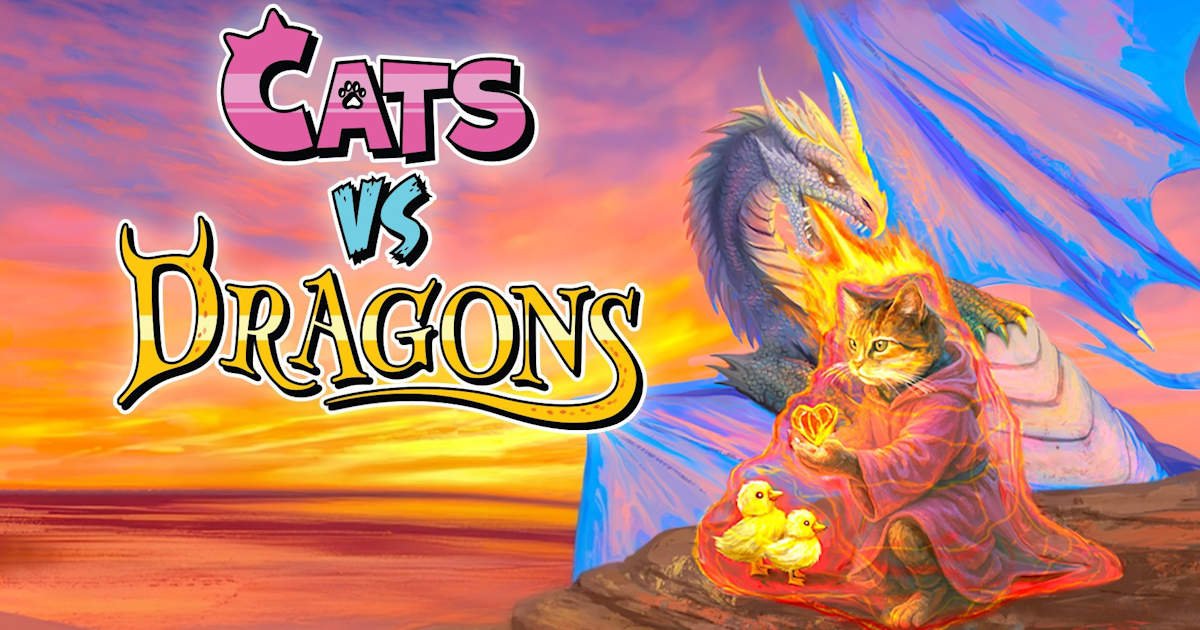
The sky cracks. Four ancient Dragon Gods stir from slumber, their power etched into stone and whispered through time. Across the battlefield, feline forces gather, not timid, not tame, but cunning and chaotic, ready to claw their way into legend. The air hums with tension. Spells shimmer. Artifacts pulse. Somewhere between myth and mischief, the war begins.
This isn’t a tale of heroes. It’s a clash of instincts, of bluff and bravado, of creatures stacked high and alliances built low.
So, is Cats Vs Dragons a breath of fresh air or a fireball destined to fizzle out?
Setup
- Set the 4 Dragon Gods to form a square, with space between them, to place card stacks for each player.
- Each player takes 1 of the God Artifacts. This card remains on the table in front of the player until played. It does not count towards your hand. All cards are the same. Please, no fighting.
- Shuffle all the other cards together and deal each player 7 more cards. This is the player’s hand.
- Place the remaining cards face down in a pile where all players can reach them.
- Each player rolls 2 6-sided dice or a 12-sided dice. Whoever rolls the highest goes first.
- Set the resource counter(s) to 3 and place them so they are visible to everyone. (We suggest using D6 dice.)
Gameplay
Game Round
- Starting with the first player, each player takes their turn in a clockwise direction.
- After the last player’s turn, increase the resource die by 3 until you reach 18, after which, the counter remains at 18.
Player’s Turn
- Draw one card from the central deck. If your hand is empty, draw 2 cards. (Draw even if you go first.)
- Play a card or cards from your hand whose total cost is equal to or less than the current value of the resource counter. These can be artifacts, creatures, spells, a God Artifact or a combination.
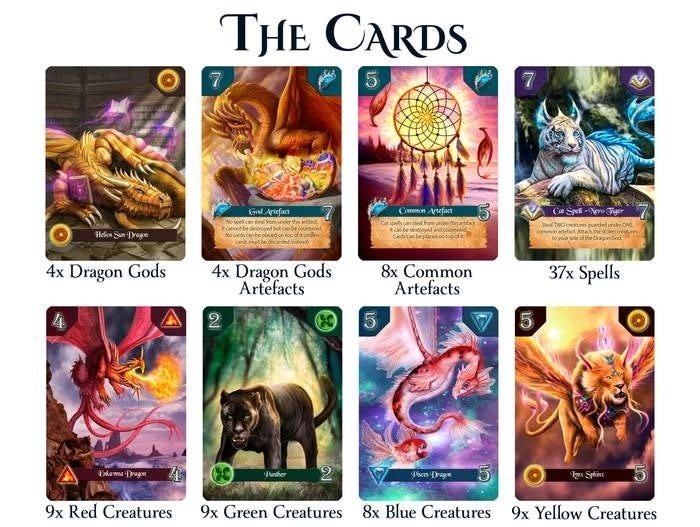
- Artifacts and Creatures: When playing a creature card, place one short edge of the card on the Dragon God of the same colour and the other short edge facing you. Do the same for artifacts. Each additional creature or artifact card you play to the same pile is placed on top of the previous, with the resource number showing, creating a stack.
- Spells: When you play a spell, read the text description and do what it says. Discard after use, except RainbowDragon.At the end of your turn, if you have more than 8 cards in your hand, then the player to your left takes a card at random and places it on the discard pile.
- End Turn
Game’s End
When the last card is drawn, each player will have one last turn, starting with the player who drew the last card from the central deck.
To determine the winner, count how many points each player has on their side of a Dragon God, including both creatures and artifacts. Whoever has the most points on that Dragon God gains one Victory Point. Repeat foreach Dragon God. Whoever has the most Victory Points wins the game.
If multiple players have won an equal number of Victory Points, then whoever has the highest total score, counting points from all DragonGods, wins the game
Solo Mode: How to Play
First Thoughts
I played Cats Vs Dragons over three sessions last week. Actually, four if you count the half-game that got abandoned when someone spilled coffee on the Dragon Gods (Luckily, it was a print-and-play version, so it wasn’t a complete loss). That one doesn’t really count, but it did leave a sticky ring on Jeff (that will make sense later) that I couldn’t clean off, so I reprinted it.
The first full game of Cats Vs Dragons was with my kids. Well, not my actual kids, more like the two younger guys at work who’ve decided I’m their unofficial mentor-slash-dad, as they found out I’m a few decades older than them. They call me “Daddy Dez.” I wish I were joking. It started as a joke, I think, but now it’s just… a thing. I’ve stopped fighting it, no matter how weird I find it. They text me for advice, send me memes, and occasionally ask if I’ve had too many coffees today (the answer is always yes). It’s kind of weird, kind of endearing, but more weird.
Anyway, they were hyped to play Cats Vs Dragons, as they love board games. One of them kept trying to play spells during other people’s turns, the other stacked his creatures sideways because, and I quote, “it just looks cooler.” I let it slide. They were having fun, and honestly, the chaos kind of suited the game. At one point, they both tried to cast Bixie’s Slap at the same time, shouting “DOUBLE SLAP!” like it was a wrestling move. Technically not allowed, but I didn’t have the heart to stop them. We ended up creating a house rule on the spot: if two Slaps are played simultaneously, the Dragon God gets flipped upside down. No strategic reason. Just vibes.
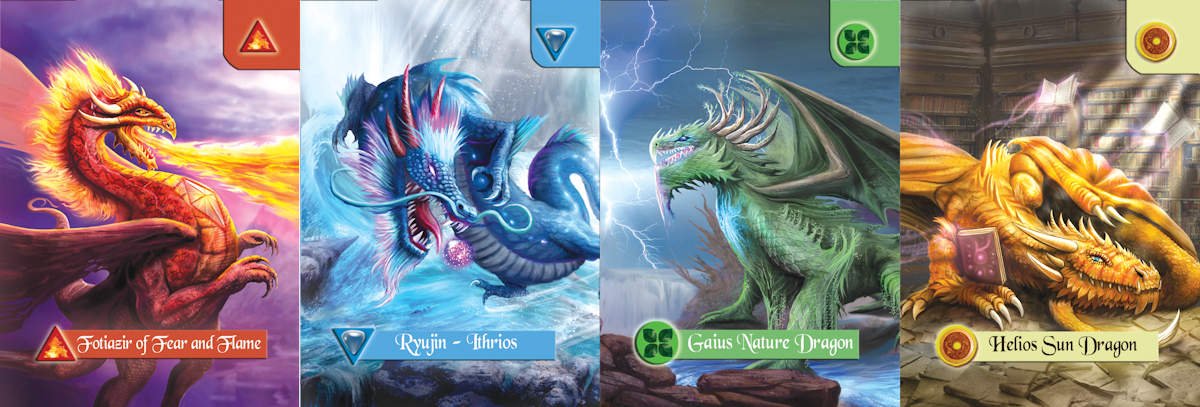
They also kept forgetting which Dragon God belonged to which colour. I had to explain it three times, then gave up and let them assign nicknames. “Red one’s Gary,” they decided. “Blue’s Susan. Green is Jeff. Golden’s just Goldie.” By the end of the game, they were cheering for Jeff like he was a real person. I think Jeff won. Or maybe Gary. Honestly, I lost track.
The best moment? One of them tried to bluff a trade in Trade Wars mode in-game 4, offering me a card he didn’t actually have. I called him out, and he just grinned and said, “You know me too well, Daddy Dez.” I didn’t know whether to be proud or concerned.
We didn’t tally points properly. I think someone won. Might’ve been me. But it didn’t matter. Cats Vs Dragons turned into a kind of storytelling session, with spells becoming plot twists and creatures getting personalities.
That session reminded me why I like games like this. Not because they’re balanced or clever or even particularly fair. But because they permit people to be silly, to bend rules, to invent lore mid-game and argue passionately about whether Jeff should be allowed to cast spells while upside down. In other words, have fun!
The second time I played Cats Vs Dragons was with a couple of friends who treat board games like blood sport. Calculators out, rules memorised, bluffing like it’s poker night. They spent half the game arguing whether Bixie’s Slap overrides a God Artifact. I think they were both wrong, but I stayed quiet and kept stacking cats like I had a plan, which in the end, didn’t work for me.
It was intense. Every move was dissected, every spell debated, especially in the first game. One pulled off a brutal combo with two Steal spells and a Common Artifact; I had to respect it. I lost badly. Played my God Artifact too early, got slapped twice in the final round, and ended up with a mess of mismatched stacks.
Afterwards, they wanted a full debrief. Strategy talk, pacing analysis, and even resource curve theory. I nodded along, but honestly, I’d been winging it. Compared to the chaos of my first game, this one felt like a tournament. Not exactly fun, but satisfying in a strange, exhausting way. Yet they loved it, as they love that way of playing games.
That is the beauty of board games. You can play the same game, and each person has their own style, and whether you are more like session 1 or 2. You will still enjoy your session.

The third session was solo. I stuck to the standard rules, thankfully, no Trade Wars, no house tweaks. Just me, the Cats Vs Dragons deck, and a quiet table. I started narrating turns out loud, partly to stay organised, partly to fill the silence. That is, until my housemate randomly appeared out of nowhere. Judging by the confused and slightly worried look on her face, I’m guessing she’d been watching a few rounds.
The solo version was surprisingly revealing. It actually helps you get to know and understand Cats Vs Dragons better. I’d definitely recommend giving it a go; not just because it’s quieter and less chaotic, but because it offers a different kind of fun.
Trade Wars Mode: Bluffing and Chaos
The alternate mode of Cats Vs Dragons, Trade Wars, is where things get weird. Not chaotic like the base game, more psychological. You pick a personal Dragon God, build your army around it, and suddenly the game isn’t just about stacking creatures. It’s about trust. Or pretending to trust. Or pretending not to trust. It’s hard to tell.
The bluffing mechanic is the heart of it. You offer a card face down to another player, claiming it matches their Dragon God’s colour. They can accept, or someone else can call “Trade Bluff” and become the Truth Seeker. If you were honest, you get both cards, and the Seeker skips their next draw. If you lie, you lose everything, and the Seeker gets a bonus. It’s simple, but it messes with people.
In a three-player game, I tried bluffing a trade. Offered a card to the guy on my left, saying it was green. It was. The third player called a bluff, got burned, skipped their next draw, and I walked away with both cards. Felt great. Smug, even. Like I’d unlocked a secret layer of the game.
Next round, I got cocky. Lied. Said I had a red creature, and handed over a spell. Got called out instantly. Lost both cards, didn’t get to draw, and watched the Truth Seeker grin like they’d just won the lottery. That felt… less great. The mood shifted. People started second-guessing every trade. Even honest ones felt suspicious.
Trade Wars adds tension, no question. Every interaction becomes a mini mind game. But it also slows things down. Turns take longer. Players hesitate. There’s more talking, more second-guessing, more “wait, let me check the rules again.” Some people love that. They lean into the drama, the bluffing, the layered strategy like my second session players. Others just want to stack cats and dragons and cast spells without feeling like they’re in a social deduction game.
I’m somewhere in between. I like the tension, the unpredictability, the way it forces you to read the room. But sometimes I miss the simplicity of the base mode, just building stacks, slapping spells, and watching chaos unfold without needing to explain your motives.
Trade Wars is clever. Maybe brilliant. Maybe broken. I still haven’t decided. But it definitely changes the game. Whether that’s a good thing depends on who you’re playing with and how much they enjoy being lied to.
Artwork
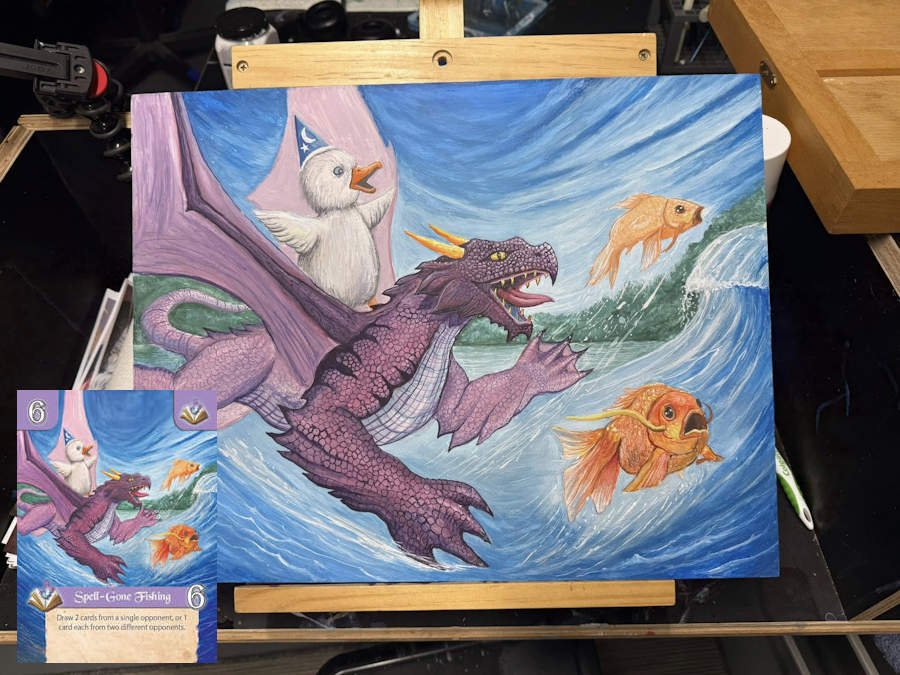
If you’ve seen Antonios Christou’s work before, whether in Luminous Ages, War of the Worlds, or his gallery pieces that stop foot traffic at pop culture expos, you’ll know what to expect. And yet, Cats Vs Dragons still manages to surprise. The hand-painted art is luminous, layered, and unapologetically bold. Every card feels like it was pulled from a dreamscape: dragons that shimmer with mythic weight, cats that radiate mischief and charm, and backgrounds that hum with story even before the game begins.
Christou doesn’t just illustrate, he world-builds and Cats Vs Dragons is no exception. His brushwork carries emotion, movement, and a kind of narrative tension that makes each card feel alive. At conventions, you’ll see people pause mid-aisle, drawn in by the colour, the texture, the sheer presence of his work. I should know, I was one of said people! And when those same people sit down to play, the game becomes more than mechanics and art; it becomes theatre.
What’s remarkable is how consistent he’s been across projects. Whether it’s a sprawling fantasy epic or his beautifully designed and hand-painted dice or a cheeky card game about bluffing and chaos, Christou delivers. His art elevates the experience, giving players something to marvel at between turns, and something to remember long after the game ends.
Cats Vs Dragons doesn’t just benefit from his style; it was made for it. The game is fun, yes. But the art? The art makes it unforgettable.
Final Thoughts: It’s Fun. Mostly.
Cats Vs Dragons surprised me. Not because it’s perfectly balanced or brilliantly designed, but because it made space; for chaos, for strategy, for storytelling, for silence. It let my pseudo-kids turn spells into wrestling moves and Dragon Gods into beloved mascots. It gave my competitive friends a battlefield to dissect and dominate. And it gave me, alone at a quiet table, a moment to reflect, to narrate, to play and still feel something real.
Each session felt like a different kind of conversation. One loud and messy, one sharp and focused, one quiet and strange. But all of them reminded me why I love games like this. Not for the mechanics, but for the moments. The laughter, the bluff, the unexpected nickname, the upside-down Dragon God. The way a simple card game can become a shared memory, a story you tell later, a weird little ritual that sticks.
Cats Vs Dragons isn’t just flexible, it’s generous. It meets you where you are, whether you’re mentoring, competing, or just trying to stay sane in your own company. And if you let it, it’ll give you something more than a win. It’ll give you a story worth remembering.





Recent Comments