

Media Release:
2025 Australia Plays study finds parents believe video games help children create opportunities for learning, connection and creativity
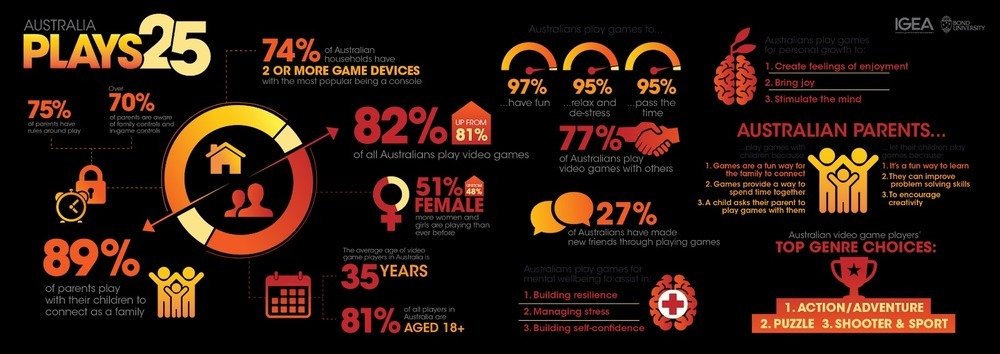
More Australian families are playing video games as a way to have fun and connect, according to data from the 2025 Australia Plays study, with video games played in nine out of ten Australian households. The study from the Interactive Games and Entertainment Association (IGEA), and Bond University, has been running for twenty years and captures the trends and behaviours of Australian video gamers. The results from this year’s data highlight why parents let their children play video games and the broader benefits of video games to learning, education and mental health.
Families that play together
Video games have created a space for parents to spend more time with their children, with 54% of parents who play games with their children saying they do so as a fun way for their family to connect. Nearly half (49%) of all parents believe games help children learn, while many point to benefits such as problem-solving (48%), creativity (39%), teamwork (32%), and even resilience (21%).
“This year’s study shows more parents enjoy and understand games than we are often led to believe. Beyond that they also see how games can enhance learning and skill development,” said Ron Curry, CEO of IGEA. “We’ve seen a generation grow up with video games, and those gamers are now playing with their children. They are still enjoying playing games and they know how to use them to create joy and connection within their families.
“The research showed that many participants from this year’s survey had a strong understanding of parental controls on devices (74%) and in-game (70%) and the classification system, which is there to protect their children as they’re enjoying games. So, beyond the tools and guides that already exist to help parents navigate their families’ video gaming, there is also an extensive network of friends and other families that can be tapped into for their knowledge,” continued Curry.
Playing games and levelling up
Respondents of all ages agree that playing games help build real-world skills:
- Cognitive skills (93% for children, 92% for adults)
- Online/Digital skills (91% for both kids and adults)
- Creativity (89% in kids, 86% in adults)
- Teamwork (89% in kids, 84% in adults)
- Leadership (75% in kids, 76% in adults)
“The findings in this year’s study show that Australians believe games create an engaging environment for children and adults to learn and develop skills from video games,” said Dr. Jeffrey Brand, Professor at Bond University and author of the report. “We’re seeing this gamification of education at schools and workplaces. Parents reported games being used in 42% of children’s schools to facilitate learning, and 29% of their children’s schools have game development in the curriculum. The 2025 data shows gamification is becoming a key part of work life, with 26% of Australian adults saying they have used games at work to learn new information. More than 20% have used a game environment to learn on the job. Organisations are beginning to meet their communities in spaces they enjoy, extending the learning environment in new, engaging ways.”
The mental health boost
Mental health benefits of gaming were another key takeaway from this year’s Australia Plays. 89% of 18-34 year olds said they play video games to improve their mental health by destressing (94%) and making connections. 47% of 18-34 year olds have made friends through games, 34% became involved in community groups through games and 32% of 18-34 year olds play games to stay connected to family and friends. These are the top two ways in which adults socialise through play.
“In a time where we are recognising a loneliness epidemic, video games can provide an avenue to help find connections. Most respondents agree video games have potential mental health benefits for those who play, whether they are young or old. These benefits include resilience, building self-confidence, managing stress and depression and developing emotional intelligence,” said Dr. Brand.
The face of the modern player
- Working-age adult averaging around 35 years old
- Just as likely to be female (51%) as male (48%) (This is the first year female players have held a higher percentage than males in the study)
- 71% of all Australians who play video games are working age, with 19% being children and 10% being retirement age
- Living in a house with at least two devices
- Plays for fun and socially, collaboratively and competitively
- Plays with family for connection
- Is very familiar with family controls on devices
- Plays outside of the home – in the classroom and on the job
“Video games have benefits beyond just providing fun, joy and entertainment, which include providing connection with others, learning and education opportunities and mental health benefits,” concluded Curry.
If you would like to learn more about 2025, you can visit the IGEA website




Recent Comments